
Innawaation

Launched by Nawaat in July 2021, Innawaation is a media incubation programme designed to expand Nawaat’s multimedia platform by engaging creative practitioners working across art, journalism, and technology.

Between 2021 and 2025, eight calls for submissions were organised through the programme, resulting in the selection and support of 19 projects led by artists, multimedia technicians, developers, web architects, designers, and journalists. Through residencies, collaborations, and public events, Innawaation provides selected participants with a production budget and tailored support to develop projects and media content in close collaboration with Nawaat’s permanent team. Participants also benefit from Nawaat’s technical infrastructure, logistical support, and human resources throughout the incubation process.

OBJECTIVES

  • Strengthen the links between art, journalism, new technologies and social and citizen engagement.
  • Establish a tradition that involves artists, journalists and techies in a participative and immersive approach.
  • Rethink quality journalism and introduce creative tools through arts and technologies.
  • Bring artists to take part in citizen and media action.
  • Promote access to artistic and cultural content.
Selected Projetcs

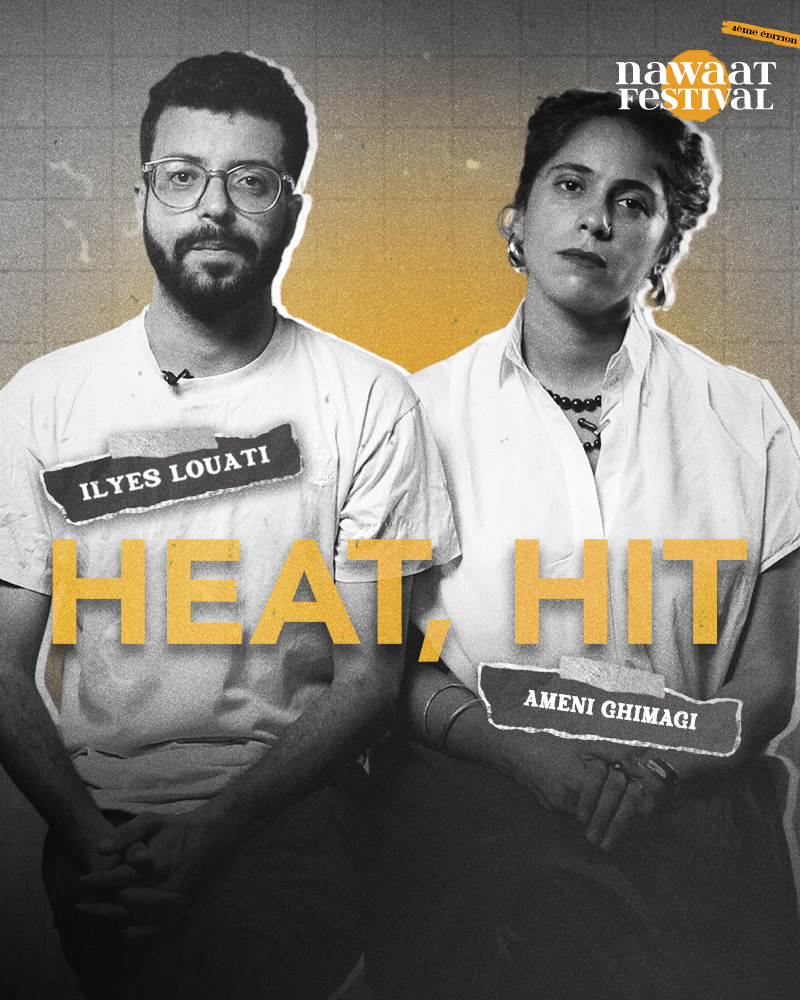
Ameni Ghimagi & Ilyes Louati

Ameni Ghimagi is a cultural manager and programmer. She holds a Master’s degree in cultural management and policy from Paris Dauphine University. For several years, she served as head of the film department at film festivals including the Carthage Film Festival and Gabès Cinéma Fen. She has supported a range of projects in cinema, music, and visual arts, combining creativity with organisational expertise.
Ilyes Louati is a film enthusiast and chief editor. He has worked on numerous short and feature-length film projects selected by major festivals. A full-time entrepreneur, he founded his production company in 2019. In 2023, he launched Room 95, a start-up dedicated to hip-hop culture. Room 95 is an alternative media platform for Tunisia’s underground cultural scene, aiming to promote local artists and introduce them to audiences through a digital platform.

art book

This book project creates a unique archive of Tunisia’s graffiti and street-art scene, documenting both mural works and the artists behind them. More than a compilation of images, it challenges the marginalisation of artists sometimes dismissed by the state as “vagrants” and recognises their role in shaping public space and cultural life.


Street art is not merely spray paint on a wall: it is a deeply rooted form of activism. It reclaims spaces once confiscated or inaccessible, fosters connections to community and homeland, and leaves a creative, political mark in the city. Since the 2011 revolution, Tunisian street art has expanded as a powerful language for expression, social critique, and collective memory.


The project pays tribute to artists whose names and works risk disappearing over time, precisely because of the ephemeral nature of their practice. By preserving their stories and creations, Ameni and Ilyes seek to inscribe these artists in Tunisia’s cultural history as agents of social and cultural change, while helping safeguard an art form that continues to transform the country’s public spaces.
Synda Jebali

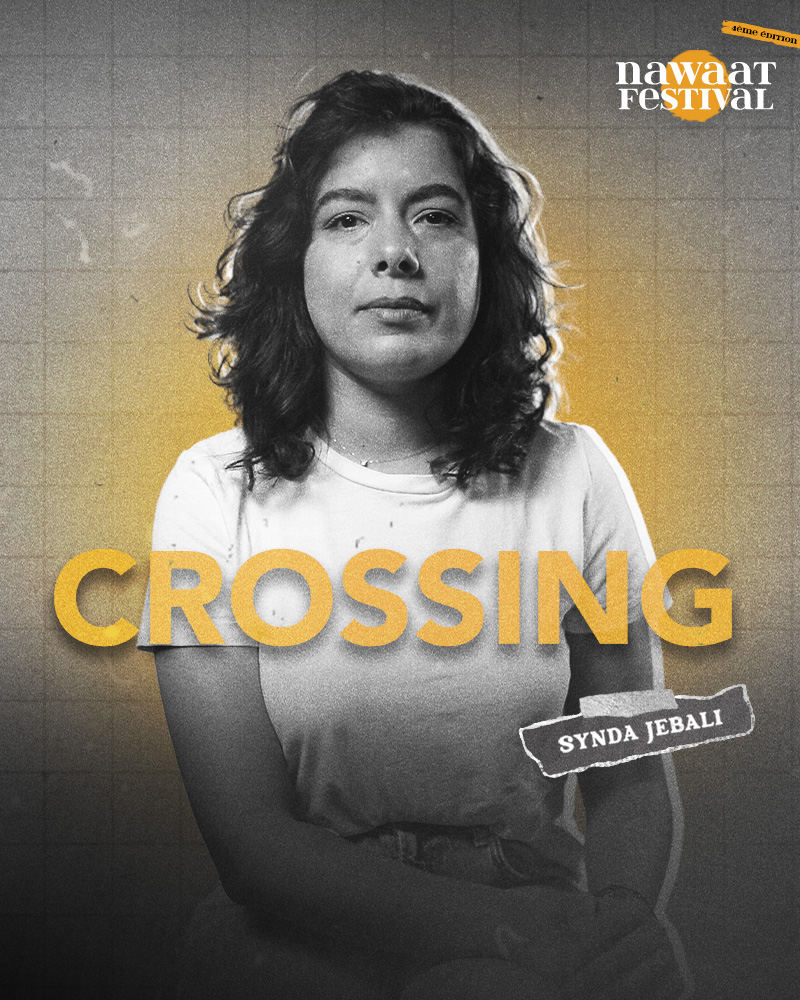
Synda Jebali is a Tunisian dancer, performer, and video artist. She studied film.
Passionate about dance from a young age, she trained with Tunisian and international choreographers. Drawn as well to the power of the moving image, Synda has worked as an assistant director and created music videos for artists. With her video installation Crossing, she enters a universe that brings together her two passions: image and dance.

Multimedia installation

What if we took a moment to contemplate dance? Come, let’s talk about it. Let’s talk about dance, bodies, and the memory that defines us.
This installation immerses visitors in the world of dance in Tunisia, a field whose history remains to be written and whose collective memory is still fragmented. Through the installation, we explore generations of bodies in motion: those of dancers, but also those of citizens in their daily lives.
The public is invited to discover a dance laboratory—a studio—where the body and dance are presented in different forms: photographs, videos, sound, articles, and more.
The project explores our cultural identity through the prism of movement and memory. Drawing on documentation that traces experiences from the world of dance in Tunisia, it offers a historical and social perspective on this ever-evolving art form. It is also a tribute to dance as a form of cultural expression with a significant impact on Tunisian society.


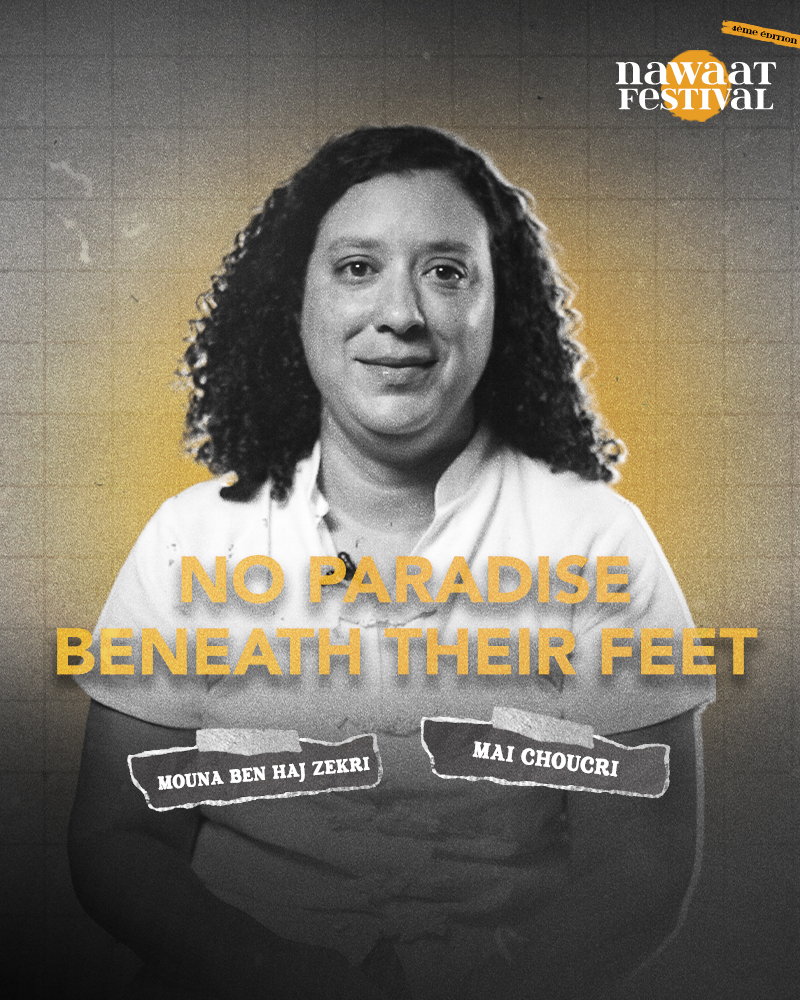
Mouna Ben Haj Zekri & Mai Choucri

Mouna Ben Haj Zekri is an actress and theatre director. She graduated from the Tunisian National Theatre’s School of Acting. Mouna has co-written and performed in several plays, including Le Point aveugle, Madame M, On la refait by Essia Jaibi, and Fenêtres sur… by Raja Ben Ammar. She has also appeared in independent films. Self-narrative and memory lie at the heart of her creative process.
Mai Choucri is a performer and researcher who has been working and performing in Tunisia since 2013. She is particularly active in the field of social development, using theatre and performance as tools for expression among marginalised communities. Mai trained as a performer with the At Al Warsha theatre company, which explores Egyptian popular culture and the vernacular expressions of everyday life.

staged reading

No Paradise Beneath Their Feet brings into view the stories of women living with non-motherhood: women unable to fulfil their wish to have a child, women who fall outside social norms, and women who question the expectation that womanhood must be defined by motherhood. The work confronts the social pressure to reproduce and gives space to voices often excluded from dominant narratives around femininity and fulfilment.
Drawing on collected testimonies, Mai and Mouna translate thoughts, dreams, desires, fears, movements, and lived situations into a powerful theatrical language. The performance builds an intimate yet political narrative, inviting audiences to listen to the complexity of experiences that challenge the idealised cult of motherhood.


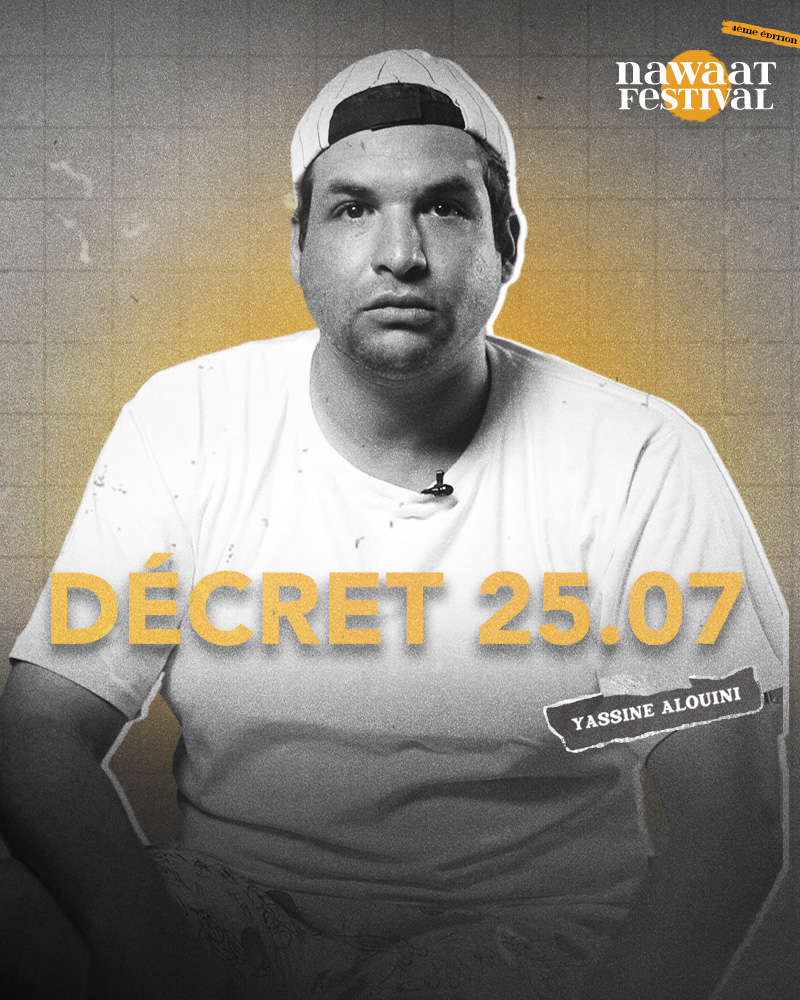
Yassine Alouini

Yassine Alouini was born in 1993 in Kairouan. He left his dental studies in Romania to fully pursue his passion for image-making. He holds a bachelor’s degree in photography and a master’s degree in screenwriting and directing.
He has contributed to a range of film projects, including major Arab productions in Tunisia, Saudi Arabia, and the United Arab Emirates. He also directs commercials and television documentaries.
Yassine served as a programmer and artistic coordinator at the Carthage Film Festival in 2016 and 2017, and at the Tozeur International Film Festival in 2019.

Short film

Under the new Decree 25.07, foreign nationals residing irregularly in Tunisia face between five and ten years in prison. Anyone who assists, shelters, or employs them is also subject to penalties. A reward of 3,000 dinars is offered to those who cooperate with law-enforcement authorities in the arrest of a group of irregular migrants. The decree has given rise to a new profession: “bounty hunters.”
It is 2025, and the situation of migrants continues to worsen. According to the authorities in power, they represent a threat to social order. The story of Didier and Katio unfolds within this context. This young couple from Côte d’Ivoire finds themselves in Tunisia by chance. Their stay in the country is meant to be temporary, as they hope to escape to Europe. But the bounty hunters will disrupt their journey.


Med Arbi Soualhia

XR producer, with extensive experience in creating immersive and virtual reality experiences and art direction and curation for various festivals and events such as Gabes Cinéma Fen and JMC. He is a specialist in combining innovative technologies and creative storytelling to create memorable and unforgettable experiences for audiences. Alongside his work in the field of virtual reality, he is also a skilled chief editor and colorist, having worked on a wide range of short and feature films, TV shows, commercials and music videos. His attention to detail, technical and creative vision help him to get the best out of every project he works on. Passionate about innovation and deeply committed to excellence, he thrives in fast-paced, dynamic environments, where he can collaborate with like-minded professionals to bring like-minded professionals to bring bold ideas to life.

Virtual Reality experience combining image, sound and drawing.

In 2023, in the Matmata mountains, the remnants of an ancient Amazigh village, Zraoua, stand proudly on a high plateau. Although deserted, the village’s walls still bear the stories that are eternally engraved in the memories of the elders. In this virtual space, we will be immersed in Uncle Ali’s memories for about fifteen minutes. We will wander through the village’s narrow streets, explore its empty houses, and listen to his stories, which will be illustrated to bring the ruins back to life and stimulate the viewer’s imagination.


From independence to the 1970s, Amazigh villages faced political, social, and economic pressure, causing many residents to leave. They abandoned the mountains for the plains, seeking the pseudo-civilization offered by the government. As time passed, both the memories and the identity of the people began to fade. To preserve the collective memory of these villages, we embarked on an experiment. We enlisted the help of an elderly man, a former resident of Zraoua, to guide us through the narrow streets and share snippets of his life. Through immersive illustrations, viewers will descend into the village, witnessing the stories come to life and helping to archive the collective memory of the Amazigh people.