
Innawaation

Launched by Nawaat in July 2021, Innawaation is a media incubation programme designed to expand Nawaat’s multimedia platform by engaging creative practitioners working across art, journalism, and technology.

Between 2021 and 2025, eight calls for submissions were organised through the programme, resulting in the selection and support of 19 projects led by artists, multimedia technicians, developers, web architects, designers, and journalists. Through residencies, collaborations, and public events, Innawaation provides selected participants with a production budget and tailored support to develop projects and media content in close collaboration with Nawaat’s permanent team. Participants also benefit from Nawaat’s technical infrastructure, logistical support, and human resources throughout the incubation process.

OBJECTIVES

  • Strengthen the links between art, journalism, new technologies and social and citizen engagement.
  • Establish a tradition that involves artists, journalists and techies in a participative and immersive approach.
  • Rethink quality journalism and introduce creative tools through arts and technologies.
  • Bring artists to take part in citizen and media action.
  • Promote access to artistic and cultural content.
Selected Projetcs

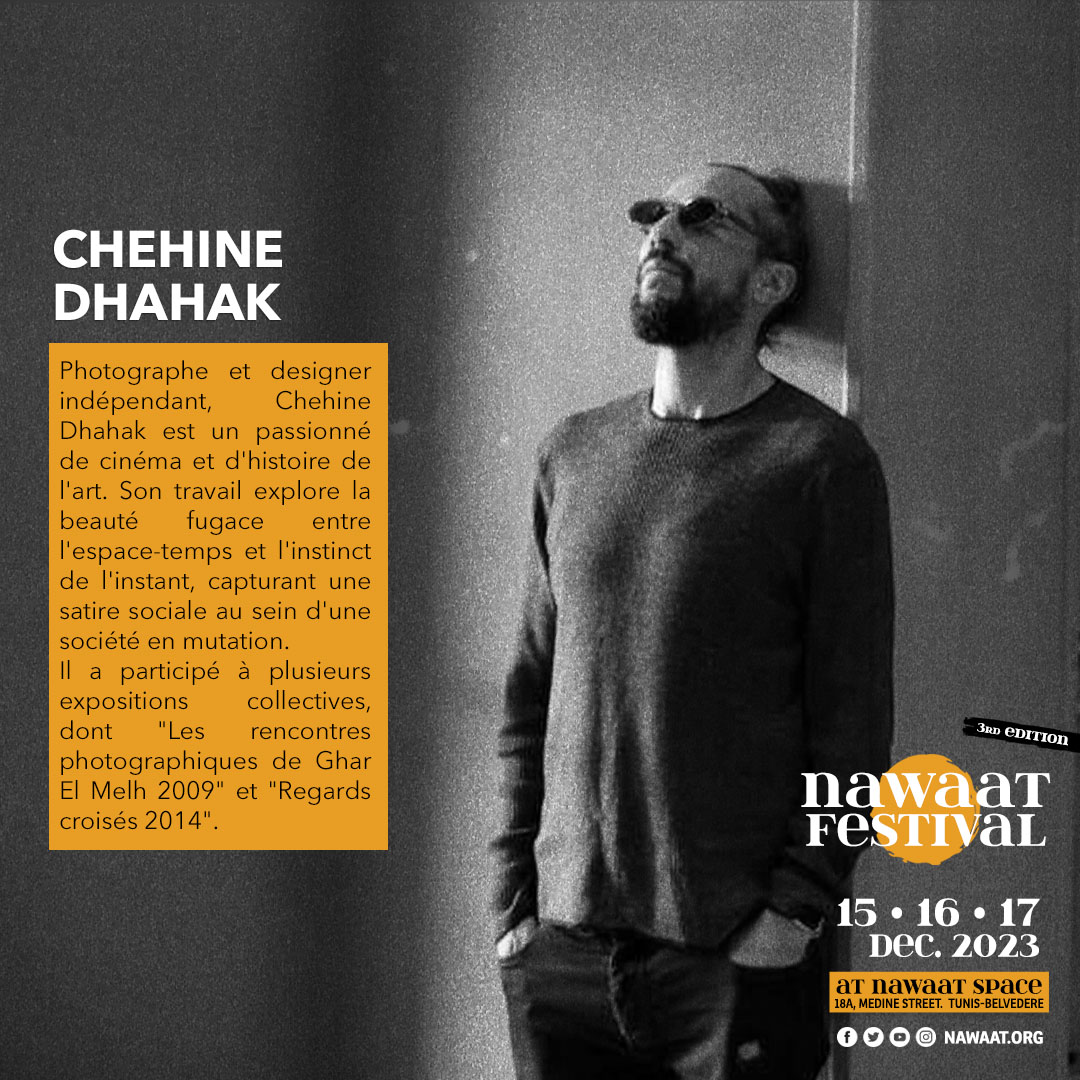
Chehine Dhahak

Freelance image designer, Chehine is a lover of cinema and art history, he entered the School of Design Science and Technology, graduating in 2011 with a degree in audiovisual advertising, followed by a research master’s in cinematic praxis at the Gammarth Higher School of Audiovisual and Cinema. Since then, cinema and photography have played an eminent role in his work. Constantly challenged, his work is a quest for fleeting beauty between space-time and the instinct of the moment. With his camera, he draws a certain social satire in the midst of a changing society. Contrasting with the pace of modern life, cynical and vagabond, his images take on a zest for urban and rural life.
Several group exhibitions to his credit, including “Les rencontres photographiques de Ghar el Melh 2009”, “Le Printemps des arts 2012”, “Regard croisé 2014” and other artistic projects.

Exhibition

For days and nights now, I’ve been scanning the skyline, weaving my way through the maze and enjoying the time of an urban rout to detect the balances and flaws that shape the anonymity of human beings and the omnipresence of concrete.
A blind wall, battered buildings, silos with industrial structures restoring an oppressive volume extracted from an anodyne everyday life: all in shades of black and white, playing on the brick color that offers a reddish counterpoint to the cement gray that reinvents urban wastelands.
Like a metaphor for laborious survival, a stooped figure, head bowed, fallen but alive, crosses these deserts braided with solitude.
Bursts of color conjure up the emptiness with their exuberance, and sometimes a whole family emerges as a counterpoint to these abstract urban landscapes adorned with silent violence.
Finally, the wandering continues on both sides of the day, until the long-awaited anabasis…
This subtle interplay between being and structure reinvents a fantasized reality, a chimera that defines the relationship between people and things.
I wander on an inner quest, as random as chance, at the mercy of fleeting and boring revelations. Vagabond and nomadic, I end up settling down to give this dynamic appearance to a photogram in perpetual agitation.


Yasser Jridi

A visual artist and graphic designer from the Higher School of Sciences and Technologies of Design (ESSTED).L For the last six year, Yasser was working in several fields related to art, graphic design, marketing/communication, artistic creation, experiences with festivals, companies, and civil society NGOs. After many experiences and internships with large companies and design firms, he left to explore the world of young entrepreneurs supporting their newborn projects with guidelines, visual identities, marketing and communication strategies. after 2 years he founded his own studio called “Maze la Boite”, an active collectif in the world of art and design.

Digital Performance

Walls have ears, streets have memories, and towns hold old energies and impressions, including memories of bodies, shapes, and feelings. These dynamics, which have interfered with the space, are not lost, evaporated, or disappeared. However, our memories and perceptions as mankind are selective and easily altered.
Memories of Concrete is a 30-minute digital performance based on Mapping techniques, projected on the facade of the central market of Tunis. The performance offers a psychic immersion in a tunnel of sounds, lines, and twisted shapes, capturing the interactions of energies in the space. Those projected memories are based on video recordings of people’s hands and feet in motion, treated afterwards to be shaped as the energies that are printed into the space by humans of the central market, when they move, act, interact with the space, with each other.

The performance is a tribute to those who never gave up, reflecting the daily struggle for resistance in the central market of Tunis. Working is a symbol of Resistance, it is filled with this charge of leading a daily fight to overcome conflicts and repression of all kinds. This struggle becomes reflected in the smallest details: waking up, providing, walking tall and proud, singing and being festive, exchanging … every movement we lead is in itself a sign of resistance, it’s a dance with the course of life.


Haithem Sakouhi

Born on 16 June 1993, Haithem Sakouhi is a filmmaker, photographer, street artist and researcher in film science and technology. He has directed several short films that have received both national and international recognition, including « 1999 » and « Zulu Rema ».

Movie

Le syndrome de Tunis (Tunis syndrome) is an urban symphony which tells the story of an anonymous photographer whose fascination with his city becomes an obsession. A docu-drama that sheds light on the current condition of colonial architecture in Tunisia’s capital city.


Callum Francis Hugh

Based in Tunis since the summer of 2011, Callum Francis Hugh is a self-taught photographer originally from London. Whether through his work on a TV documentary with Free Reporters or multimedia journalism collaboration with the collective blog Nawaat, Callum’s approach is one of immersion into his surrounding environment, offering a nuanced and close-up view of the world around him. Callum returns to Nawaat with a new exhibition « Hors-réseau » (Off-the-grid), a glimpse into the life of a nomadic family in the Tunisian Sahara.

Exhibition

Far beyond the destructive influence of social media, 4G and « catch all » algorithms, who and where are the individuals living outside the echo chamber that is today’s media landscape? Is their existence « off-the-grid » by obligation, or by choice? To answer this, Callum set out with his camera into the Saharan desert, where he met a family of nomads, the Raabia. In this arid zone of southwest Tunisia, transhumance is the core of existence for the Raabia, whose cross-desert migrations to graze their herds are dictated by the changing of the seasons. While borders may be of little concern to this family, climate change has begun to take its toll on daily life, threatening their very survival.


Malek Khemiri

Malek Khemiri is a filmmaker and photographer. He is also co-founder of Armada Bizerta, an underground Tunisian hip-hop group. With different international collaborations, he tries to combine various art forms in his work. Major of his class at the ESAC with a video essay on skateboarding in Tunis Malek gets his master in directing and screenwriting in 2019 to devote himself to a daily photographic practice, the realization of clips and the animation of photographic and cinematographic workshops with young people in Kef in Tunis and Sousse.

The need to broaden the tools of expression have pushed Malek to be interested in the image and to study cinema. A collaboration with SVT, the Swedish national channel, he embarked on the realization of a series of reports in Tunisia. Malek made his first documentary in Regueb, the city of the first festival of the revolution in Tunisia. He followed this up with Triton chasseur, his graduation project in collaboration with Fusam, a sound dystopia, shot in part at the Goethe Institute in Tunis as part of a cultural and experimental lab. This experience pushed Malek to experiment with the use of the silver photographic tool in a sort of return to film.

A photos exhibition

No more than it is appropriate to go through Malek Khemiri’s photographs at a run, one should not look for a practice of reporting in Black Babel. His approach, subject to the authority of current events, nonetheless tends to go beyond them. These images taken between January and February 2021, would they be more than small pebbles left behind, snapshots of memory? From that winter, when the pandemic was in full swing, we will have kept the memory of corseted nights, sucked in until noon by the clamor of the riots whose day would prolong the echo.

What is offered to the eye is scenes that fit together too well, because everything is there: from hooded faces to drones, without forgetting of course the fireworks and the cops sprayed with paint or spat upon. But let’s be reassured: there can be no narrative in Khemiri’s work other than contraband.

What challenges us is the way in which Khemiri is at odds with a certain exercise of photojournalism. Here, the eye does not investigate nor does it seek the exceptional shot. To the omnipresence of the slogan and the word, he prefers the opacity of bodies and the grammar of gestures. It is less the presence on the square that interests Khemiri than what makes up the subalterns, a fraction of a social body eaten away by despair and shouting its anger in the face of arbitrary arrests and sentences. If the report of these anonymous people goes beyond the presence in a public space confiscated under the blind spot of the state of emergency, the photographer is solid at the post to probe the pulse of antagonisms and solidarities in presence.

It is in this that Black Babel would be of a paradoxical fecundity. Flirting with abstraction to the point of duplicity, as if it could grasp the raw fact, the documentary facture of this series is somewhat perverted, between the possible and open place to the accident and the premeditation of the frame inside which the real and its double come to be inscribed. One would say of this maverick that he rushes into the middle of events where it hits, then sets off again on the hunt as if in battle.