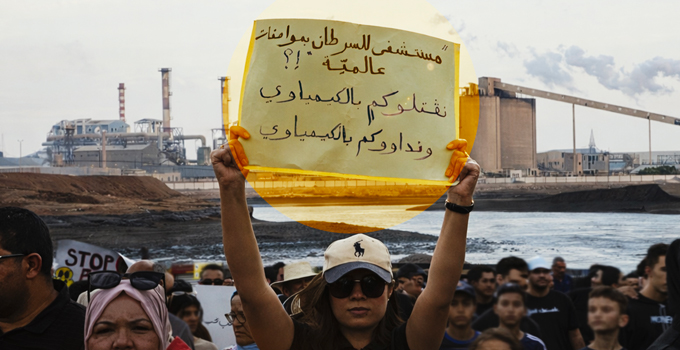
Never has the slogan “the people want!” resounded more true than during the general strike in Gabes on October 21, 2025. More than 130,000 citizens led the country’s largest demonstration since January 14, 2011, demanding an end to the region’s slow destruction by the Chemical Group’s pollution-causing activities. Although pollution affects everyone and everything in Gabes, it has had the most devastating consequences on women’s health, and their reproductive health in particular. For they suffer these consequences on top of all the other illnesses plaguing the local population, as the government looks on in silence.
On Tuesday, October 21, 2025, the governorate of Gabes witnessed an unprecedented mobilization in which locals responded to the Regional Workers’ Union call to action. Citizens’ vast participation in a general strike froze all services, resulting in a success rate of 100%. Following the strike, more than 130,000 demonstrators turned out for a massive march through city streets, demanding an end to the continued crime of chemical contamination that has caused irreparable damage to humans and the environment in Gabes.
In urban areas near these industrial plants such as Chott Essalem in Gabes, nearly all households are afflicted with respiratory illnesses, bone disease and other health issues including cancer. The cause of these conditions: gas emissions released into the air by the nearby industrial site, and its liquid chemical waste which pollutes the land and the sea. The impact of these contaminants on women in the region is exacerbated by the fact that most of them care for a family member who is ill as they deal with their own health issues.
Combatting Pollution And The Illnesses It Causes
Thirty-something Radhia is married and lives in Chott Essalam. When she became pregnant, she realized within the first couple of months that something was not right. Tests showed signs of irregular fetal development, she relates. But like many mothers, she was in denial, choosing to remain hopeful rather than to give in to fear:
I felt that something wasn’t right, but I held onto the idea that things could get better. Maybe my maternal instinct was stronger than all my fears.
Radhia’s anxiety grew as her pregnancy progressed, but she clung to the hope that her baby would survive. However, the eighth month was decisive: the doctors confirmed that her baby had stopped growing, and that developmental defects had grown more severe, so that a C-section would be necessary. She gave birth to a baby girl who lived just six short days before succumbing to congenital complications.
After the death of Radhia’s newborn, her doctor explained the medical diagnosis, indicating that the baby’s defects were caused by chronic exposure to pollutants in the area surrounding Radhia’s home near the Chott Essalam industrial units. According to her doctor, the effects of such pollutants on fetal growth begin in the first weeks of pregnancy, although they may not be apparent right away.
Scientific research shows that chronic exposure to industrial air pollution such as fine particulate matter (PM2.5) and toxic gases (such as sulfur dioxide) is associated with unfavorable pregnancy outcomes and irregular fetal development, especially low birthweight, premature birth, delayed fetal development and maternal health complications. Air pollution can also provoke gestational hypertension, miscarriage and fetal growth complications due to the impact of these pollutants on placental function and the transfer of oxygen and nutrients to the fetus.1

In Gabes, the Tunisian Chemical Group’s industrial units constantly expel pollution into the air, especially toxic gases and fine particulate matter, exposing residents—especially pregnant women—to severe health risks. Local data and scientific studies have illustrated these risks. However, authorities continue to ignore demands voiced by the local population to dismantle these pollution-producing industrial plants. The government’s attitude denotes its incapacity to protect citizens and exposes an entire region to fatal danger, perpetuating the crisis.
35-year-old Jamila lives in the same neighborhood. Her mood each day is determined by the odor in the air. When she wakes up tired and ill, she knows that “el-bakhara” has released thick toxins, leaving a film of grey dust on the windows. Jamila is awakened by her youngest daughter’s coughing, which breaks the silence of the household every morning.
Several years ago, Jamila ran her household without too much trouble. Today, however, her severe asthma has changed everything: climbing the stairs has become a strain, requiring Jamila to stop frequently to catch her breath. With each inhale of toxins produced by the nearby chemical plant, her steps become heavier. The air—which should be a source of life—has become a daily burden.
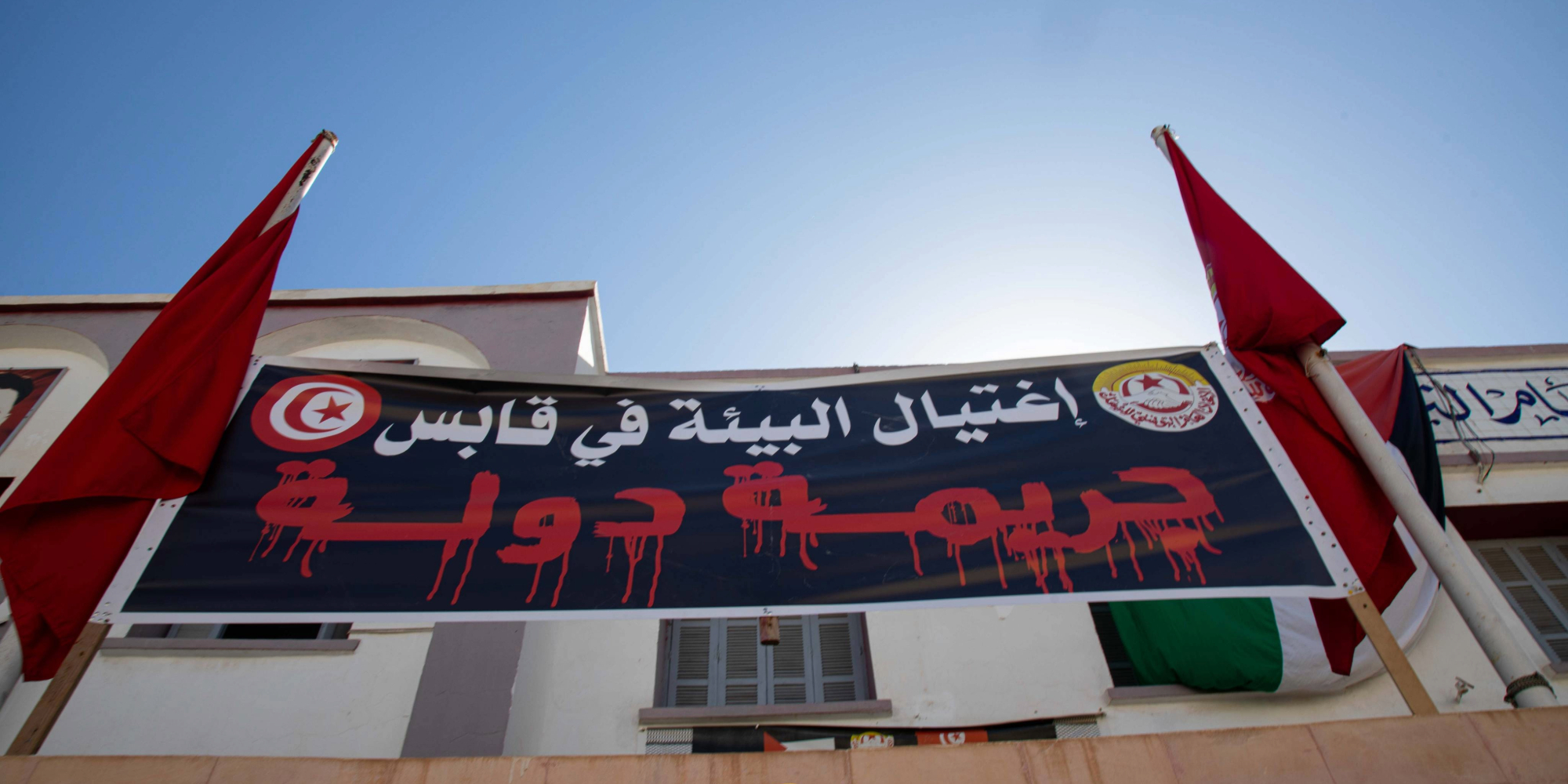
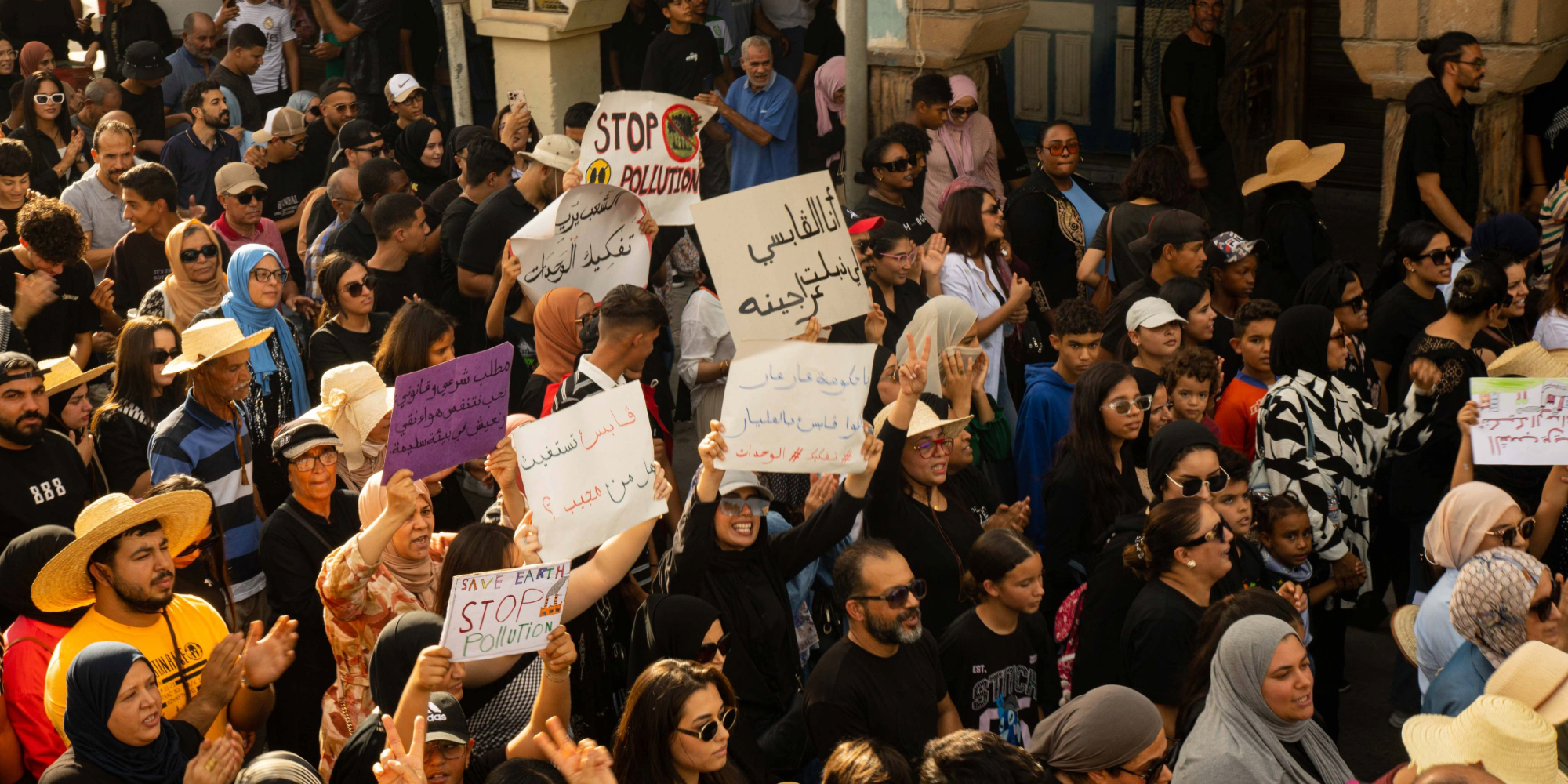
Such scenarios are commonplace for families living in the areas nearby to Chemical Group facilities, where neighborhoods have been ravaged and households suffocated by the ambient pollution. Over time, however, their expressions of distress and resistance have become amplified, as the local population unanimously calls for the closure of the chemical industry’s toxic facilities. This was indeed the main demand voiced during protests on October 21, 2025 that were marked by a strong female turnout.
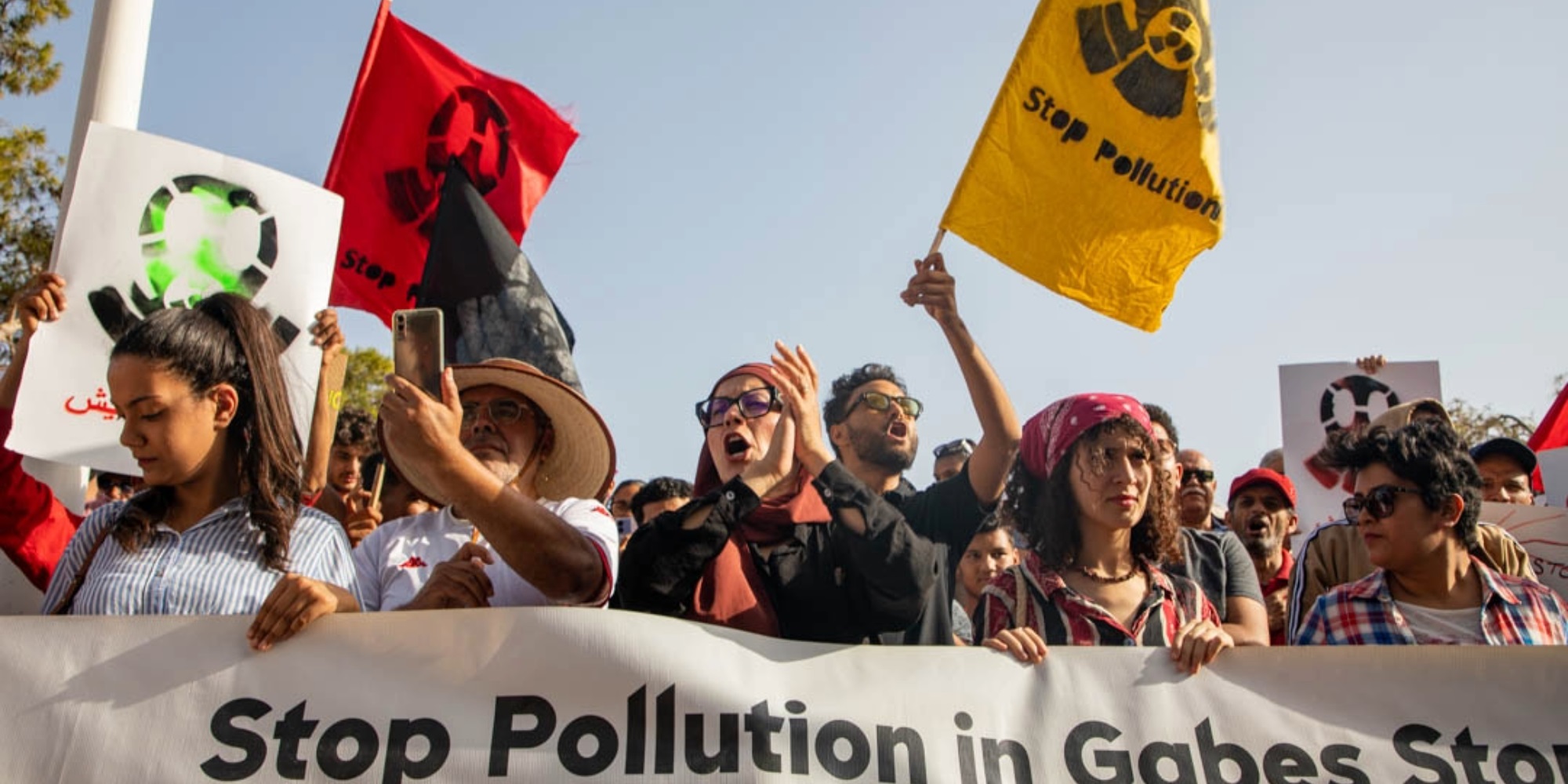
Women are in the front lines of every protest, carrying signs and chanting slogans. They are present in large numbers during sit-ins organized by the Stop Pollution movement. Their presence is not a symbolic detail, but a daily act of resistance in the face of an environmental crisis that menaces their own and their families’ lives. Women suffering from chronic illnesses exacerbated by pollution actively participate in movement leadership, infusing it with a highly human, gendered dimension, and reinforcing the idea that preserving health and the environment is neither a luxury nor a choice, but an existential, daily necessity.
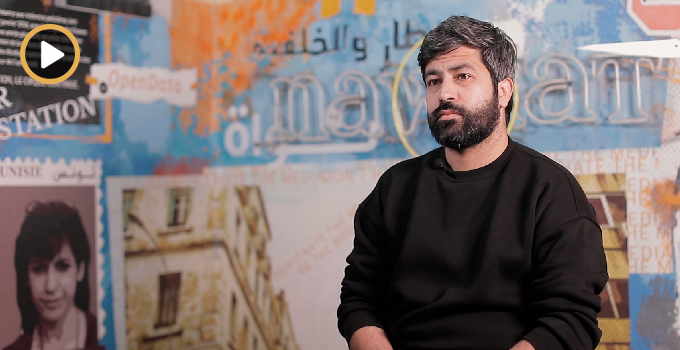
In this report, Maryem takes us to meet three young women active in the fight against pollution in Gabes, including toxins released into the air and water by chemical product factories, as well as the wastes they produce which contaminate the land. According to these activists, the crisis could be turned into a source of income and job creation.
Wearing a green headscarf which covered half her face, Jamila stood out from among the sea of marchers. She carried two asthma inhalers, a testament to her distress. She spoke to Nawaat about how the polluted air which has devastated her neighborhood is also the cause of her and her family’s chronic respiratory illnesses:
“My entire family suffers when the smokestacks which dispel chemical products are opened. My daughter, my husband, my mother-in-law…we all suffer from asthma and shortness of breath, sometimes to the point of suffocation.” She continues:
My son is hospitalized three times a year, and it is us, the women, who pay dearly for it…Every year in October, we test for breast cancer because we live in constant fear, plagued by a permanent headache. My son was born with asthma because I was sick during my pregnancy, and ever since, our house is filled with breathing devices.
Fatma also shared her difficulties with Nawaat: “I participate in the protest movement even though my husband works in the Chemical Group and is sick himself, and my father died of cancer. I myself had cancer in 2010, and still bear the scars on my breasts and uterus.”
Fatma, who is fifty-something and from Chott Essalam, remembers when Gabes was “a paradise, an oasis, with the sea and mountains,” before being transformed into an “environmental nightmare.” She asserts: “We want pure air and a decent life, no more pollution; these factories must be dismantled immediately!”
Widespread pollution created by the Chemical Group’s industrial units constitutes a danger for the entire region, particularly phosphogypsum—an industrial by-product produced when phosphate is manufactured to make phosphoric acid. Full of chemical residues and toxic metals, phosphogypsum is dumped into the sea in enormous quantities. Such waste not only affects the marine ecosystem, but also the air and water surrounding urban areas, causing chronic respiratory illnesses as well as severe risks for fertility and fetal health. Gabes is thus among the regions in Tunisia most impacted by complex industrial pollution.
Faced with an accumulation of health issues, especially chronic respiratory illnesses, hormonal disturbances and a staggering increase in cancer among women, Gabes residents have remained anything but passive. For years, the Stop Pollution movement has organized regular protests which draw thousands of city dwellers, both men and women, to call for the closure of the pollution-causing industrial units, and for an end to the ecological disaster which threatens their lives. Despite changing governments and successive promises, the local population has never let down its guard, reiterating at every opportunity that clean air is not a luxury, but a fundamental right.
Haunted By The Fear Of Birth Defects
Numerous testimonies describe the extent to which women in Gabes are tormented by the risks that endanger their reproductive health, since industrial pollution constitutes a direct threat to a healthy pregnancy and fetus. Dr. Ouarda Mahdhaoui confirms that this threat is a result of chronic exposure to pollutants and heavy metals in the air and water. In her words:
Pollution has a direct effect on a woman’s fertility. Chemical substances that are widespread in Gabes, especially heavy metals, impact ovarian health, regularity of ovulation and how smoothly pregnancies progress. Exposure to these pollutants can lead to fetal defects, low birthweight and cellular irregularities, and can also cause miscarriage.
Dr. Mahdhaoui continues: “Thyroid-related illnesses among women are among the most concerning health indicators in Gabes, especially hyperthyroidism, which has increased significantly over the past few years. Women also suffer from respiratory problems and pain related to rheumatism and osteoporosis, which are illnesses—among others—that may be caused by pollution.”
Dr. Mahdhaoui also affirms that “health issues related to pollution have become widespread across the region, but the absence of precise and up-to-date statistics prevents us from knowing if their rates are higher in Gabes than they are in other governorates. However, the increased number of cases and complaints voiced by women concerning these illnesses render this catastrophe an inarguable reality.”
According to Mahdhaoui, “breast and thyroid cancer are the most common among women in the region, which suggests that they are directly linked to environmental pollution.” This is because gas emissions and pollutants contain heavy metals such as cadmium, whose concentration “vastly exceeds the maximum limit authorized internationally, as well as uranium. These elements are known to cause cancer and other serious diseases.”
Noting the lack of studies and viable statistics available regarding the health crisis in Gabes, Dr. Mahdhaoui shares that in 2020 she participated in a study on the connection between pollution and cardiovascular diseases, which focused on risks for women’s health. Today, there are still not enough national studies that center specifically on the impact of pollution upon women’s health.
The Conner 2025 evaluation questionnaire confirms that constant exposure to air pollutants, especially fine particulate matter (PM2.5), volatile organic compounds and heavy metals, causes severe issues for women’s reproductive health: chronic inflammation, oxidative stress, and ovarian hormonal imbalance. The study shows that women living in polluted areas suffer from higher rates of miscarriage, premature births, delayed fetal growth and menstrual cycle disturbances. Low to moderate pollution levels can also affect the quality of a woman’s eggs, implantation of the embryo and future fertility.2
Despite its short observation period, data from the Cancer Register of Southern Tunisia (2010-2014) reveals elevated cancer rates among women (notably breast, thyroid and cervical cancers) albeit without showing any relation to the quality of the environment. Nevertheless, this data serves as a reference for comparing Gabes with the national average for southern Tunisia, and for formulating hypotheses regarding the impact of pollution on women’s health.3
Recent studies such as the one carried out by the Department of Lung Disease at the hospital of Gabes (2024) also confirm the connection between air pollution and respiratory complications. Elevated levels of sulfur dioxide are associated with an increased use of non-invasive ventilation, while fine particulate matter (PM10) is associated with the formation of pulmonary abscesses and complications including pleural effusion, all of which are exacerbated by heat and humidity.4
On more than three occasions, Nawaat reached out to the Ministry of Health for clarification and statistics concerning the consequences of pollution on population health. The Ministry’s silence is a response in itself. In the absence of transparency, the health of this population is captive to a policy of denial, rendering the situation one of complicity. Authorities have fallen back on the easy solution, pursuing and arresting activists instead of taking radical measures, in particular the dismantling of these factories which constitute a real danger that takes a daily toll upon the entire region.
Women At The Heart Of Resistance
During protests in Gabes, women do not settle for simply participating in marches and sit-ins, or for chanting slogans and waving signs. Their role extends to awareness-raising campaigns on social media and organizing public events. Their presence reveals a will to transform daily struggles caused by pollution into a productive collective dynamic.
Women’s participation in social movements in Tunisia is not a new phenomenon, but a practice deeply rooted in the country’s social and political history. From the colonial period through the Gafsa mining basin uprising in 2008, to the revolution from December 17, 2010 to January 14, 2011, women have been at the heart of popular movements, not as supporting actors but as full-fledged protagonists, taking part in and leading marches and gaining important experience in public action.
Interviewed by Nawaat, sociologist and feminist activist Fathia Saidi explains:
What characterizes the environmental movement in Gabes today is growing ecological awareness and greater demand for sustainable development that respects the right of future generations to a clean environment. An awareness that has blossomed as much among women as men. This transformation has led to the qualitative evolution of social demands, especially in relation to the increasing threat of toxic gases, in contrast with the early years in which the Chemical Group was starting out in the 1970s. It is also important to note the recent cases of asphyxiation, notably among school children living close to the complex, which played a definitive role in raising awareness and galvanizing protests.
Fathia Saidi compares women’s presence on the front lines of marches in Gabes to that which marked the Gafsa mining basin uprising in 2008. She points out the commonalities: first, the intense emotional reaction expressed by women in relation to their health or that of their family members, and also their capacity to organize, their dauntlessness and resilience. Women are more apt to shape the social landscape and more audacious in the context of confrontation, qualities inherited from their upbringing and heavy baggage that they carry to maintain family and social cohesion.
Our interlocutor concludes that the environmental protest movement constitutes an exceptional case in the history of social movements in Tunisia, in that it surpasses traditional employment-related demands and the struggle against vulnerability. It represents a demand for development that is based on a comprehensive rights-based approach, and that places the right to health and a clean environment as top priorities.
The relentless struggle led by women in Gabes shows that the feminist movement is not a symbolic presence, but true resistance in the face of dangers which threaten their own health and that of their families. Like all Tunisian women, they face discrimination and sexual violence, on top of the consequences of chemical pollution that are specific to the region of Gabes, including serious illnesses such as cancer. While Gabes offers the world a lesson in resistance against avaricious and pollution-producing capital, the women of the region—through their role as leaders and their activism—provide a masterful lesson on the inextricable link between environmental, social and gender justice.
Test Your Knowledge
How many citizens participated in the demonstration in Gabes on October 21, 2025?
What is the main health issue affecting women in Gabes due to pollution?
What was the main demand voiced during protests on October 21, 2025?
Quiz generated by Nawaat Chronicles
- Air Pollution and Pregnancy – PMC (Study) ↩︎
- Conner, H. (2025). “Pollution environnementale et santé réproductive” [Environmental pollution and reproductive health]. PubMed. ↩︎
- Registre du cancer du sud de la Tunisie [Cancer Registry of Southern Tunisia] (2010-2014). Health Ministry, Tunisia. ↩︎
- Sahli, S et all. “Pneumonie communautaire et exposition à la pollution atmosphérique” [Community-acquired pneumonia end exposure to air pollution]: study by the hospital of Gabes. Tunisia (2024). PubMed. ↩︎

iThere are no comments
Add yours