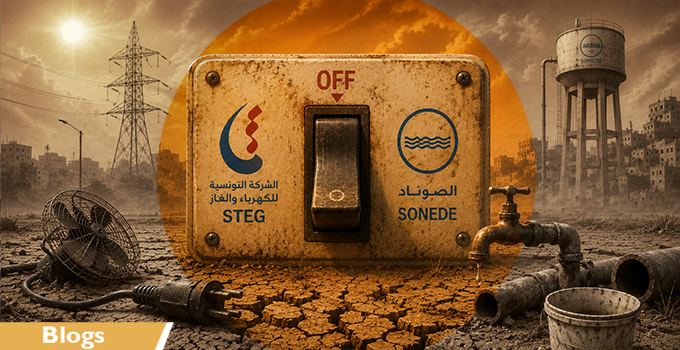
Five people have died in Tunisia in recent days, according to local media reports, after their oxygen machines stopped working during power cuts inside their own homes. One of them was being treated for cancer[1]. This week, Tunisia introduced rolling power cuts for the first time at this scale, as temperatures pushed past 48 degrees Celsius[2]. The national grid needs roughly 600 additional megawatts of capacity every year through 2030 simply to keep pace with rising demand, and this summer, it did not have them.[3]
The official story is a familiar one, extreme heat, rising air conditioning use, a grid under strain. But Tunisia’s own energy union has been naming the deeper cause for over a year. STEG, the Société Tunisienne de l’Électricité et du Gaz, the state power company, has been financially and technically weakened by years of underinvestment, some of it tied to World Bank and government measures that limited the utility’s ability to invest in new generation capacity. Workers organized under the General Federation of Electricity and Gas, FGEG, part of the UGTT, Tunisia’s national labor union, warned about exactly this outcome well before this summer’s heat wave arrived, and were ignored. In June 2025, they came close to a nationwide strike over energy policy they said favored foreign investors over public service and worker protections.[4] The warning went unheeded.
The financial picture is worse than underinvestment alone suggests. STEG’s total debt reached 7.36 billion dinars by June 2026, while unpaid bills owed to the company, by private clients and public institutions alike, reached 6.06 billion dinars.[5] Tunisian lawmakers reached the same conclusion. In June 2026, a member of parliament’s finance committee testified that STEG’s crisis is fundamentally about governance, not financing[6]. Once a profitable company that contributed to the state treasury, STEG now survives on billions in borrowed credit. More loans without reform, he warned, will only reproduce the same crisis.
Government projections show electricity demand growing between 2.5 and 3.5 percent every year for the rest of the decade[7]. A country that knows this in advance, and still gets caught off guard by the same season it faces every year, is not living through a natural surprise but rather a planning failure. Foresight is not a luxury reserved for wealthy states. It is a basic function of governing, the discipline of preparing for what is already known before it arrives. That discipline has a name, anticipatory governance, and Tunisia has shown almost none of it. For the first time since 2021, ordinary Tunisians are expressing real anger on social media and directing it squarely at the President Kais Saied, despite the climate of fear that now surrounds dissent.
Kais Saied’s seizure of full power in 2021 drew genuine public support. The explanation given by supporters was consistent: ten years of procedural democracy, elections, parliamentary debate had failed to improve material conditions. A single decisive executive appeared to offer what a deliberative system could not.
That support was grounded in a measurable reality. Tunisia’s 2011 revolution was organized around a single slogan: “employment, freedom, and dignity”. The political system built after 2011 delivered on freedom. Elections were held, a free press operated and civil society organized and grew. Employment and dignity, defined by most Tunisians in economic and material terms, remained largely unaddressed. Arab Barometer data confirms this pattern directly: Tunisians surveyed do not distinguish conceptually between democracy and dignity, and associate democratic governance more strongly with the delivery of economic outcomes than with electoral procedure[8]. The disappointment that followed was a response to an incomplete system, not a rejection of democratic values as such.
Five years of concentrated executive power provide a test of the alternative that was proposed. The results are available and measurable. Water cuts in Sfax exceeded two hundred incidents in 2025, despite the existence of a desalination plant built specifically to prevent them[9]. Tunisia’s Water Observatory recorded 2,153 unannounced water cuts nationwide in 2024 alone, a figure that provoked 186 separate protest movements linked to water scarcity that same year[10]. Roughly 20 percent of the national water network, more than 12,000 kilometers of pipe, is now considered obsolete. At the current pace of renewal, modernizing it would take more than a decade[11]. This week, Tunisia introduced scheduled power cuts following a heat wave that exposed a structural shortfall in generating capacity[12]. STEG, the state utility, has operated for nearly a decade under loan conditions and licensing arrangements that directed new generation capacity toward private developers rather than toward the public utility itself, a pattern documented by the utility’s own workforce and left unaddressed through the transition to concentrated executive rule.[13]
Centralizing authority did not correct this structural weakness. It removed the institutional mechanisms, an independent press, a functioning parliament, protected space for union organizing, that had previously made the weakness visible and contestable. Here is what deserves to be said plainly. The governments of the democratic transition delivered little on material conditions, yet they answered for it, debated in parliament, on television, on the radio, challenged openly by anyone willing to raise their voice. Today, that same act, an ordinary citizen speaking out in anger, can end in prison. Tunisians made a trade in 2021, freedom for delivery. They have neither. That is the double loss. An executive accountable to no external body has no institutional incentive to correct failures that no one has the standing to expose or challenge. The current outage is evidence of that dynamic, not an unrelated coincidence.
Responsibility for the conditions that made concentrated executive power appealing extends also to civil society and political actors who built and defended Tunisia’s post-2011 political system. Much of the decade’s political energy was consumed by identity politics, the divide between Islamist and secular currents, a battle that dominated headlines and coalitions while material governance went largely unexamined. Both sides fought that battle largely on the same terrain, individual rights, freedom of expression, freedom of conscience, the boundaries of the state’s authority over civil life, which meant the political model that ultimately took hold was drawn substantially from liberal democratic tradition, prioritizing individual, civil and political rights, electoral competition, and procedural checks on state power.
That focus on individual rights did not stay a purely domestic story. Liberal democracy, once adopted, does not arrive as an isolated political framework. It travels bundled with the economic assumptions of the institutions that finance it, market liberalization, private investment, and loan conditionality, pursued largely without the regulatory state needed to direct that growth toward the population and protect those most exposed to its costs. Tunisia’s political actors adopted the procedural component of this model with considerable energy and commitment. The economic component, guaranteeing water, electricity, and material dignity as enforceable state obligations rather than anticipated outcomes of market development, received comparatively little organized political attention. The absence of sustained pressure on this front left the material conditions of daily life available for a strongman narrative to claim as evidence against democratic governance generally.
The evidence across nearly every sector confirms that concentrated executive power has not resolved Tunisia’s material failures. As a few examples: Public debt rose from 67.8 percent of GDP in 2021 to a peak of 84.9 percent in 2024[14], and youth unemployment in Tunisia stands at 38.4 percent.[15]
The outage underway this summer demonstrates that concentrated executive rule has not, and structurally cannot, fix Tunisia’s basic services, since it removed the very mechanisms through which such failures are identified and addressed.
That is also why this argument belongs in the middle of a outage, because people are not moved by defending democratic theory. They are moved by whether the lights come on tonight. Substantive democracy is not competing with people’s daily concerns for their attention. It is the only framework that takes those concerns seriously as political demands rather than technical problems to be managed later by someone else. That is precisely why this conversation can rally people now, in a way an abstract argument about institutions never could. I have seen this pattern before it reached Tunisia.
I write to you from the future. I have lived and worked in countries further along this road than Tunisia is today, places where power cuts and water shortages had already lasted long enough to become permanent weather rather than emergency. I watched what filled the vacuum when the state quietly gave up: the private sector. People bought their own generators, built their own water tanks and entire neighborhoods learned to plan their lives, their businesses, their hospital visits, around whichever family had the means to solve, privately, what used to be a public guarantee. And I watched inequality deepen alongside it. Those who could afford to buy their way around the state still had light and water on demand. Everyone else waited.
I do not blame anyone for reaching for these solutions. When the water runs out in the middle of Eid al-Adha, with guests arriving and a sacrifice to prepare, you buy the tank if you can. It is a reasonable response to an unreasonable situation. But it is also a dangerous trend. Every generator bought and every tank installed quietly moves responsibility off the state and onto whoever can afford it. It does not solve the underlying failure. It only privatizes who gets to be spared from it. And so inequality does not simply persist. It deepens, until the people who could never afford a tank or a generator are left further behind than everyone else.
Tunisia has now tried two versions of governance, an elected system that ignored people’s material lives, and a concentrated one that ignored their voices entirely. Both left the country in the dark, literally, this summer. What has never been tried is a democracy answerable for both, the vote and the tap, freedom and the light staying on.
If nothing changes once the power comes back on, the plausible scenario is not difficult to write. It looks like this summer, repeated, worse, until outages stop being news. But a plausible future is not the same as an inevitable one. There is a preferred scenario too, and naming it is itself a political act, a democracy that treats water and electricity as rights, not eventual outcomes, built by people who refuse to wait for permission to imagine it. Which future arrives is not a matter of luck or weather. It is a matter of what we build in the meantime, deliberately, together, with our eyes open.
A blackout is exactly what it looks like when a nation stops planning for its own future with its own people. The lights will come back on ; what we do before they go out again is still ours to decide.
[1] Euronews Arabic, “Amid a Record Heatwave: Sudden Power Cuts in Tunisia Leave Deaths and Widespread Anger,” July 16, 2026.
[2] “Extreme Heat Forces Tunisia into Rolling Power Cuts to Protect Grid,” EuropeSays, July 2026.
[3] “Extreme Heat Forces Tunisia into Rolling Power Cuts to Protect Grid.” Middle East Online, July 2026.
[4] Elyes Ben Ammar and Lala Peñaranda, “Threatening to Strike, Energy Unions in Tunisia Win a Victory for Public Energy and Worker Rights,” Trade Unions for Energy Democracy, July 2025.
[5] “La Steg croule sous les dettes: 7 milliards de dinars d’encours et 6 milliards d’impayés,” Business News, June 27, 2026.
[6] “Continuer à emprunter ne sauvera pas la Steg: pour Issam Chouchen, la crise est avant tout une question de gouvernance,” Business News, June 29, 2026.
[7] “Extreme Heat Forces Tunisia into Rolling Power Cuts to Protect Grid,” Middle East Online, July 2026.
[8] Arab Barometer, “Democracy in MENA: A Demand for Dignity, Not Just Elections,” Wave VIII, 2023 to 2024.
URL: https://www.arabbarometer.org/media-news/democracy-in-mena-a-demand-for-dignity-not-just-elections/
[9] African Manager, “Drinking Water in Summer 2026: Between Official Promises and Reality at the Tap,” June 2026.
[10] Securing Tunisia’s Constitutional Right to Water: Policy Solutions, Carnegie Endowment for International Peace, Sada, 2025.
[11] “Drinking Water in Summer 2026: Between Official Promises and Reality at the Tap,” African Manager, June 2026.
[12] “Extreme Heat Forces Tunisia into Rolling Power Cuts to Protect Grid,” Middle East Online, July 2026.
[13] Trade Unions for Energy Democracy (TUED), “Threatening to Strike, Energy Unions in Tunisia Win a Victory for Public Energy and Worker Rights,” by Elyes Ben Ammar and Lala Peñaranda, bulletin, July 2025.
[14] Tunisia’s Public Debt Records 84.9% Increase in 2024, APA News (African Press Agency), April 23, 2026.
[15] Tunisia Economic Outlook, African Development Bank Group, June 2026.

iThere are no comments
Add yours