Temperatures surpassed 45 degrees Celsius (113 degrees Fahrenheit). Fans and air conditioning stopped working. From the tap, only a trickle of tepid water. At the corner store, shelves usually stocked with mineral water were empty. From mid-July through the end of August 2026, Tunisia endured this relentless sequence of events: blazing temperatures, recurring water and electricity outages, shortages of bottled mineral at the same time that tap water was nearly undrinkable. Three overlapping crises, and citizens in search of explanations.
Official Silence, Followed By Different Versions
Explanations came…late, and each one from a different source. The Tunisian Electric and Gas Company (STEG) pointed to the public’s sudden rush to turn on the air conditioning and the network’s weaknesses. The National Water Use and Distribution Company (SONEDE) indicated that, due to lack of power, its pumping stations could not keep up with soaring demands. The Commerce Ministry reported that the amount of mineral water consumed quadrupled in July, while electrical and water outages disrupted factory operations and depleted supplies. Each institution described its own set of challenges; not one offered any insight into the situation at a systemic level.
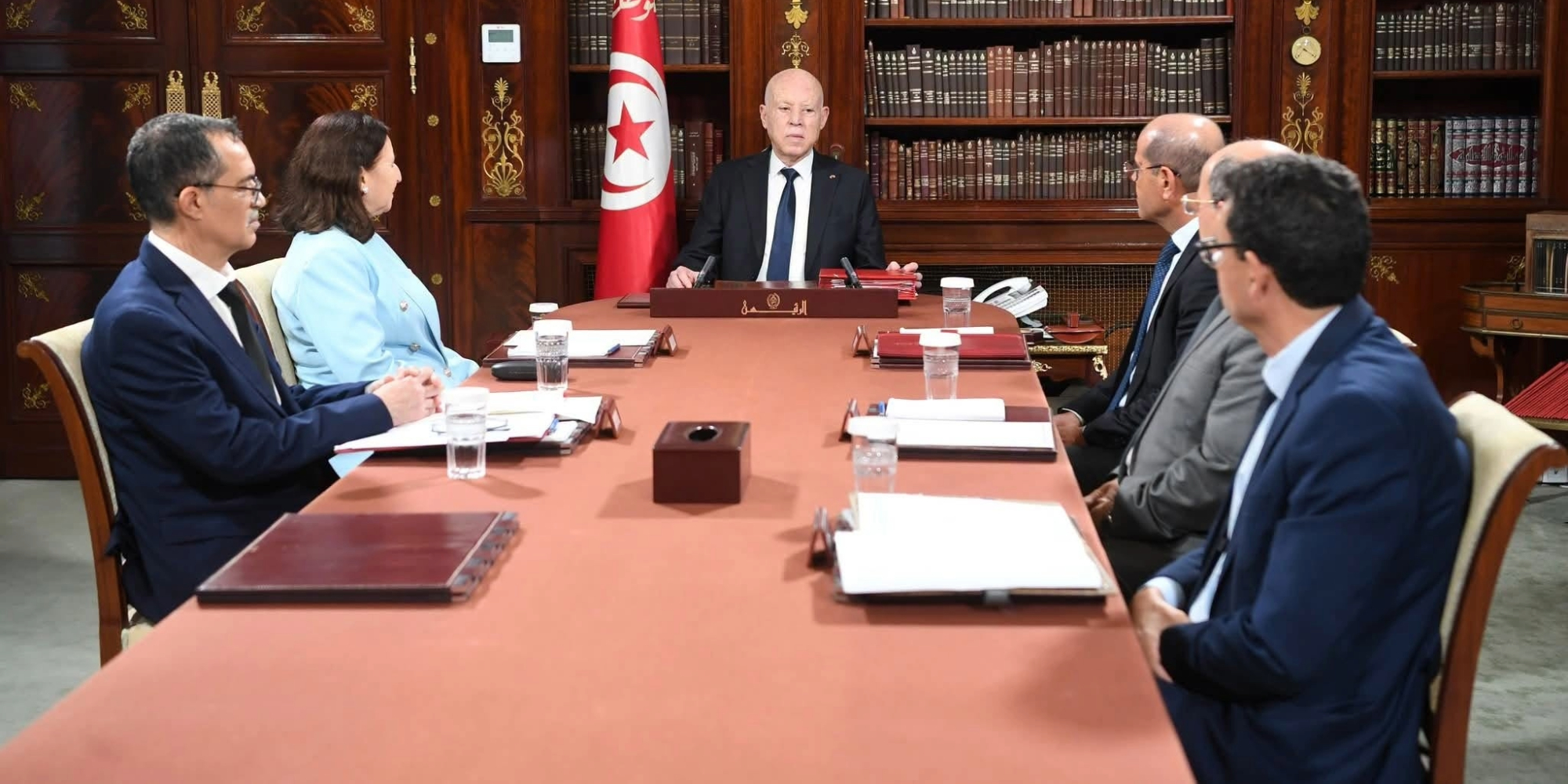
President Kais Saied’s version of the situation was something altogether different. According to the Head of State, these outages were the product of “planned acts of sabotage” orchestrated in order to create tension, spread rumors and lies, and deprive citizens of essential services. An interpretation which shifted the question of failure to one of ill intent.
Playing It Safe: The Media Relay Statements, Stick to the Practical Angles
In the midst of these multitudinous versions, the media made their choices, rarely opting to connect the dots. Some settled for relaying official releases and statements. Others handed the mic to experts, especially to focus on the exceptional nature of the heat wave and its connections to climatic instability: a solid, well-documented and convenient angle that did not call into question the responsibilities of government.
Discrepancies in information concerning the issue of mineral water amounted to near absurdity. National media sources largely relayed authorities’ statements assuring citizens that supplies were “sufficient” and that retailers were stocked. At the same time, Al Jazeera and France 24 published videos of empty delivery trucks. Tunisians thus had to search elsewhere in order to learn what official discourse was not telling them.
Social Media: Magnifying Glass And Amplifier
It was on the Internet that the scope of the crisis actually took form. Videos of blacked out neighborhoods, testimonies of families, real-time alerts showing elderly persons with medical devices requiring electricity to operate, blocked elevators, store owners watching their stock go bad, celebrations interrupted. These citizen reports often preceded official information and shed light on the realities that the media were not covering.
Anger was quick to spread, fueling accusations against STEG and SONEDE agents while enabling rumors, hate speech and unverified content to thrive on the Internet.
Amid the confusion, citizens were left to their own devices to sort lived experience from accusations and misinformation. In times of crisis, however, information is not a luxury, but—like water and electricity—an essential service. It was indeed this vital service which was most severely lacking for Tunisians over the summer of 2026.
An Afflicted Information System
The causes are many, but the primary issue lies upstream where information should begin: public institutions. For Fatine Hafsia, journalist and member of the Press Council, access to official information has become the profession’s greatest obstacle. Hafsia points a finger at a bureaucratic apparatus that is responsible for a veritable “desertification of official information.” His observation is unequivocal: “this information represents half of journalistic work and, without it, journalists are flying with a single wing.”
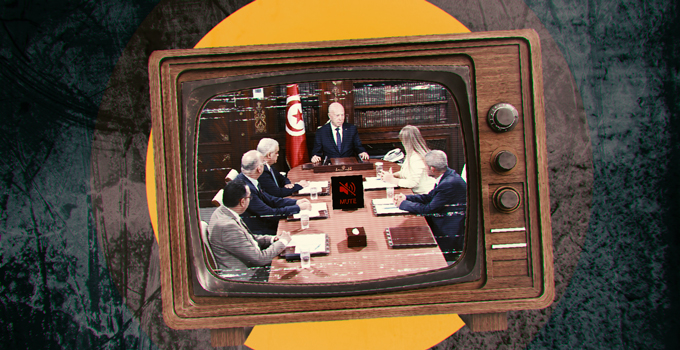
Far from accidental, this withholding of information is structured upon a written framework. Circular 19 of December 10, 2021 requires ministers and secretaries of state to coordinate with the Presidency’s communications services regarding the form and content of every media appearance. In practice, Hafsia observes, the control reflex penetrates far beyond the circle of government.
Every official we contact for information or a statement wants to consult their superior, who in turn must consult with theirs, and so on.
The result is a chain of validations in which each link fears speaking independently of the others. Between inquiry and reply, lapse time drags on and, for sensitive issues such as water or electricity outages, responses ultimately take the form of an “absolute refusal.” Even theoretically benign topics like purchasing power, for instance, are not spared this blockage. Hafsia characterizes the situation as “a media and communications circle that is silent, a blackout that deprives citizens of their right to information.”
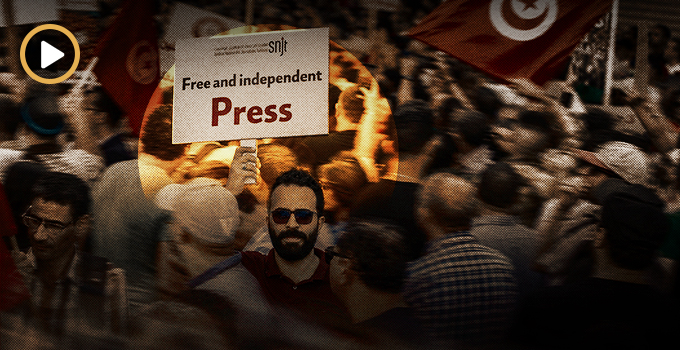
In Tunisia, the price to pay for information can be high, especially for certain topics. Journalist Mohamed Ali Sghaier remarks that journalistic work requires a minimum of freedom and, above all, safety. Without these two conditions, informing the public becomes a perilous, even impossible, undertaking. Today, however, Sghaier comments that “the present climate increasingly resembles a judicial reign of terror. The continuous incarceration of journalists has sent a message that has been received across the profession: public speech comes with a price that can be paid in prison.”
Within this climate, self-censorship is born. But unlike self-censorship of the past, in which banned topics were clearly spelled out and the censor was known to all, “this version is more insidious. It is born of fear, infiltrates editorial boards and ultimately permeates the reflexes of the profession. Over time, it undermines coverage of current events and erodes the space occupied by subjects of public interest,” Sghaier observes.
To avoid danger, editorial teams turn to less exposed subject matter that does not come with the risk of court summons and legal complaints. This deflection is “a concession more than it is a chosen editorial line,” Sghaier explains. “Revisiting the nation’s independence, major historical figures, foundational events or the grey areas of a bygone era enables us to continue producing quality, documented, relevant content, without exposing us to the same risk. The past offers a space for speech that the present no longer allows us.”
“Repeated Recourse To Severe Criminal Measures Has Instilled Fear Within Editorial Boards”
This fear is justified, the product of an oppressive legal context. Decree-law 54 of 2022, and its Article 24 in particular, fuel grave concerns around freedom of expression and the work of journalists. Although a revision of the text on September 30, 2026 removed the penalty of imprisonment for a first offense, financial sanctions remain in effect, and the prison penalty still applies in cases of repeated offenses. That modification was not enough to reassure actors in the sector who are afraid that the text will be used against journalistic publications. Instead, Mohamed Ali Sghaier advocates for the application of Decree-law 115 of 2011 on the freedom of press, printing and publication, because, as he points out, “Investigating, critiquing, corroborating, all of this is weakened when each article can lead to prosecution.”
“Tunisian Media Have Invested Precious Little In Fact-Checking”
The paradox is glaring. On the one hand, local media information is becoming scarce or silenced. On the other is the boundless profusion of online content. Citizens are faced with an endless torrent of information whose credibility is widely variable. The issue is no longer simply accessing information, but verifying it, reframing it within context and separating established facts from misleading content. In such a climate, fact-checking should be wielded as an essential tool. This tool, however, has not yet been honed within Tunisia’s media sector.
Fact-checking emerged in Tunisia in 2014 and gained traction during the 2019 elections and Covid-19 pandemic. Today, it has lost ground. Researcher Arwa Kooli who specializes on the topic offers this grim assessment: “Today, only two structures have managed to maintain their activity: Tunifact, run by the SNJT, and BN Check, affiliated with Business News. Otherwise, Tunisian media have invested precious little in the verification of facts.”
This is due in part to dependence upon foreign funding, which often comes with an expiration date. Kooli elaborates:
In Tunisia, we do not have a single for-profit fact-checking organization. All of our structures depend entirely upon overseas funding. This precarity compromises the continuity of activities and the ability to sustain permanent teams.
But funding is not the only reason that fact-checking has failed to take root in the media landscape. According to Kooli, “Journalists know how to use tools, but have not integrated fact-checking as a permanent practice. Verification remains a specialized and fragile procedure, as opposed to a reflex integrated into journalistic work.” In other words, “it is not merely the survival of a few specialized structures which is at stake, but indeed the capacity of the entire media system to verify before publishing, and to offer the public solid points of reference in an environment that is saturated with content.”
“Being Connected Does Not Mean Being Informed”
Statistically speaking, Tunisians are plugged in. At the end of 2025, 84.3% of the population used the Internet, and 63.3% were active on social media, according to DataReportal. This hyper-connectedness coexists with widespread mistrust of traditional media outlets. A study published by the Tunisian Press Council in May 2025 reported that 64% of those surveyed did not trust traditional media sources. Among young people, that rate was even higher: 77.8%. More than TikTok, YouTube, or any other platform on the Internet, Facebook was easily Tunisians’ preferred source of information online. But for Hamida Elbour, a researcher specializing in information and communication sciences, “being connected does not mean being informed. Social media platforms, especially Facebook, have become the primary digital forum. We find everything there. And although a segment of informed internet users are able to detect rumors, approximations and false information, the general public is less discerning of unverified content.”
The proliferation of online platforms calls into question the credibility of information itself. “There is a clear correlation between the rise in digital use and growing mistrust of traditional media.” This paradox is even more striking in light of Elbour’s observation that “mainstream media outlets themselves occupy a central place on social media, and have nevertheless failed to counter the public’s loss of trust in them.” Despite the fact that the media are showing up where the public is, traditional platforms have yet to earn back their credibility.
But is social media alone to blame for the shift away from traditional media sources? Elbour rejects this convenient assumption: “The phenomenon is far more complex, demanding more thorough empirical research in order to identify the driving forces behind this rupture and the levers that would enable a relationship of trust with the public to be reestablished.”
“Developing Critical Thinking Is No Longer A Luxury, But An Urgent Necessity”
The paradox is by no means unique to Tunisia. According to the 2026 Digital News Report by Reuters, populations worldwide are hyper-connected and mistrustful of traditional media sources.
In Tunisia, however, the trend is more concerning given the near absence of a vital safeguard: media literacy. A shortcoming that begins at the level of government, which has yet to take action on this front. “To this day, no strategy has been adopted by the concerned ministries,” says researcher Wahiba Ghali who specializes in media literacy.
Without a coherent national policy, media literacy has yet to find footing. Schools have not stepped in to help; the integration of media literacy within the educational system has failed, and even the draft law submitted in July 2025 to create positions for specialized instructors is sitting on a shelf somewhere, collecting dust. Nor does civil society fill the gap. Of 25,000 recorded associations in Tunisia, barely 0.1% are taking concrete action along these lines. The few projects that have been initiated since 2011 depend almost entirely upon funding from outside the country.
Result: the public has been left to its own devices to face a flood of boundless content, in which rumors and facts intermingle freely. Learning to distinguish one from the other is no optional coping mechanism; “Developing critical thinking skills is no longer a luxury, but an urgent necessity,” Wahiba Ghali insists.

iThere are no comments
Add yours