To be sure, the decade following January 14, 2011 saw numerous attempts to gag the public media. Still, it was during that particular period in history when freedom of the press thrived in Tunisia. Citizens grew accustomed to seeing presidents, ministers and government officials publicly challenged, denounced and confronted with proof of what some of them had hoped to hide from the public opinion. News programs broadcasted on public television invited experts (including the man who currently serves as the country’s President) who openly criticized heads of state and governments. Having voiced the most biting criticism, interlocutors could return home safely without a second thought. Today, this tradition has been abandoned. The most docile and zealous of figures have been called upon to close this public service to any voice that might embarrass the ruling power and its leader.
After 2011, Tunisian public media benefited from training programs and the support of local and foreign specialists as well as international media in efforts to align the sector with basic professional standards. After July 25, 2021, however, the country’s old demons returned. The public media abandoned their internal reform agenda and fell under leadership that has consolidated the sector into the mouthpiece for a single party: the ruling power.
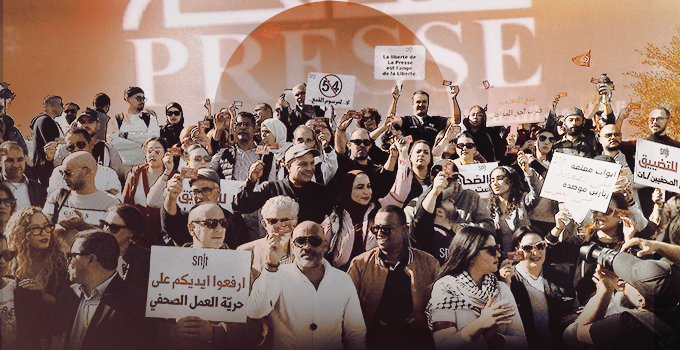
Going through the list of directors who head Tunisia’s national television and radio stations as well as the Tunis Afrique Presse (TAP) agency and public or nationalized newspapers, it becomes apparent that these individuals honed their weapons under Ben Ali era, and have not changed despite reform projects initiated over a decade ago.
And yet, in their midst, small groups of journalists are fighting, to different degrees, to resist official orders and to preserve a minimum of professionalism.
CENSORSHIP AND MEDIOCRITY
On Thursday, September 17, the capital and other cities were submerged beneath heavy rains, with flooding exacerbated by tired, inadequate infrastructure. Featured that day on the national radio’s official Facebook page was a report on the participation of CEO Henda Ben Alaya Ghribi in an awards ceremony for journalists who had covered the 2026 Mediterranean Games. Beneath a photograph of Ghribi flocked by journalists, the article read, “This tribute marks a tradition that the General Direction of the Tunisian Radio has carried on for three years. A tradition which aims to support its children and to recognize their performance, and which reaffirms the will of the public information service to pursue its noble mission with aptitude and objectivity.”
The public might be hard pressed to understand why the administrator of the National Radio’s Facebook page posted an item of such little consequence that day. An item of no more interest than other publications concerning the CEO’s activities, such as her meeting with the new board members of the Association of Former National Radio Journalists, or the designation of a new director, “via Zoom,” at Radio Gafsa.
A journalist who has worked at the Tunisian National Radio for a number of years spoke to Nawaat on condition of anonymity for fear of “retaliation” by its management. Our interlocutor affirmed that the CEO interferes, directly and intensively, in content broadcasted on the air and published online. According to the journalist, it is Ghribi who manages the Radio’s official Facebook page and erases whatever content she wishes.
Within this context, a small group of journalists is endeavoring, on an individual basis, to resist the strict directives imposed upon them by administrative and editorial personnel. However, the efforts put forth by this group are restricted by the severe censorship that weighs upon their work. The journalist explains: “Faced with the systematic restrictions imposed upon journalists, a very small group has chosen to resist, even if only by refusing to participate in propaganda. Sometimes, we diffuse brief reports on the activities of certain organizations that have been banned by the editorial department, and we choose specific time slots such as the evening televised news. But the web content administrator does not diffuse this information on the website or on the Radio’s Facebook page.”
Things are no better at the country’s national television agency. Since July 25, 2021, a small group of journalists has attempted to resist the “government rhetoric” which pervades the entirety of the station’s content, as much in its news broadcasting as across its other programming. According to a group of journalists who spoke to Nawaat,
“There is a minority within the national television agency that is fighting to preserve a minimum of professionalism,” says one journalist. “We work for a public television company whose mission is to diffuse content that reflects a diversity of opinions and sources. Any viewer who watches the national station can plainly see the complete absence of shows in which debates provide a space for divergent opinions. In fact, since July 25, 2021, not a single guest with a contrary opinion has been permitted to set foot in the studio.” The same journalist adds that the handful of journalists who have attempted to resist so that journalistic content remains balanced ultimately gave up, especially owing to a lack of general solidarity among journalists. He explains, “The worst part is that some [colleagues] record them and share with management the opinions—whether political or purely professional—they express on their personal Facebook pages. Pressure is applied to journalists at the national station in three ways: they are harassed, marginalized, or steered toward topics of lesser importance. Some journalists have thus been sanctioned and brought before the disciplinary committee for having expressed their opinion on questions of public interest, or for having protested against work methods at the national television station.”
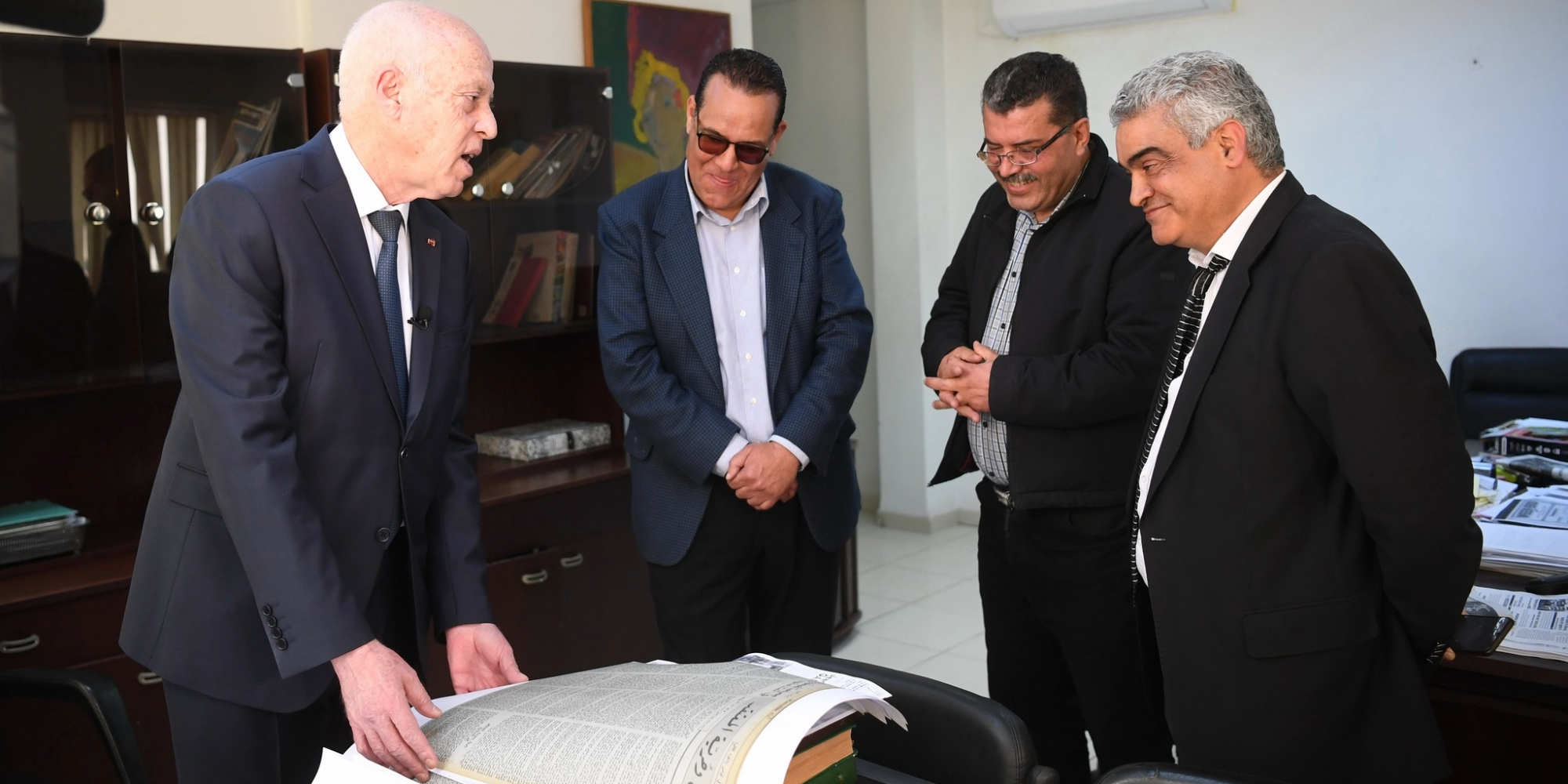
The government’s influence also extends to confiscated media outlets such as the newspapers published by Dar Assabah, where ample space is reserved for governmental and presidential affairs, but not for issues relating to rights and liberties. Nawaat interviewed a journalist who works for a newspaper within the press group who affirms that she must go out of her way to cover subjects which the periodical once published without any form of censorship. Whenever she proposes an article relating to human rights issues, her suggestions are rejected. She adds,
“I try to work in a professional manner along with a group of colleagues. But whenever we propose articles we would like to work on, our proposals are rejected, even when they center on social or economic themes. Sometimes, when we apply enough pressure that the editorial team accepts these proposals, we are limited to addressing the topic from an angle that conveys the “positive side.” Ultimately, our efforts are wasted in debates on pointless technical details. The public does not see our work behind the scenes nor the efforts exerted by some of us to uphold the ethics of our profession. On the contrary; pressure is placed on journalists to deprive them of their right to address topics that have become taboo, through the mobilization of technical agents in an attempt to prevent Dar Assabah from regularizing its situation. They outnumber the journalists. This is why any form of protest by the latter is doomed to failure. As the director solemnly stated, “Anyone who does not like the work method here can quit!”
In April, TAP journalists donned a red armband in protest of any meddling in the agency’s editorial line and in support of its independence. The TAP, like other public press outlets, faces growing pressure and interference in its editorial line.
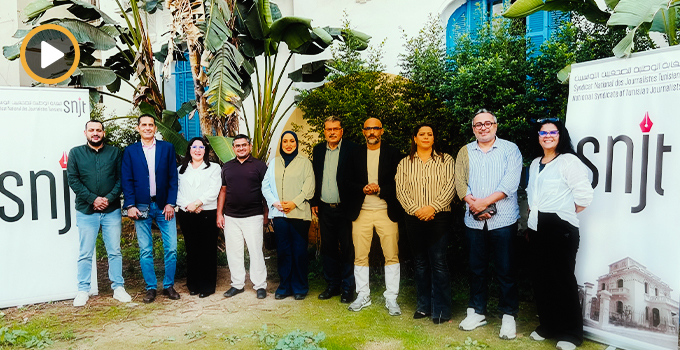
According to Adel Riahi, president of the local chapter of the SNJT, the CEO of Tunis Afrique Presse began meddling in the agency’s editorial line by deleting its content thread upon his designation three years ago. As Riahi told Nawaat, “This interference in editorial content has intensified with the banning of any coverage of political party activities. The directives were to cover only information deemed positive. Pressure placed by management on the work of journalists has intensified as certain colleagues have rallied to our cause. Journalists are carrying out a form of resistance in which pressure is applied to section editors and the editor-in-chief, who sometimes concede to our demands. Thus we manage to cover protests, for example. However, due to tampering with press dispatches, the information becomes incomprehensible and devoid of meaning. A few journalists who are very attached to their independence are victims of different forms of harassment. Me and a colleague were subjected to interrogation by management concerning an article on the collective “Nafas,” on the pretext that the article did not reference any sources. Today, information relating to civil society and political parties are on the list of subjects banned at the TAP. Despite intervention by the local branch of the SNJT to stop these pressures through innumerable meetings with the CEO of the agency, the situation remains unchanged. I think that there are common directives issued to the public media so that they adopt a uniform editorial policy with the main objective of eclipsing any actor who is not in the same camp as the ruling power.”
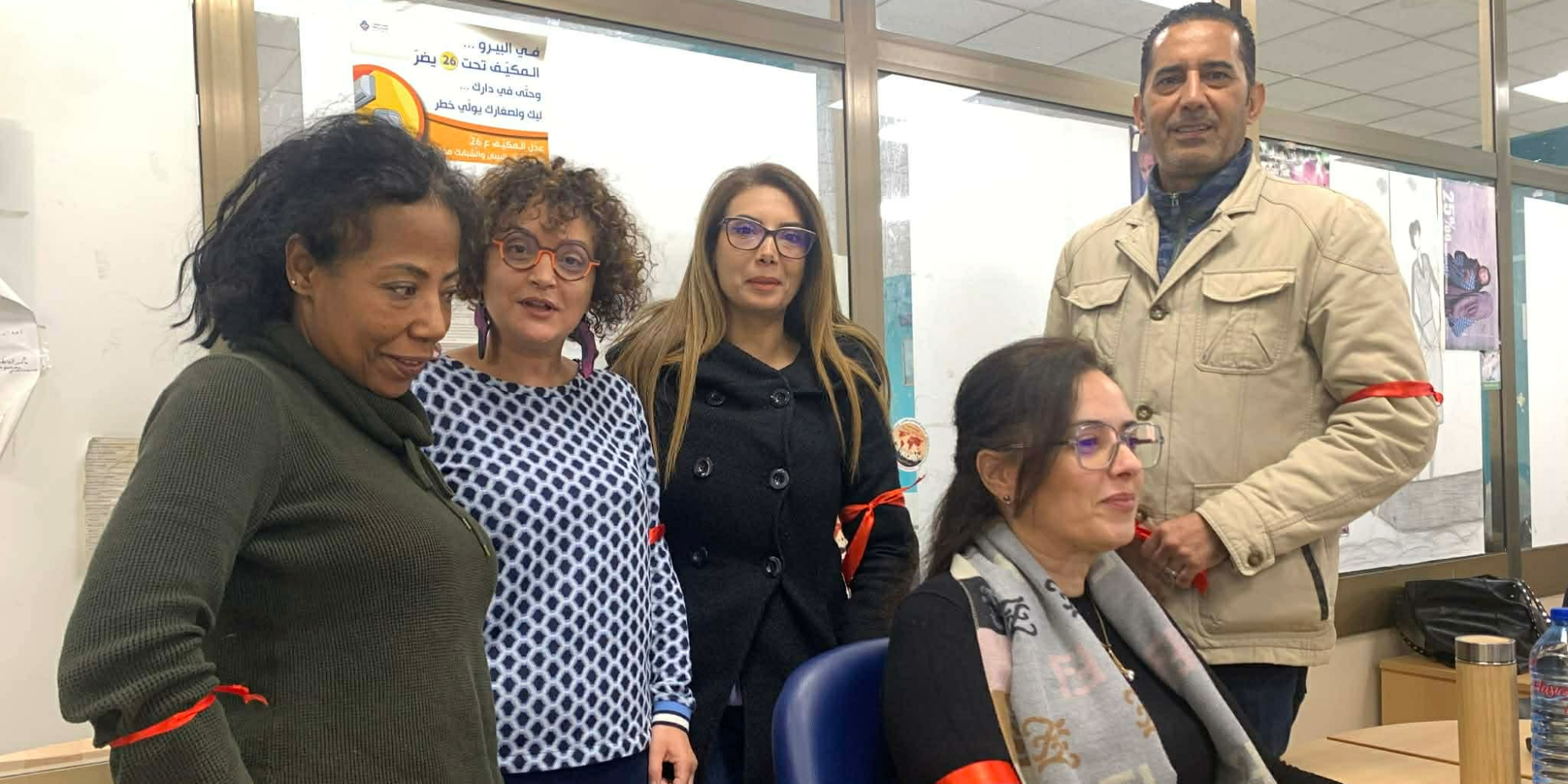
The government strengthens its control over the public media through direct orders to the heads of press agencies, and through pressure on the journalists who work there, blackmailing the latter in relation to their professional situation. Within the group La Presse, for example, a number of journalists have been waiting for years to see their situation regularized. These journalists held a sit-in at their place of work to protest precarity and the non-renewal of their contracts. The demonstration lasted six days before being suspended on Wednesday, September 30.
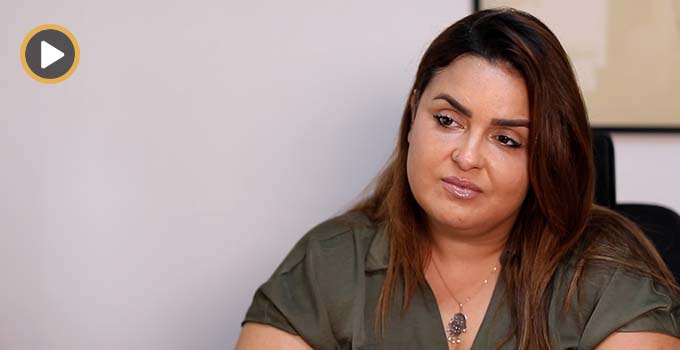
Jihene Louati, member of the SNJT’s executive bureau, reports that two journalists and a number of other personnel working in precarious conditions held a sit-in for nearly a week at SNIPE-La Presse. “Whether at La Presse, Dar Assabah or other public press outlets, the government has control over journalistic content at two levels: it imposes a form of self-censorship in exchange for the regularization of their precarious situation, and uses the lever of public funding. The government controls funding for public media institutions, and thus has control over the content that is diffused or published; as a result, these establishments have become governmental, and not public. At the national radio station, for example, a number of journalists are working without a contract and have not been paid for four years, although the right to work is very clear on that subject. Management is taking advantage of this situation to dictate the editorial line that is to be obeyed.”
The Presidency Pervades The Public Media
A journalist at the national radio echoes Louati’s remarks: “The Radio has not respected neutrality for nearly five years now. And everyone remembers how the director ensured live coverage on the station’s Facebook page in celebration of Kais Saied’s electoral victory, offering by way of explanation the absence of a team of journalists to cover the event. Nor does the director conceal her personal interference in the editorial process. She even admitted as much in a video that was removed from the station’s Facebook page. She claimed that she was editor-in-chief in addition to her duties as director of the station.”
The editorial charter published by the national radio station on its official website stipulates that the establishment must observe complete independence in its journalistic content, and must respect the freedom of expression and the public’s right to information. In another chapter, the charter indicates that the Radio must “preserve neutrality and objectivity in its news coverage and reporting on current events, and to promote the values of democracy and human rights.” The contrast is glaring between the station’s editorial chart and the content it diffuses on the air and on the Internet, as well as the way it treats its employees.
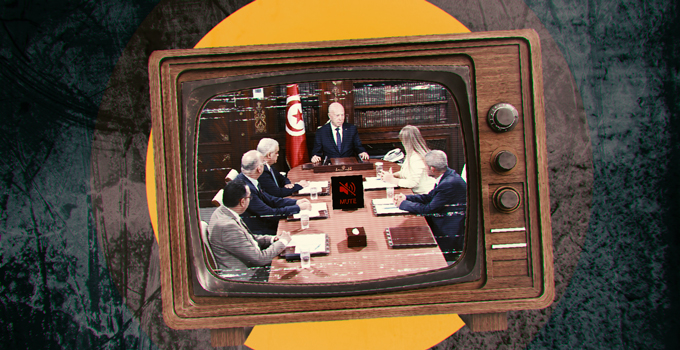
Our interlocutor continues, “Since July 25, 2021, the principle of equal opportunity in media coverage has been flouted, as illustrated in coverage of the presidential elections. President Kais Saied enjoyed far more media coverage during his campaign than did other candidates during theirs, even though we fought so that equal opportunity would be respected for everyone. Also, saying that the Radio’s management receives instructions from the Presidency is not a simple point of view. I remember that during the season of the Hajj in 2025, the director received a video that had been put together by an official institution, in which Tunisian pilgrims lauded the organization ensured by Tunisian authorities.” The journalist adds,
National radio personnel at every level do not respect the fundamental principles of journalism, such as neutrality and the freedom of expression. This manifests in two ways: first of all, through censorship of the content and subjects proposed by journalists; second of all, through the execution of the government’s direct orders and the development of propaganda-based discourse. Worse still, journalists today are monitored everywhere, including in the context of their informal conversations. Especially since a camera was installed at the station, on the pretext of preventing theft, even though there are already cameras all along the hallway outside the office. The climate of fear has made it so that people are careful in their private conversations on social media, in particular since word has spread that management can hack their personal Facebook accounts.
In its news coverage and programming, the national radio agency abstains from covering the activities of certain organizations such as the Tunisian Human Rights League (LTDH), the National Syndicate of Tunisian Journalists (SNJT) and the Tunisian General Labor Union (UGTT). It has also ceased reporting on demonstrations and protest movements, which goes against the principles of its own editorial charter. Jihane Jouati explains: “The national radio’s editorial management has created a list of events to boycott, including mobilization initiatives organized by the UGTT, and, more specifically, the October 17 march which the Union called for.”
She continues: “Management at the national radio exercises control over the journalistic content broadcasted on the air and published on its official site. And the director herself is in charge of removing any information she considers to be at odds with the editorial line, which is aligned with government rhetoric, even when the information is banal. The worst part, in my opinion, is that journalists practice self-censorship in their work.”
The same is true at Tunisian Television. What more is to be expected when, in place of its editorial charter, an institution of such magnitude publishes a legal framework along with a few lines about what it calls a “central governance cell”? On its website, nestled under the section “Who are we?” and the sub-section “Our values,” is a definition that resembles the editorial line of the national radio agency, particularly in its reference to respect for independence: “We propose content of general interest which respects journalistic ethics. We distinguish between information and opinion, and respect plurality in points of view in accordance with professional standards.” The national television agency’s editorial charter, however—elaborated in partnership with the British station BBC—is not to be found on the website. Instead, the station refers exclusively to governmental decrees, notably “Decree 4030 of 2014 approving the code of conduct and ethics for civil servants.” Article 4 of the text stipulates that the code in question is to serve as a reference in good governance, while Title 2 stipulates that civil servants “must respect their superiors, without trying to win their favor through flattery” and must “obey their direct superior and execute their orders and instructions (…)” This measure seems tailored to fit the national television’s leadership, enabling them to legitimize the execution of orders by journalists in their capacity as civil servants who fall under the jurisdiction of Decree 4030.
“What the public media are facing today is worse than what they endured under Ben Ali. It is incomparable,” a journalist at Tunisian Television told Nawaat.
Under the Ben Ali regime, there was what could be described as professional, intelligent propaganda, for the simple reason that the national television’s leadership had a minimum of professionalism. At that time, several figures recognized by the ruling power issued instructions, such as Abdelwahab Abdallah and Abdelaziz Ben Dia, who delineated the political orientation of the station and of the public media in general. Today, the government’s orders are transmitted to the heads of the public media, but we don’t know who these individuals are, nor their functions within government. They exploit the past of the individuals running the public media, who always submit to the ruling power, in order to make them execute directives without thinking twice. These individuals are named in the work of former president Moncef Marzouki, entitled “The Black Book.” In sum, there is what we can call a “general editor-in-chief” who oversees the public media; his name is Kais Saied! Moreover, he has never hidden his demands that the heads of these media platforms intervene in purely editorial details.

iThere are no comments
Add yours