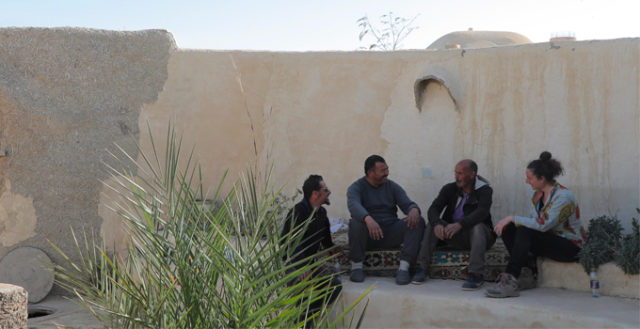
In 2013, the Abassi family settled into a semi-arid region in the center of Tunisia to practice permaculture. Ten years later, how is their agricultural experiment faring? Report.
Since 2021, Tunisia has been living a paradox. Never has the rule of law been so abused as it is today, under the regime of a university professor of constitutional law. Most concerning about the situation are its potentially long-lasting consequences, and the series of dangerous precedents now engraved in the country’s collective memory.
President Saied’s hostile remarks about IMF injunctions have stirred public debate around economic alternatives to pull Tunisia out of crisis. The struggle is bitter between adepts of the classic « structural adjustments » prescribed to save flailing economies, and adherents of the president’s magical thinking-based approach.
Television stations have traditionally reserved the majority of airtime for entertainment shows during the holy month of Ramadan. This seasonal exception is, however, becoming the rule throughout the entire year, as stations continue to shed their political programming. Not only are Tunisians overcome by « news fatigue », but also apolitical shows are far more conducive to product placement.
Recent statements by high officials in the West—namely Giorgia Meloni and Emmanuel Macron—in addition to increased contact with Qatar are burying the aspirations to turn away from Tunisia’s traditional western allies, as proposed by supporters of the current regime. Close up on the geopolitics of president Kais Saied.
Both at home and abroad, Kais Saied is—more than ever—alone. Well before his scandalous remarks concerning sub-Saharan migrants, he had already erected the walls and forged the bars of the cell that he occupies today. And with his isolation, Tunisia is condemned to devastating paralysis.
El Faouar, Kebili governorate: the lack of water, encroaching sand, plummeting revenues from date palm production, and inability to invest in lands in order to make them arable have put much of the local population in an impossible situation. With little or no hope left for the future, many locals are leaving El Faouar in search of new horizons.
Rising fuel prices, a failing public transportation system, air pollution… More and more Tunisians are turning towards the two-wheel solution: bicycling.
As water levels in Tunisia’s dams have fallen, the country itself has fallen below the water poverty line. Water levels in the country’s dams are at a record low in comparison with previous years, at 28.5% of reserve capacity, according to the Ministry of Agriculture and Financial Resources. This drop has had a direct impact on agricultural activities and contributed to soaring prices, while also causing interruptions in the supply of water used for irrigation and human consumption.
Tunisia’s president has accused civil society of fomenting the country’s colonization by undocumented migrants from sub-Saharan Africa. Kais Saied denounces those who wish to « change the demographic composition » of Tunisia, evoking their « violence and criminality ». His proof? Contacted by Nawaat, the Interior Ministry affirmed that it does not have statistics regarding the number of migrants implicated in criminal activities. A glimpse at the facts exposes the president’s xenophobic fiction for what it is.
A political party recognized by the Tunisian government is openly displaying its xenophobia and rejection of sub-Saharan migrants. « Racism is a heinous crime punishable by the law. This racist discourse includes the incitation of violence and violates the provisions under Article 9 of the law combating racial discrimination », one jurist says. And yet members of the Tunisian Nationalist Party are clearly benefiting from its ins with authorities, even receiving airtime on television.
Extremely low participation in the first round of legislative elections has brought the government face to face with a dilemma: how to set up a regime intended to be the expression of the people’s aspirations…without the people?
As the CEDAW Committee prepares to examine the situation for women’s rights in Tunisia, feminists fear the Convention’s demise. In 2011, Tunisia withdrew its reserves regarding the CEDAW. A political decision that was not followed by legislative reform.
Presented as a crucial political moment, the December 17 legislative elections were supposed to be the final act of Tunisia’s state of exception which began on July 25, 2021. If nothing else, this affirmation deserves to be put into perspective.
Their names are Baya Zardi, Hanène Elleuch, Najla Ettounssia, Rania Toumi… What they share in common: a certain representation of beauty and knack for creating a buzz. And indeed, they devote themselves body and soul to this end—even when it sets them against other women.
« Tunisians residing abroad (TRE) have suffered a double penalty: first of all, the number of their representatives’ seats decreased from 18 to 10. Second of all, the requirement for obtaining 400 sponsors is absurd and unfair » says one candidate who did not make into the upcoming legislative elections. Indeed, the country’s new electoral law has clearly diminished TRE’s chances of benefiting from representation in parliament.
Tunisia’s new agreement with the IMF is just two months away from becoming operational. The government, however, is far from being prepared to navigate what follows once it begins the precarious task of dismantling the subsidies system which covers basic goods and hydrocarbons. Rather than alleviating pressure on the country’s most vulnerable groups, it is likely to incite anger and indeed set off the social time bomb that it had hoped to disarm.
As Serbia expulses dozens of Tunisians from Belgrade, thousands of others are making their way towards Europe along the Balkan route. « I can count on one hand the number of them who are still here », says a sixty-something-year-old resident of a small village in the center of Djerba. Report.