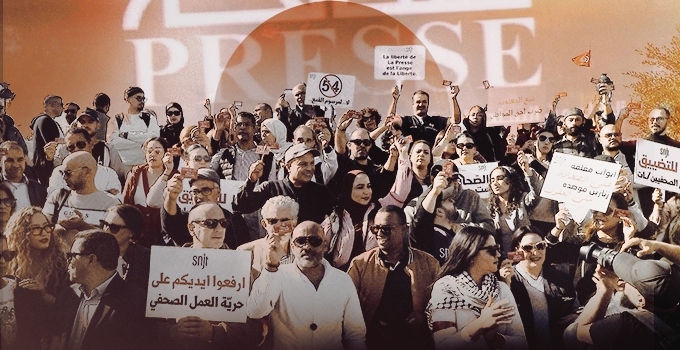
The deleterious situation surrounding Tunisian media and journalists today prompts many questions. What factors have threatened the progress of Tunisia’s “democratic transition” in terms of freedom of the press? Why has this “transition” so quickly turned us from a regime of almost absolute freedom towards a situation characterized by the return of authoritarian and repressive practices?
In an attempt to respond to such questions, we will focus on a political and historical analysis as a means of understanding changes within Tunisia’s media landscape since the country’s independence.
Our starting point is the principle that, beginning with the years of independence, on through the era of former President Ben Ali and all the way until today, the context in which the media evolve is constantly influenced by political upheaval, in turn shaped by the events which rattle the country1.
This can be explained by the fact that, ever since the state took control of society (and, by extension, the media) in the 1960s, the latter found themselves confined to a restricted space, under the supervision of an omnipresent political authority. In this context, the exercising of fundamental liberties such as freedom of the press and freedom of expression, was considerably limited in the name of the so-called “public interest.”
However, against a backdrop of social and political crises affecting state structures, the political authority oversaw an “authoritarian liberalization” in the form of occasional political “openings”2. For a brief time, the sector of information and the media thus experienced brief thaws, or ‘bright spots’, in the political and media sphere3.
The fall of the Ben Ali regime gave way to an unprecedented political cycle, characterized by a dynamic which emerged—for the first time— bottom‑up. This dynamic was spurred not by a top-down, state-imposed political decision, but by the will of the people which would henceforth challenge the state and its political institutions.
This phase was marked by the absence of an uncontested central authority as well as a legal and institutional framework capable of regulating the media and journalists. The consequence of this paradox was that the journalists who had lived over fifty years under severe repression found themselves completely autonomous, left to their own devices as they set out in a completely free space for which they were neither professionally nor ethically prepared.
The period from 2011-2021 was thus characterized by an abundance of political and social activities. Political parties and associations were born owing to several liberal provisions. In these conditions and during this decade, the media landscape experienced a period of exceptional freedom in the country’s history. The number of newspapers, radio stations and TV stations increased abundantly.

Newly gained freedoms enabled citizens and journalists to inform themselves and to debate with peace of mind but often without any guidelines. TV platforms were sometimes transformed into arenas of confrontation where different actors would clash.
But this “bright spot” began to fade in 2021 for one specific reason: reforms initiated did not sufficiently permeate the journalistic profession and the media sector. They did not succeed in establishing real safeguards against the risks that the “democratic transition” might be derailed for political and personal ends. The state’s role as driver of these reforms was essentially extinguished by the proliferation of interests and practices of private actors who rushed to fill in the gaps. Moreover, in this period of transformation, the lack of transparency within media companies and the professional instability of journalists undermined the role of the media, transforming them into tools for political and economic powers.
In this regard, the absence of mutual trust among the different actors of the transition process on the one hand, and among authorities and citizens on the other, against a backdrop of social and economic decline for the country’s most vulnerable populations, produced a strong and widespread sense of resentment. Feelings that were spurred by disappointment and disillusionment in relation to political elites of all orientations. These elements combined had a strong bearing on the presidential elections and their outcome in 20194.
As a result of the disenchantment expressed by many Tunisians regarding the “democratic transition,” and the sense of discontent especially among those on the margins of the “revolution,” a new political figure on a populist platform, Kais Saied, comfortably emerged during the second round of presidential elections in 2019. Saied positioned himself in contrast with the traditional elites who had led the country since 2011.
In July 2021, the new president caught Tunisians off guard when he declared a state of emergency and took complete control of the government, acting as the sole master on board5.
Beginning in 2022, freedom of expression and the right to information came under attack. Unconstitutional legal provisions had a significant impact on the work of journalists and the diffusion of opinions on social media (Decree-law 54 on cybercrime), restricting spaces of expression and information. Decree-law 54 prescribes severe prison sentences for the propagation of “fake news” and “rumors” on the Internet and also, de facto, in the media. In the same vein, in 2023, opponents of various political affiliations, activists, lawyers and judges were accused of “conspiracy to undermine national security” and imprisoned. Legal backing for heavy prison sentences was an anti-terrorism law from 2015 which imposes restrictions on liberties and opens the door to all kinds of abuses, such as framing political opponents as “terrorists.”
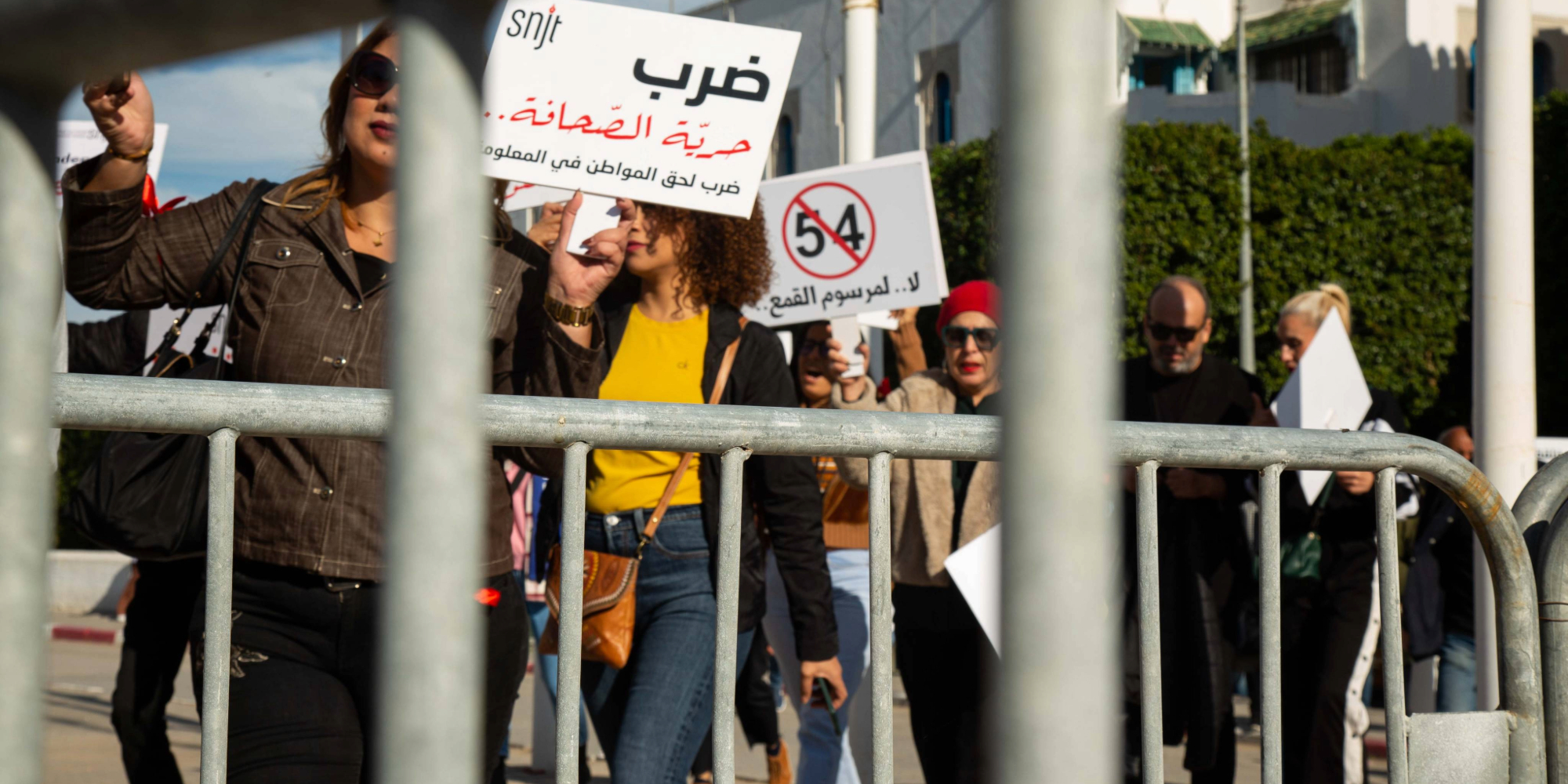
The situation rapidly deteriorated, as illustrated by Tunisia’s drastic fall on the World Press Freedom Index (Reporters Without Borders). The climate of intimidation, prosecutions and growing fear have produced a sense of anxiety and the restriction of spaces for free expression.
In reality, the departure of Ben Ali and the rise of new ruling elites did not in fact contribute to breaking with old practices or replacing old institutions with new structures built on a fundamentally reformative vision.
The media reform policy imposed by the early governments of Tunisia’s transition process (2011) is telling. It highlights the stark contrast between legal texts intended to regulate the media, and their actual application by different actors across the sector.
First, we examine the main provisions introduced in 2011, then identify the malfunctions and distortions they introduced into the democratization process.
FORMAL LIBERALIZATION
At the beginning of the transition process in 2011, a broad consensus was forged among the new ruling elite in order to free the media from government control and to ensure institutional regulation of the audiovisual sector by means of an independent public authority.
New legal mechanisms were thus introduced in November 2011 to regulate the print media and audiovisual sector: legislation on the press, printing and publishing (Decree-law 115, Official Gazette 84 of November 4, 2011), organized into four chapters which outline, respectively, the system of media companies, the status of professional journalist, the right to correction and the right of reply, and the criminal liability of journalists. Decree-law 116 of November 2, 2011 concerning the freedom of audiovisual communication enshrined the freedom of audiovisual communication and, for the first time in Tunisia, mandated a regulatory body for the audiovisual media: the Independent High Authority for Audiovisual Communication (HAICA). Inspired by French and Belgian legislation, the text attributed the HAICA with a legal personality and financial autonomy, and tasked it with “guaranteeing the freedom and pluralism of audiovisual communication” and well as “issuing a binding opinion regarding the appointment of CEOs of public audiovisual media.”
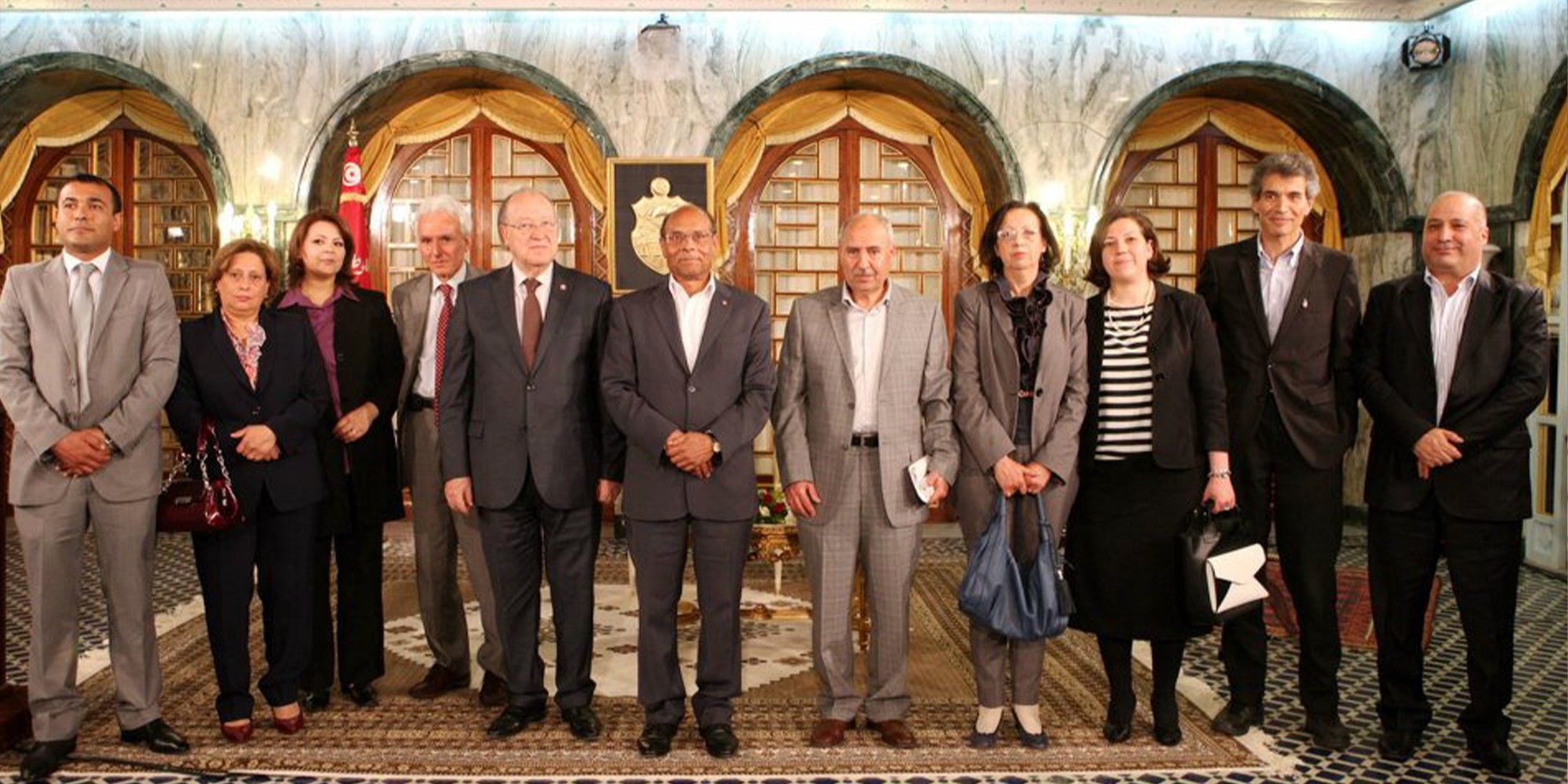
Moreover, in the constitutional text adopted on January 26, 2014, the freedoms of opinion, thought, expression, information and publication are guaranteed (Article 31) and “These freedoms shall not be subject to prior censorship” (Article 31). The right to information and of access to information are also ensured by the state, which further “guarantees the right of access to communication networks” (Article 32).
LOST ILLUSIONS
However, these “politico‑media ‘openings’” that the media sector enjoyed between 2011-2021 remained relative and, especially, extremely vulnerable. On the one hand, the elaboration of a legal and institutional framework did not jumpstart the necessary reforms in newsrooms and across the sector as a whole. The majority of companies were left to their own devices, often yielding to the public appetite for buzz and sensationalism. On the other hand, the temptation of money and opacity surrounding financial sources for the majority of private media companies constituted a threat to their independence6.
Furthermore, the HAICA was incapable of implementing decisions to close channels and stations which broadcasted without a license. The authority could neither fulfill its prerogatives nor execute its decisions without support for its functions from government structures. The only occasion when the government intervened to close a television station banned by the HAICA—Nessma TV—was just before the 2019 presidential elections. At the time, the station’s director, Nabil Karoui, was running in the elections; his main rival was none other than Tunisia’s prime minister, Youssef Chahed. Under pressure from politicians, Nessma TV resumed its broadcasting one week after having been shut down, “with a commitment to resolving the situation”7. Evidently, the decision to close down the station, but also the decision to allow it to resume broadcasting, were the result of confabulations among political leaders from which the HAICA found itself wholly excluded since it “did not give its authorization.”
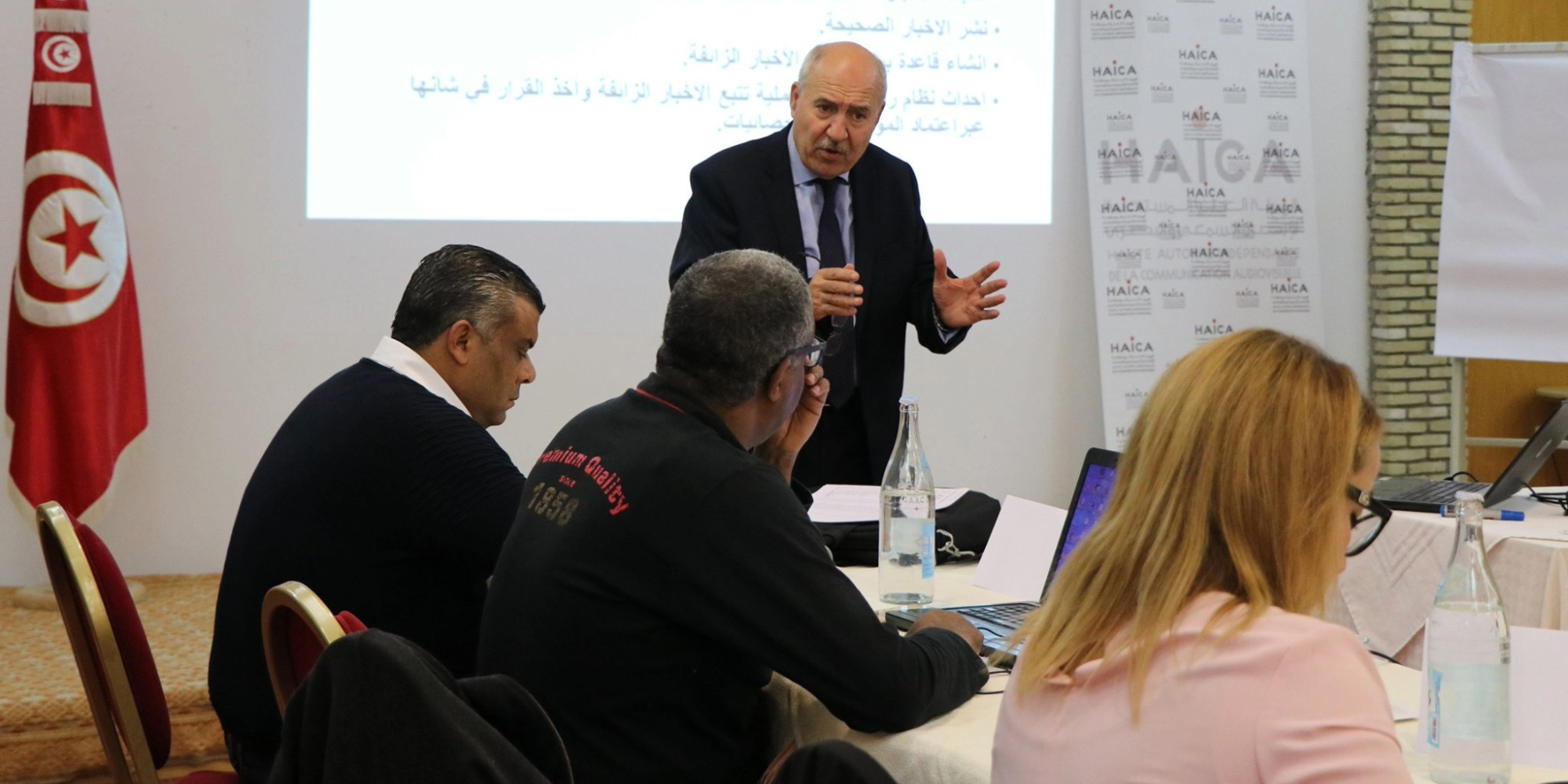
In the majority of media companies, the distinction between administration and editorial team is illusory, with no or ineffectual structures in place to the end of promoting and protecting ethics and professionalism, such as editorial boards, meetings and guidelines.
Owing to the repercussions of its dependence on political power since the years of independence until 2011, the milieu of Tunisian journalism is anything but homogenous. Although the “revolution” opened up a space for unprecedented freedom in the country’s media landscape, work and material conditions for journalists remain precarious. In some companies, salaries are not disbursed on time and downsizing is a common occurrence due to a fall in advertising resources and the sector’s economic vulnerability. Beyond this, journalists in newsrooms today are anxious about the arrests that have been carried out across the sector and legal pressure.

What is more, the system of basic journalism training is struggling to take on structural reforms and to adapt to the norms and practices in line with the democratic principles which emerged after the “revolution,” leaving programs and methods largely unchanged8.
And so, during this transition to a state of democratic law “which encompasses liberalizing the media,” the latter were not prepared “to […] function as instruments of government surveillance”9.
PRIMACY OF LEGAL RULE
For policy-makers in post-revolution Tunisia, the new legal standard was to be a catalyst for structural reforms in the media so that they would conform with “democratic standards.”
Along the way, new provisions and notions were introduced to legal frameworks, without the buy-in of all concerned actors and without ever leading to an irreversible break with the former media system in place prior to January 14, 2011.
Among these innovations: regulation of the audiovisual sector, self-regulation of print and electronic media, financial transparency, the transformation of government bodies to public service media, the separation of administration and editorial teams.
But it is not enough to simply transform these notions into ready-to-use legal norms, ignoring the process of assimilation which requires the in-depth work of raising awareness and pedagogy so that these notions are truly appropriated by all concerned actors. Moreover, the absence of strong political will among ruling elites to pair legal and institutional changes with substantial reforms— from training journalists to educating and socializing audiences to the process of democratization —explains the state of anomie in which the media finds itself today.
By way of example, we recall the diagnosis presented by the Authority for the Reform of Information and Communication (INRIC) and its recommendations concerning substantial changes to introduce (included in its general report from September 2012); the latter neither provoked national debate nor spurred the slightest interest among authorities10.
The lack of cohesion within the team of government actors following the first elections in October 2011 and their failure to commit to undertaking the necessary reforms led INRIC members to suspend the authority’s activities and collectively resign11.
The conclusion of our analysis is thus a bitter one. Long-awaited structural reforms in the media sector have been unsuccessful or are struggling to take effect. Among the reasons evoked is the tendency in post-January 14 Tunisia to prioritize legal norms at the expense of a practical approach based on the emergence of a new political will manifested by the state, strong and trustworthy public institutions, and media companies that are truly professional and independent from politics and money.

At the time of this report on the political and historical evolution of the media from independence until today, it is clear that any reform must be based on an understanding that the media’s entanglement with political power constitutes the main impediment to its liberalization and full development. In other words, the question of emancipating the media remains problematic so long as it remains unable to free itself from the grasp of political power by committing to radical reforms, and so long as autonomous authorities tasked with regulating and self-regulating the media fail to replace governmental structures.
However, it is also clear—in the hostile and toxic climate that weighs so heavily upon Tunisian media and journalists today—that the very concept of audacious reforms for press freedom is virtually inconceivable.

This article is an English translation of a text originally published in French in issue 18 of Nawaat’s print magazine.
- Inspired by our contribution in ARI. 13 Years After the “Revolution”: Media and Tunisia’s 2024 Presidential Elections, 21 February 2025. ↩︎
- Among the events which took place: the failed cooperatives policy in 1969/1970; the power struggle between the UGTT and Bourguiba’s government which culminated in a general strike on January 26, 1978; the ousting of Bourguiba and the accession of Ben Ali on November 7, 1987… ↩︎
- Mohamed Larbi Chouikha, Médias Tunisiens Le Long Chemin De L’émancipation (1956-2023), NIRVANA, Tunis , 2024, p 35-70. ↩︎
- Larbi Chouikha (2019) Le processus électoral tunisien en 2019 : instabilité institutionnelle et jeu des acteurs. ↩︎
- Sarra Grira, 30 mars 2023, Tunisie. Entre peur et divisions, Kaïs Saïed seul maître à bord. ↩︎
- Larbi Chouikha (2019) Tunisie. Des médias sous la coupe des intérêts privés, 6 février 2019. ↩︎
- TUNISIE / Reprise de la diffusion de la chaîne Nessma TV après une courte interruption on May 16, 2019. ↩︎
- Cf, Larbi Chouikha (2024) Chapitre I – La formation des journalistes : enjeu politique des pouvoirs autoritaires, in Médias Tunisiens Le Long Chemin De L’émancipation (1956-2023), NIRVANA, Tunis , 2024, pp 30-34, ibid. ↩︎
- Olivier Koch, Les médias dans les « transitions démocratiques » : état des lieux et prospective. ↩︎
- http://www.inric.tn/rapports/fr/ INRIC_Rapport_final_fr_introduc-tion.pdf
Septembre 2012. ↩︎ - Cf, Larbi Chouikha (2013), « La difficile entreprise de réformer les médias en Tunisie », Communication, Vol. 32/1 | 2013. ↩︎


iThere are no comments
Add yours