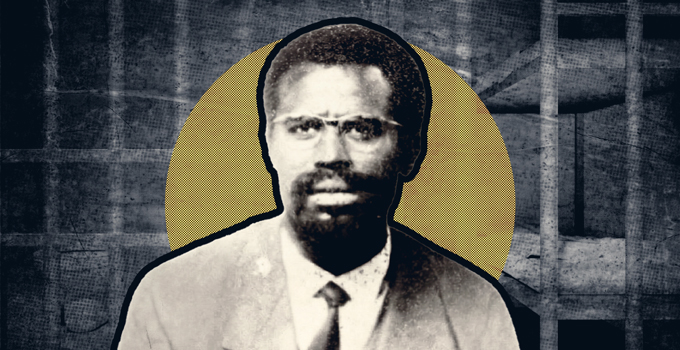
It is often assumed that the mobilization of Black Tunisians against racism began during the 2010–2011 revolution. Long before that major political break, however, one initiative—heretofore understated and very sparsely documented—signaled the emergence of a collective consciousness in the face of racial discrimination. At the epicenter of this first attempt to mobilize were the actions of a Black man named Slim Moussa, also known as Slim Marzoug (after the name of his mother, Zina Bent Marzoug).
Born and raised in the city of Gabès in southern Tunisia, Marzoug grew up in a social context marked by deeply-entrenched racial hierarchies. After spending time abroad for university studies, Marzoug returned to his country with an increased political sensitivity to questions of racism, equality, and social justice. It was in this context that he sought to unify Black Tunisians in an effort to inspire collective awakening and the organization of a movement for the full recognition of their rights as citizens.
In the 1960s, Marzoug was one of the first Black Tunisians in the country to bring the issue of anti-Black racism into the public arena. Until 2011, his name and story were largely unknown to the public. A few researchers took an interest in his life and work, notably sociologist Laroussi Amri and political scientist Jalel Bahri1 in his thesis defended in 1992 on cultural relations between Tunisia and sub-Saharan Africa. Marzoug’s story was also evoked in Ines Mrad’s thesis on Black Tunisians.2
Nevertheless, the life and work of Slim Marzoug have almost been forgotten, his story never having been openly shared by those who witnessed it: “people often spoke about him, but discreetly, especially during the time of Bourguiba.”3 For many years, it was indeed not without risk to tell this story. Daring to evoke Slim Marzoug’s activism, his struggle against racism and his efforts to publicly expose the marginalization of Black Tunisians in society, meant defying the censorship of the Bourguiba regime.
The story—as told to us by Marzoug’s sister—is heartrending, even for a researcher in social science who is supposed to maintain a certain distance from the narratives of social actors. From the many interviews with her carried out between 2011 and 2014, we were able to collect details heretofore unknown about the life of this Black Tunisian leader.
Slim Marzoug, known as “General Slim,” was a Black Tunisian from Gabès who returned to Tunisia in the 1960s following university studies in aeronautical engineering in Paris, and training in the United States. Upon his return, he met Bourguiba who reportedly “refused to grant him a position in his government because of his skin color.” His sister affirms that Bourguiba told him:
You have completed higher education, so I will send you to serve as ambassador in a sub-Saharan African country, that way you will be among your people.
As of yet, we do not have any documents or other testimonies with further details regarding this encounter between Marzoug and Bourguiba. However, certain remarks have been corroborated by other witnesses, confirming that after this exchange, Slim returned to southern Tunisia to try to rally people to his cause, and sought to create a political party composed exclusively of Black Tunisians.
He organized meetings in Medou and Arram4, and in villages outside Gabès, which has a large Black demographic. Bourguiba, fearing that this political mobilization might take on a national—and even international scale by aligning with the African American cause—evidently decided to stifle it. Slim Marzoug was thus imprisoned, and subsequently committed to the Razi psychiatric hospital in La Manouba (a suburb of Tunis), where he spent more than thirty years.
In 1987, after the “medical” coup d’etat by Ben Ali, Marzoug’s sister prepared a case for his release. But Marzoug refused to leave the asylum:
Who is going to provide compensation for these twenty-seven years of exile in a psychiatric hospital? You are old; are you going to take responsibility for me? My sister, let me finish my life here. I’ve gotten used to it, I have my newspapers, my medications, my doctor friends…
One month before his death, the hospital administration finally had him taken to his sister’s home in Gabès, where he died in August 2001.
These interviews were prolonged by a film shoot carried out in 2014 by myself and photographer Lotfi Ghariani with Marzoug’s sister, who had until then refused to talk about her brother’s story. Left paralyzed after a stroke, in October 2014 she finally agreed that we record her testimony for a film about her brother: “I accept that his story be known to everyone and that justice be served on his behalf posthumously” (Fatma, Gabès, October 2014). From her bed, she shared her memories with us. Her own children said they were surprised by certain details about which they had known nothing.
Marzoug’s story, much like that of his political movement, is still shadowed by many grey areas. The circumstances of his confrontation with the authoritarian regime remain nevertheless engraved in the memories of those who knew him. During my interview with his neighbor, the latter described Marzoug as if he could still see him: “His presence, his silhouette, his gaze, his clothing, his glasses… He looked like Patrice Lumumba. He frightened the authorities,” he said.5
The same neighbor recalled: “When police officers would come to beat Slim in his house, they would leave the car engine running and order us to go home and close our doors. They would hit him until he was like a vegetable, then leave.”6 This neighbor, as well as Marzoug’s niece, still remember his last arrest: “It happened in the morning. He was in pajamas when police officers came to get him. He told them: ‘Wait until I get dressed, I’m not going out in pajamas.’ He put on his suit, took a book, and we never saw him again. That same evening, a fire broke out in his room.”7 His niece continues:
They took him from home in a suit and brought him back to the same place thirty‑seven years later, wearing an adult diaper and covered in a sheet. He hurt everywhere and wasn’t speaking, only moaning.
Much as Marzoug’s personal story remains largely unwritten, that of his political movement is still equally unknown to the general public and to historians of contemporary Tunisia. His family members, his sister and nieces who we interviewed and who experienced these events and know many details, admit to certain memory gaps8:
He suffered a great deal. Many things happened, but we have forgotten. My mother has grown old, she must have forgotten things. As for me, I was little when he was arrested the last time.
The violence of the Bourguiba regime’s response to Marzoug’s political initiative can be explained by the incompatibility of the latter with the authoritarian logic of “Tunisification” as conceived by Bourguiba. “The reformist state led by Habib Bourguiba (1956–1987) could not […] tolerate so‑called ‘subversive’ actions capable of accusing the ruling power of racism.”
Ever since, Black Tunisians have remained largely silent; no collective outcry against racism or against their situation of social and economic relegation truly manifested during the Bourguiba and Ben Ali eras. They remained largely invisible and absent from the spheres of politics, culture, media, and academia.
It was not until the 2011 revolution that Black Tunisians began to mobilize against the invisibilization, marginalization, and injustices to which they have been subjected. Slim Marzoug’s story is still vastly unexplored and constitutes a blind spot in contemporary Tunisian historiography, one that deserves to be further investigated by future work.
- Bahri Jalel: Tunisia and Black Africa: A Cultural and Institutional Analysis, political science doctoral thesis, University of Bordeaux, 1992. ↩︎
- Mrad Ines: Multiple Identities and Many Stories: “Black Tunisians” from 1846 to Today, doctoral thesis, advisor Jocelyne Dakhlia, EHESS, Paris, 2009. ↩︎
- Interview with the author, Gabes, 2011. Ali, nephew, and Khira, niece of Slim Marzoug. ↩︎
- Two villages close to Gabes, where the majority of residents are Black Tunisian citizens. ↩︎
- Interview with the author, October 2014. A, neighbor who was close with Slim Marzoug. ↩︎
- Interview with the author, October 2014. A, neighbor who was close with Slim Marzoug. ↩︎
- Interview with the author, Gabes, October 2014. Khira, Slim Marzoug’s niece. ↩︎
- Interview with the author, Gabes, October 2014. Khira, Slim Marzoug’s niece. ↩︎

Thank you so much for bringing this story to light. I have the felling that one day we will have a Tunisia to be proud of, and that people like Slim Marzoug will be honored and remembered in our History as great men of our nation. Truth always takes the stairs, but enevtually, it arrives. Too many have forgotten this; karma is a bitch