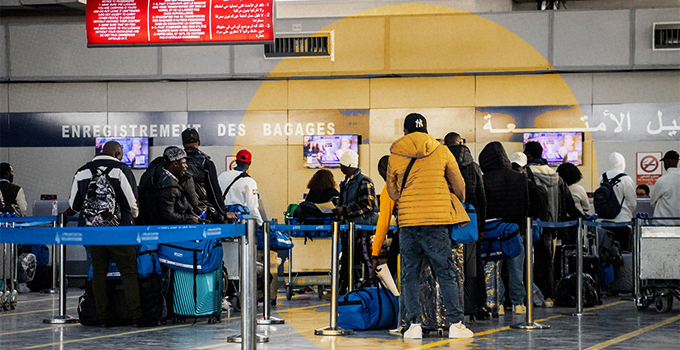
“Voluntary return” has become the buzz phrase of official discourse in Tunisia. The expression even made its way into one of the most sordid incidents in recent news. Last week, a video diffused on social media showed Tunisians attempting to rape a sub-Saharan woman. The Interior Minister reacted by denouncing a plot to tarnish the government’s image, before reaffirming his “determination to ensure the voluntary return of undocumented migrants.” The Minister’s response to attempted gang rape thus concluded with a promise of the latter’s departure.
Such rhetoric arises from a clearly defined political trajectory. Ever since Kais Saied’s speech in February 2023 characterizing the presence of sub-Saharan migrants in the country as an existential threat to Tunisian identity, there has been a systematic increase in violence, expulsion and the refoulement of undocumented persons to desert border regions.

Broadly diffused and amplified on social media through hateful and xenophobic content, this discourse has contributed to a climate of widespread hostility towards sub-Saharan migrants in Tunisia. Contacted by Nawaat, the Union of Ivorians in Tunisia (UIT) denounces the situation, and recalls that Tunisian legislation criminalizing racial discrimination has yet to be applied in practice.
RECORD NUMBERS
Since the program was launched in July 2025 with the participation of the Interior Ministry, the Tunisian Red Cross and local authorities, some 4,500 nationals from sub-Saharan Africa have returned to their countries of origin, official sources report.
This data is cited without any critical distance by numerous media outlets, as if the adjective “voluntary” sufficed to guarantee the statistics. However, these numbers are more reflective of official propaganda calibrated to pacify internal tension around migration management.
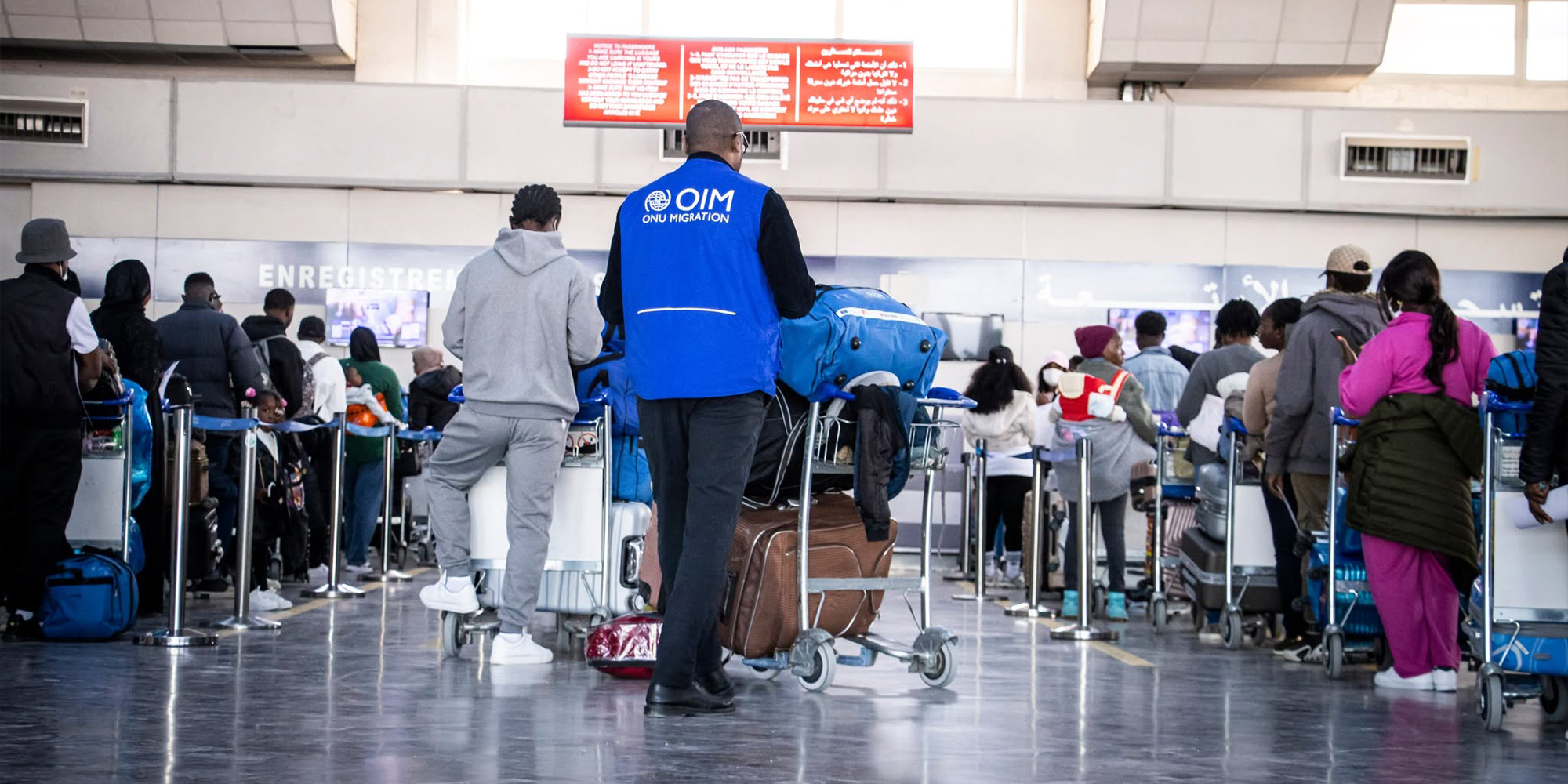
The International Organization for Migration (IOM) also has an “Assisted Voluntary Return and Reintegration” program that is supposed to provide migrants who are stranded or undocumented with the means to return safely to their country of origin. This program includes transportation (by plane) and medical assistance, and in some cases provides financial or logistical reintegration assistance.
In March 2025, Kais Saied took it upon himself personally to put pressure on the IOM, calling for the acceleration of these expulsions disguised as “voluntary return.” Not satisfied with the 1,544 migrants repatriated since the beginning of the year, the president asserted that that number “could have been much higher.” In the same address, he urged all concerned organizations to double their efforts to rid Tunisia of its undocumented migrants.
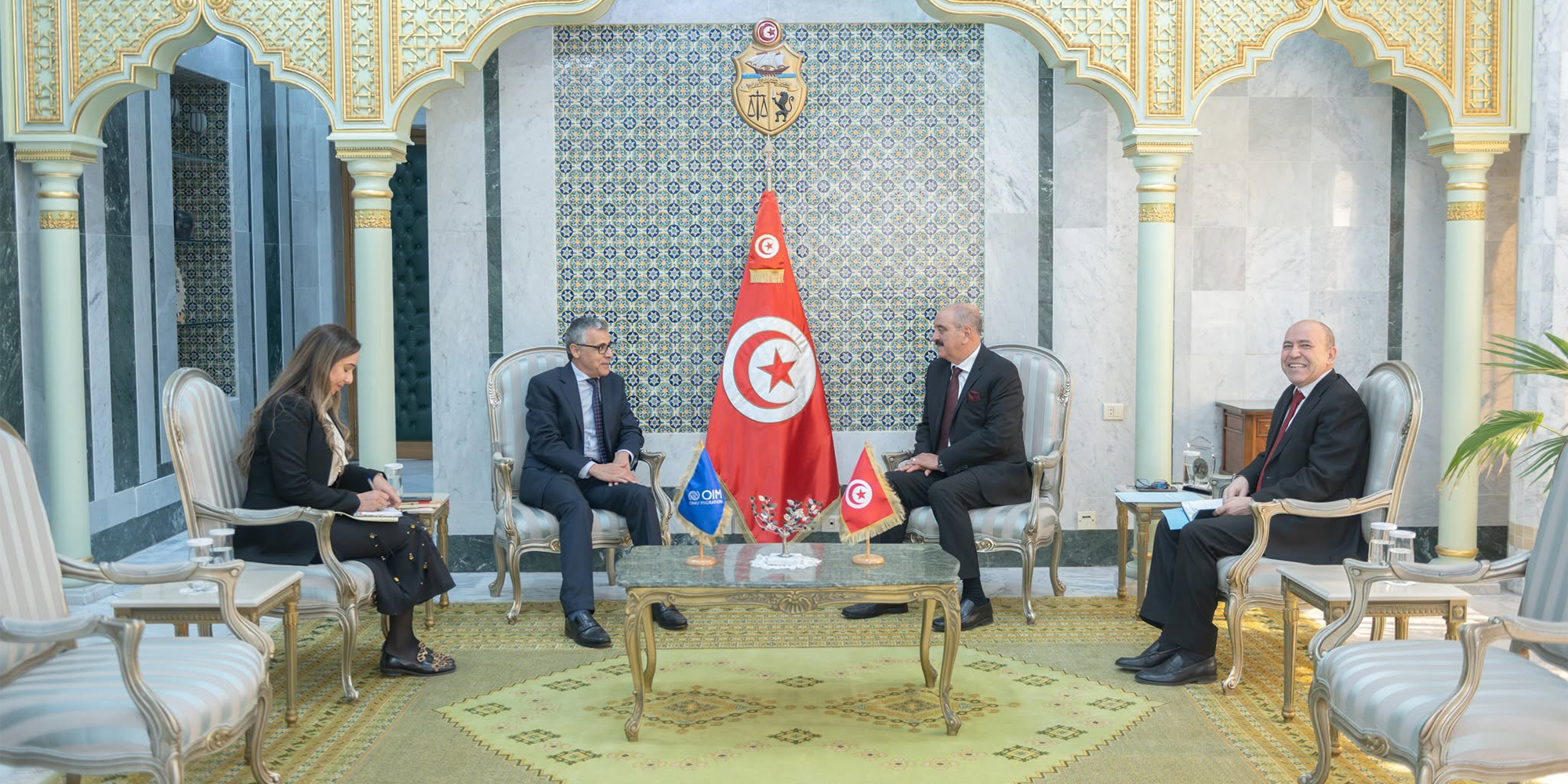
That pressure bore its fruits. In 2025, the IOM reached a “record” 8,853 returns, compared with 6,885 in 2024 and 2,558 in 2023. On May 18, 2026, Foreign Affairs Minister Mohamed Ali Nafti met with the head of mission for IOM in Tunisia, Azouz Samri, who reported on the outcomes of the voluntary return and reintegration program. Since it was launched in 2022, the program has overseen the return of 22,377 undocumented immigrants, including 2,103 since the beginning of 2026, and 400 others preparing to leave the country.
These numbers have been presented as a measure of performance, even success, but deserve to be questioned: to what extent are these departures actually “voluntary” when executed in a context of repression, extreme vulnerability and overt political pressure? Nawaat contacted the IOM for answers, but received no response.
Beyond this, the program has clearly demonstrated where its limits lie: once back in their countries of origin, some migrants have found themselves without resources and left to their own devices. Associations have formed to defend the rights of those who have returned to their countries.
Meanwhile, a second mechanism was set up in 2025, run entirely by Tunisian authorities and outside the scope of any international framework. Opaque and unmonitored, this second program crystallizes all of the concerns expressed by the World Organisation Against Torture (OMCT) in a recently published report.
WHAT INTERNATIONAL LAW BANS, TUNISIA PRACTICES
International law is unequivocal. In order for a return to be considered voluntary, three conditions must be fulfilled: freedom of choice without physical or psychological coercion; an informed decision, based on exact information and objectives; an individual’s legal capacity to provide informed consent.
The Global Compact for Safe, Orderly and Regular Migration furthermore requires states to carry out individual evaluations before any return process, and to abstain from collective expulsions or any return in violation of the principle of non-refoulement.
States are further required to guarantee legal safety for returns (the absence of persecution or sanctions in the country of origin), physical and material safety including access to means of subsistence and essential services upon repatriation.
For children, international law is even more stringent: no minor can be returned to his country without prior determination of his best interests. A parent, legal guardian or specialized official must accompany the minor throughout the return process.
Since June 2024, however, the UNHCR’s procedures for registering and determining refugee status have been at a standstill. As of December 31, 2025, 7,929 individuals were under international protection in Tunisia, including 5,550 asylum seekers awaiting a decision regarding their status. Among those who were unable to register, 75% were nationals of countries covered by the UNHCR’s no return policy, the OMCT reports.
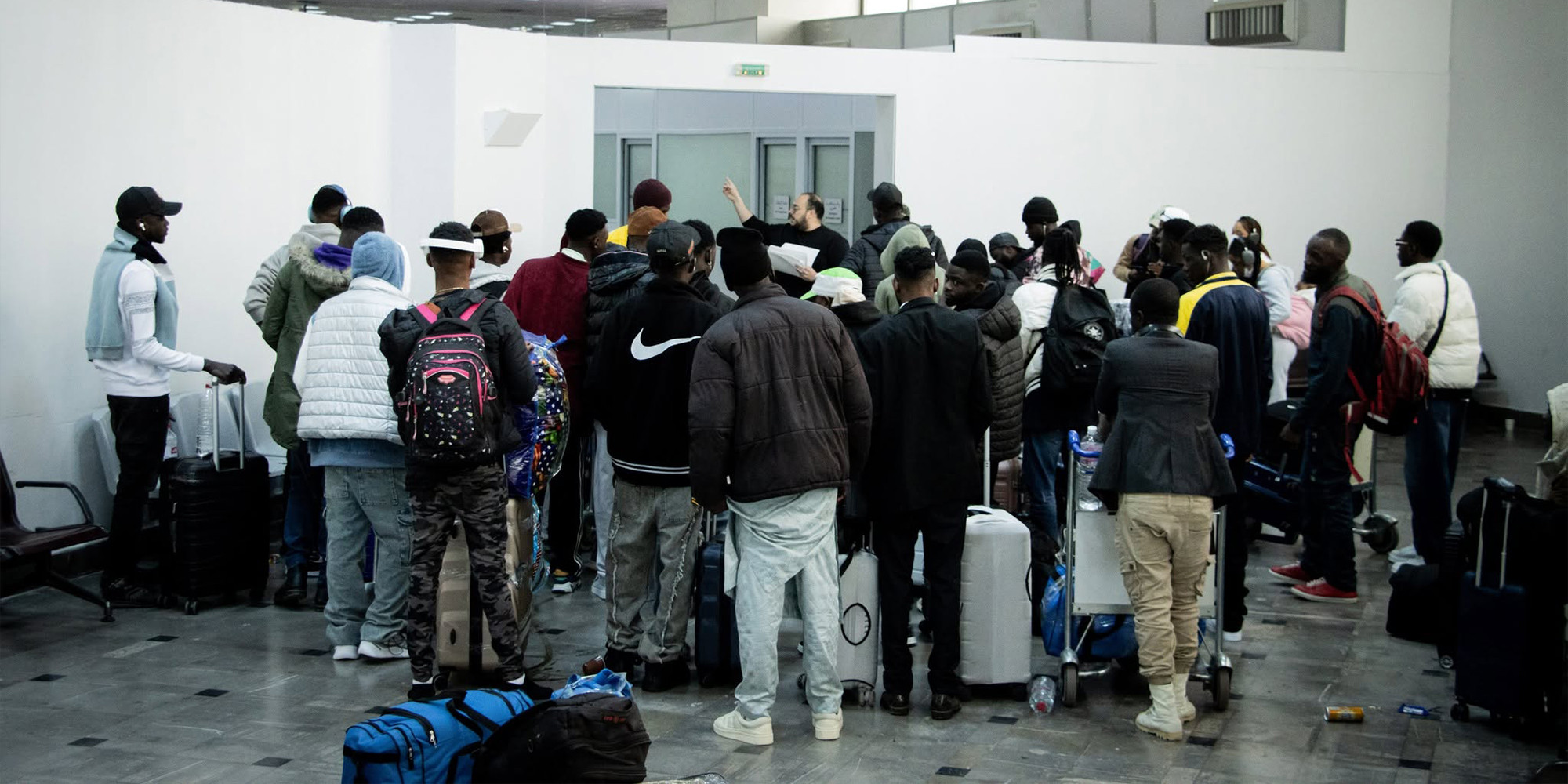
In the context of Tunisia’s gaping institutional void, accepting to get onto a bus is not a choice, but a capitulation in the absence of alternative options.
WHATSAPP GROUPS IN LIEU OF PROCEDURES
Since June 2025, buses regularly depart from the Lac 0 neighborhood of Tunis, as well as from Sfax and Sousse. The passengers are men, women and children from sub-Saharan Africa who are headed to commercial flights with a changeover in Turkey.
The program implemented by Tunisian authorities has no formal public framework. It is diffused via Facebook and WhatsApp groups dedicated to “voluntary return”. Among these groups which sometimes boast more than a thousand members, some—remunerated by authorities— promise prospective beneficiaries departures within a few days’ time.
As the OMCT reports, “information available on social media can be diffused in a way that is partial, imprecise or possibly misleading, limiting potential beneficiaries’ capacity to make an informed decision based on a thorough understanding of the program, including its advantages and the risks it entails.”
Those who sign on receive 100 euros in financial aid at the time of their departure. According to a number of testimonies, the organization and promotion of these returns sometimes use migrants who are paid by authorities to encourage others to participate in the program.
No individual evaluation of risks is carried out, no reintegration plan prepared prior to arrival in the country of origin. The period of time between registering for the program and departure is sometimes no more than a few days, making it virtually impossible to verify the individual’s genuine consent. Children’s birth certificates and identity documents are not systematically verified, exposing minors to a real risk of human trafficking, the OMCT points out.
This climate of urgency has emerged against a backdrop of widespread fear. Targeted arrests have increased in areas with significant numbers of migrants. A particularly alarming trend peaked between May and December 2025, when there was an increase in the number of arrests of women and children for “the offense of begging” in urban centers—a direct consequence of the dismantling of informal encampments which has deprived hundreds of migrants of any form of housing.
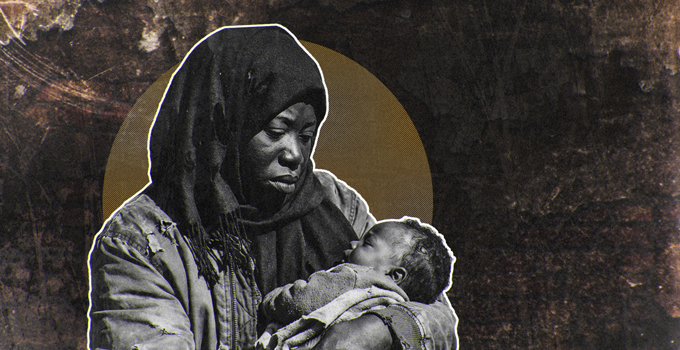
The Union of Ivorians in Tunisia has documented arrests carried out in markets, on public transport, and at the homes and work of targeted individuals. Such arrests also affect migrants with regular status whose identity documents (passports, residency or consular cards) are sometimes ignored, or even destroyed, by law enforcement.
EL OUARDIA: A TELLING CASE
In its recent report, the OMCT presents the center El Ouardia in Tunis as one of the main parts of the government’s thinly-disguised expulsion machine. El Ouardia, which was reopened to detain individuals arrested in the public space, largely operates in the absence of transparency.
Detained persons are not informed of the reasons for their detention, access to a lawyer is limited and living conditions are squalid, characterized by inadequate food, unsanitary facilities and minimal access to care. The OMCT also notes that, since November 2025, the organizations responsible for surveilling detention centers have been refused access to El Ouardia on a number of occasions.
The report highlights the case of 18 women and 24 children who were arrested in November 2025 and transferred to El Ouardia for the “offence of begging.” According to the OMCT, their telephones and money were confiscated upon arrest, and they had neither access to a lawyer nor an interpreter for language assistance.

Among those transferred to El Ouardia were eight infants, aged one year or under, unaccompanied children of about twelve years old, pregnant women and women victims of sexual violence, including some who had become pregnant as a result of sexual assault during their migration journeys.
The OMCT further indicates that several children who had been separated from their parents showed clear signs of psychological distress and that other detainees (not their own mothers) were caring for them informally.
Several weeks later, these individuals were presented with and asked to sign documents written in Arabic whose content they did not understand. They did not learn until later that these documents confirmed their consent to removal from the country. One of the women threatened that she would sooner commit suicide than be returned to her country of origin.
On December 10, the OMCT reports, one part of the group was transferred to Nigeria and Sierra Leone. These individuals travelled without adequate food or clothing until a humanitarian organization intervened during their changeover in Turkey.
Among those transferred out of the country were at least two children of around 12 years old. They travelled alone, without parents and without any confirmation that a family member or guardian would be present to meet them upon their arrival.
President of the Union of Ivorians in Tunisia Ferdinand Tohbi is unequivocal: “We are in the midst of a crisis.” Tohbi describes a community overwhelmed by the distress calls of its compatriots.
What is taking place is in fact the organized forced repatriation of individuals in an irregular situation. Today, people are afraid for their safety. And so they are forced to leave the country.
Ferdinand Tohbi
He describes the fate of migrants tracked down by the national guard and police as they await a crossing into Europe. “When they are arrested, the authorities impose this repatriation upon them, calling it ‘voluntary’.” Tohbi further notes that some individuals transferred out of the country are not Ivorian, but because they used false documents to flee their own war-torn country, ultimately wind up in the Ivory Coast.
EUROPE, THE SILENT PARTNER
In the meantime, the Mediterranean remains a death trap. At least 30 wrecks were recorded off the Tunisian coast in 2025, resulting in the death or disappearance of 533 people, including 29 children.
The OMCT points out that these numbers are probably an underestimate. More than 12,000 people intercepted as they attempted to make the crossing to Italy were forced to land along the Tunisian coast.
The European Union has a direct responsibility to bear in this picture. The Memorandum of Understanding signed by Bruxelles and Tunis in 2023, presented as a global partnership, in reality transformed Tunisia into an external border guard for Europe, without mechanisms in place to ensure that human rights are upheld. In exchange for financial and political support, Tunisian authorities have intensified the interception of migrants at sea and their refoulement, with Bruxelles’ tacit blessing.
Europe has simultaneously reduced its own commitments in relocating migrants to third countries. Its plan adopted in December 2025 only provides for 10,430 places for 2026 and 2027, an 83% decrease from designated quotas for the previous period. In Tunisia, only 72 individuals were relocated to a third country between May and December 2025—barely a third of the designated annual quota of 235 places.
And so in Tunis, Sfax and Sousse, buses transporting sub-Saharan passengers to the airport continue their routes, as the numbers of migrants exiting the country in this way continue to rise. And official statements continue to evoke “voluntary return.” But so long as a migrant’s decision to leave a country is motivated by fear rather than choice, the words “voluntary” and “return” remain no more than a fable and a euphemism.

iThere are no comments
Add yours