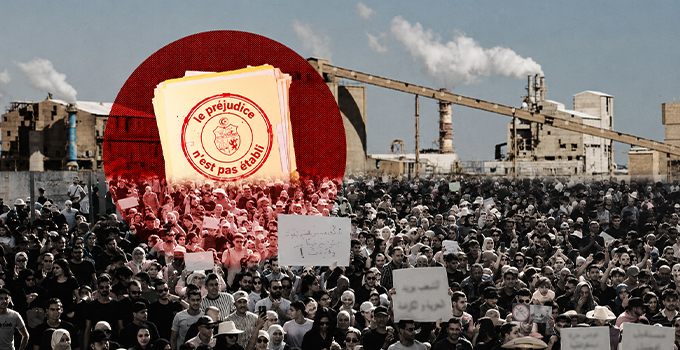
The environmental uprising in Gabes has toppled the idea that protecting the environment is a luxury afforded only to the rich. The historic march which drew nearly 130,000 citizens into the streets on October 21, 2025 was not a spontaneous action, but indeed the fruit of a long combat against the Tunisian Chemical Group. Over the course of decades, the Group has transformed the region into one of the country’s most dangerous sites of chemical pollution. Successive governments have made many promises, but Gabes has always been disregarded, its right to breathe and live without the toxic waste produced by the Chemical Group denied.

The long protest movement led by the residents of Gabes began with growing awareness about the double danger—to the environment and to public health—and the failure of development plans imposed upon the region. This awareness and resistance which it spurred have evolved over the years, growing from simple warnings to an increasingly strained power struggle, to an explicit call for the dismantling of industrial units that expel tons of toxins into land, air and sea on a daily basis. On October 21, 2025, day of a general strike, the human river which filled city streets was a scene without precedent in the history of the Mediterranean and North Africa. The event marked an irreparable break between the people and a system of governance that has reached its limits.
AN ONGOING STRUGGLE AND UNFULFILLED SOCIAL DEMANDS
One cannot understand the extent to which the environmental situation has deteriorated in Gabes without looking back on the trajectory of the local ecological movement, fruit born of a series of struggles carried out over the years. Signs of rejection were apparent, if limited, even prior to 2011. Gabesians realized the urgency and significance of the environmental issue as they witnessed the early consequences and beginning of ecological imbalances produced by the Chemical Group’s implantation into the region, as Mehrez Hamrouni, a Gabes native and environmental activist, tells Nawaat.
That said, the real transformation began in 2012, in the aftermath of the revolution. At that point, Gabes’ environmental demands transcended the context of a marginal struggle and closed circles and entered into the public sphere, piquing the interest of local and international media. The first forms of organization manifested on June 5, 2012, “around demands that were socio-economic, environmental, and for the right to a decent life,” recalls Saber Ammar, member of the campaign “Stop Pollution.” From that moment on, the campaign structured itself as a unifying force, functioning to harness local anger and to turn it into organized action, and framing the issue of pollution in Gabes as an ongoing struggle, Ammar explains. Indeed, what stands out about this movement is not only its local entrenchment, but also its capacity to persist over time. For over a decade, this trajectory has continued without interruption, resurfacing in successive phases dictated by the exacerbation of the environmental crisis and its effects.

According to Ammar, Gabesians quickly understood the need for a long-term struggle in order to move from awareness to confrontation, and thus improve the situation. Pollution in Gabes is no longer perceived to be a technical and factual problem, but as the direct consequence of a devastating global industrial system. For Mehrez Hamrouni, the issue is not one or another industrial unit, nor even the Chemical Group in and of itself, but the industrial zone as a whole which represents a major health threat. This vision correlates with the prevailing opinion within the movement that chemical activities are incapable of creating development and only serve to increase “sacrificed areas” such as Gabes, the Gafsa mine basin and others. In other words, entire regions endure the direct consequences of economic choices which, in reality, do not bring them any form of development.
The struggle is marked by several pivotal events. Protests pushed the government to hold a Council of Ministers meeting on June 29, 2017, resulting in a decision to dismantle the Chemical Group’s pollution-producing units. In 2019, the proposed plan was to relocate industrial units outside urban areas. On the ground, however, neither of these measures were executed.
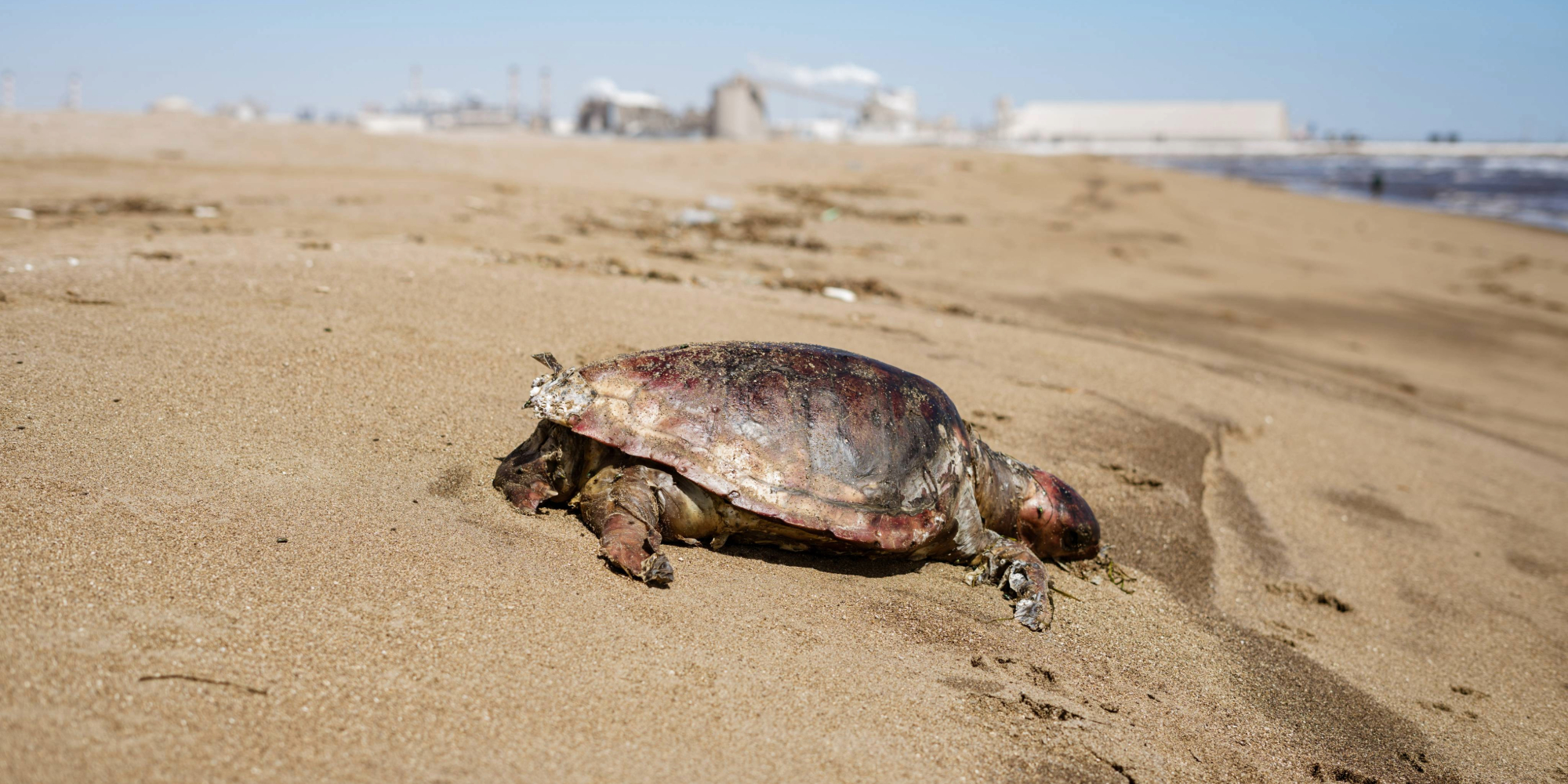
The government hedged on executing the decision made in 2017 and, by way of political interventions, buried the proposal of 2019. Hamrouni notes that the plan to transfer the Chemical Group’s units outside of the city (more specifically, within the delegation of Menzel Habib) was blocked by political meddling, with the implication that the ecological disaster at Chott Essalem and in Gabes was allowed to continue. The government’s response illustrates the magnitude of the challenge that protesters faced. And still, this disturbance did not break the movement. Rather, it helped it to take root and gain traction in a way that no other movement had. This demand, as confirmed in testimonies gathered by Nawaat during its encounters with residents and activists, was not a simple knee-jerk reaction, but an ongoing process that ultimately pushed the issue into the heart of the region’s priorities. It is an issue that remains at the center of every protest movement organized by Gabesians, in the streets of their city and, more broadly, outside the governorate and outside the country, while authorities operate to maintain the status quo.
This resilience has pushed the issue of pollution in Gabes beyond its strictly local context and given it visibility at a regional level, making it a serious test for public policies relating to the environment and social justice in Tunisia. However, successive governments have never wanted to change their methods. In fact, they have adopted an approach of crisis management based on circumvention and indecision even as protests have intensified and more signs of looming disaster have emerged.
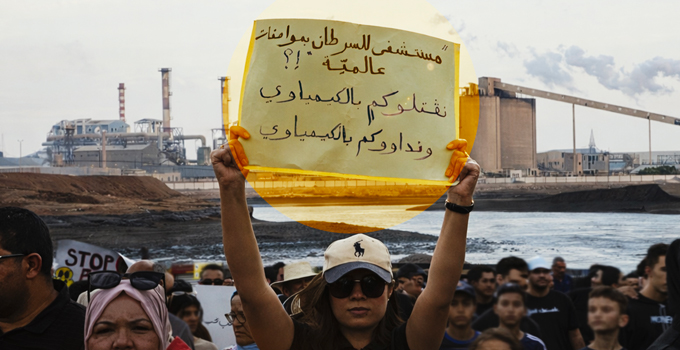
After the coup d’etat of July 2021, the suppression of pluralism and the country’s return to autocracy, the slogan “The people want” became the cornerstone of President Kais Saied’s discourse. However, this slogan was put to the test in Gabes when protesters appropriated it, demanding the dismantling of pollution-causing units and thereby clearly expressing a local demand. “The definition which the government gave to the slogan ‘the people want’ was seriously challenged in Gabes, revealing the limited coherence between discourse and practice,” notes Saber Ammar.
This expression of popular will was not equalled by any sort of political response to demands. Although President Kais Saied is attributed with comments to the effect of Gabes being “a disaster-stricken region where the environment has been killed by pollution,” and that the situation demanded a political decision and will—an admission which marked a shift in official discourse—such remarks never translated into action. Certain measures, such as the designation of a commission by the president, remained a dead letter, without any tangible result capable of stemming pollution or improving quality of life conditions in the region, as Mehrez Hamrouni explains. He evokes his meeting with the President at the Carthage palace after having travelled by motorcycle the distance between Chott Essalem in Gabes and the presidential palace, a symbolic gesture to draw attention to the environmental disaster. He recounts that he was offered support, understanding and promises which, six years later, remain unfulfilled.

RAVAGES OF DENIAL
A critical stage was reached towards the end of February 2026; a decision made by the judiciary determined a lack of proof of harm after the Bar of Gabes filed a complaint in support of the environmental movement against the Tunisian Chemical Group. The complaint was based on the 2025 environmental and social audit report prepared by the Chemical Group itself. The report is unequivocal, revealing a series of irregularities that mainly consist of “serious non-compliance,” with violations relating to, for instance, the discharge of used industrial water (in terms of temperature, acidity, chemical concentration), and the continuous flow of pollution into the sea without an effective control system in place. The report also highlights the emission of toxic gases without strict controls and up-to-date data, and structural dysfunction in waste management, especially in the case of phosphogypsum. Such elements expose deep-seated flaws in environmental governance that go far beyond simple technical failures.
This judicial process was closely tied to the situation on the ground, which was marked by an unprecedented rise in cases of suffocation in Gabes over September and October of 2025. A development which provoked large protests and a general strike, bringing to light the magnitude of the daily drama experienced by the residents of Gabes. Social unrest was exacerbated by the absence of an effective response to the ills plaguing the entire region.
JUDICIAL HARASSMENT OF ENVIRONMENTAL ACTIVISTS
Recognizing its incapacity to stifle protests, the government decided to take legal action against leaders of the environmental movement and the most prominent activists in Gabes. Forgetting its pompous slogans and promises of “new approaches” to transform the country and the world, the 25 July regime maintained the same authoritarian policies as those used by the Ben Ali regime to repress protest movements: first, censorship and disinformation, followed by police violence and a series of arbitrary arrests, and, finally, seizing control of the judiciary authority in order to intimidate activists and push them to abandon their activities. The case of environmental activist Kheireddine Debaya is the best illustration of activists being targeted for their work. Debaya was condemned in absentia to one year in prison for “hindering the right to work” on the basis of a complaint filed by the Tunisian Chemical Group.
According to a publication posted on his Facebook page following the verdict, Debaya learned of the news indirectly, from another activist. His case dates back to 2020, when he was arrested with a group of youth during a sit-in outside the Chemical Group’s regional office in Gabes. They were released several hours later thanks to the intervention of several lawyers and an on-site mobilization. Debaya reports that he and his cohorts had been assured that the case was closed before it was reactivated in 2022. Then, on March 8, 2023, 12 of these individuals were surprised by a sentence in absentia to one year in prison, without ever having received a summons or prior notification.
Debaya further recalls that search warrants were issued against him in November and December, coinciding with the environmental movement’s return to the spotlight and new calls for the dismantling of the Chemical Group’s industrial units. This harassment, Debaya remarks, will not dissuade him from pursuing his efforts, and will only strengthen his determination to continue the struggle.
The feeling is shared by activist Saber Ammar. He affirms that the reactivation of certain court cases dating back to 2020 is directly tied to the rise in environmental and social protests which the government invariably confronts with intimidation tactics. These are not isolated lawsuits, but rather a global approach to managing cases relating to the protest movement, in which security considerations are intertwined with manipulation of the justice system. This perspective is not random: it stems from on-the-ground experience in which the intensification of protests and environmental demands are rarely met with a response. Our interlocutor insists that all of these political and judicial pressures “will neither bury the environmental issue nor stifle the demands of the residents of Gabes.”
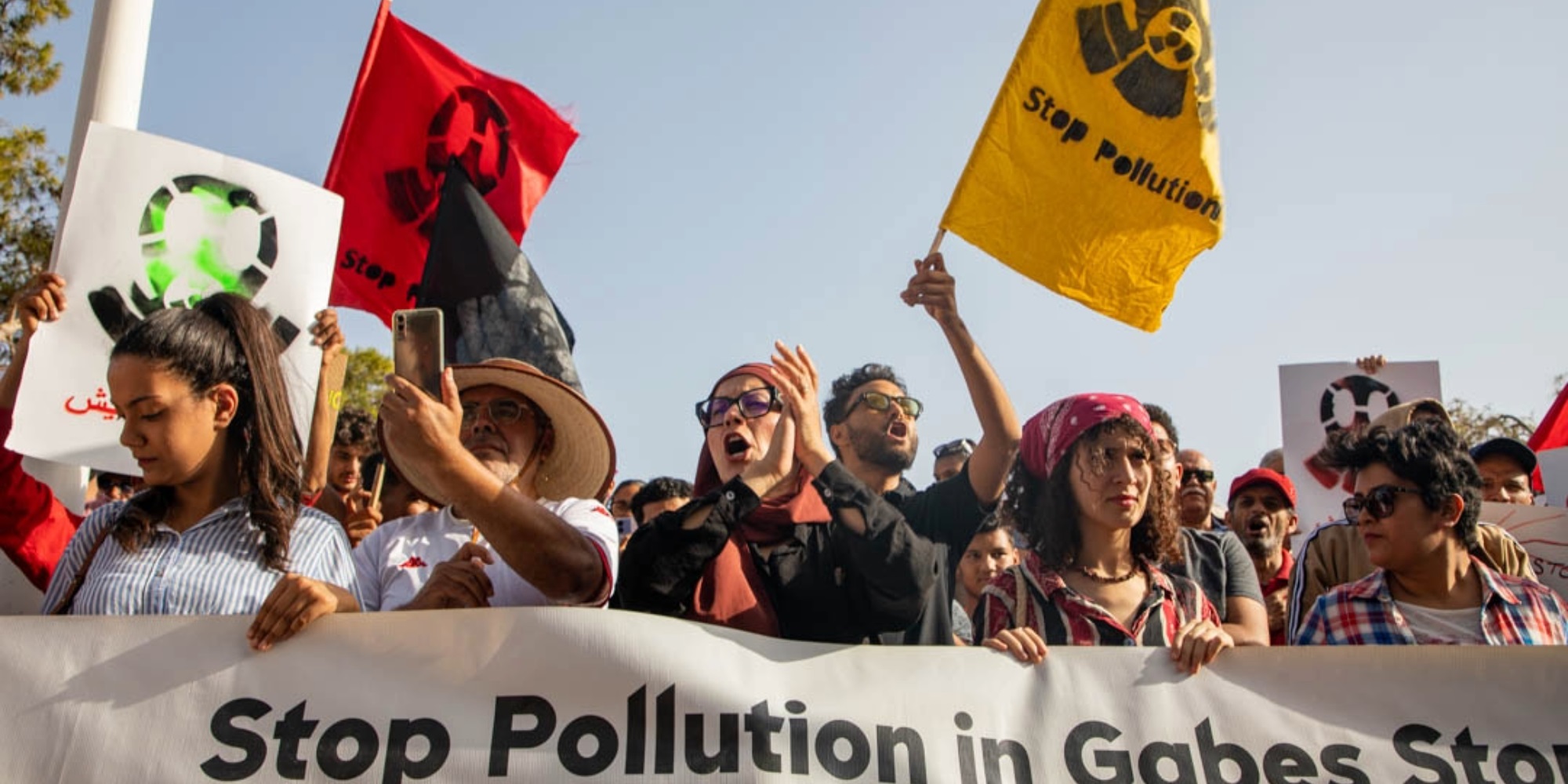
Beyond the conflict around pollution and the Chemical Group’s technical responsibility in a resolution, the long trajectory of Gabes’ environmental movement crystallizes complex issues; Environmental, health, social and legal aspects intersect in a relationship of permanent tension between information on the ground and how that information is addressed at an institutional level. Since even before the “Stop Pollution” campaign was launched in 2012, the movement has conserved its dynamism and gained experience and know-how in terms of mobilization, detecting weaknesses and negotiating. It was indeed this which enabled a successful general strike in October 2025, in which the city’s entire population showed up in the streets, forcing authorities to withdraw police forces. Faced with the ongoing legal harassment targeting activists and the absence of radical solutions to the crisis, all scenarios are possible. Beginning with the movement’s progression as a social, grassroots action that will not cease its struggle so long as the Chemical Group continues to release its poisons into the region.



iThere are no comments
Add yours