À peine née la démocratie en Tunisie risque d’être étouffée par les combines et les menées politiciennes des partis, surtouts les grands parmi eux sur la scène politique. Une entente se dessine même pour une gestion concertée du pays et de ses intérêts par deux forces du moment avec pour impératif majeur la restauration coûte que coûte et au plus vite de l’autorité de l’État.
What does foreign media make of the Ministry of Tourism’s recent decision to regulate the entry of Jews carrying Israel passports into the country? How will a national debate that encompasses questions of ethnicity, religion, secularism, history, and international relations influence potential tourists to Tunisia? For better or worse, the Djerba controversy and Karboulmania that have overcome Tunisia have yet to titillate the international community; if they have penetrated foreign media, the effects on potential tourists appear yet negligible, and reports are charged with neither the spit nor flame of online articles and commentaries from Tunisian journalists and readers alike.
480 out of 873 union members voted in the elections, presumably due in part to the absence of those who were prevented from attending the event because they did not have the obligatory member cards. Neither the Nawaat nor other online sources dwell on what would appear to be a significant administrative error…
Is the ‘Martyrs of the Revolution Affair’ that has inundated Tunisian media over the past week symbolic of an already-failing post-revolutionary justice system? Or does it instead reflect the reappearance of the same sort of political corruption that thrived under old regime? Either way, the gaping division between a recent decision announced by Tunisia’s military tribunal and public opinion has Tunisians up in arms or at least on edge about the political, legal, and moral integrity of the State.
Perusing the articles available in American media on Prime Minister Mehdi Jomaa’s visit to Washington, one is faced with the gradation of quality and specificity and attention to detail that exists among different news sources…one is reminded that The Washington Post is a reliable outlet for fluffy pieces about the US’ benevolent role in the so called developing world, for sweeping generalizations about terrorism, the Arab Spring, democracy, etc. Unsurprisingly, most US news sources follow in this line of reporting.
Intitulée « All in the Family, State Capture in Tunisia », le rapport a été publié fin mars 2014, dans la série des documents de travail de la Banque mondiale consacrés à la recherche sur les politiques. Cette enquête sur la corruption économique en Tunisie, entre 1987 et 2010 sous le régime du président déchu Zine El Abidine Ben Ali, a pour but d’ « identifier la relation entre les politiques d’investissement et les intérêts des hommes politiques Tunisiens dans le monde des affaires »
With Article 15 on the table for debate, peaking intensity of conflicts in Medenine over the closure of Ras Jedid, and Jomâa’s glowing reflections about his visit to Washington, and widespread public cynism about the volatility and apparent inefficiency of politics and politicians, the past week in politics in Tunisia captures the give-and-take, all-but-constant process that is ‘democratic transition’.
It is curious timing indeed that the report should be completed just before the Prime Minister’s official visit to Washington to entice American entrepreneurs to invest in Tunisia. In an interview with the Washington Post, Jomaa expressed intentions to pursue economic reforms that conceivably align with World Bank-propelled reforms: “The big trend for Tunisia is to encourage all private initiatives”.
That this report diffuses information which was previously inaccessible is a feature not to be overlooked or undervalued. In the wake of revolution and the unfolding democratic transition, the study’s objectives are relevant, its approach and resources transparent, its conclusions meticulously drawn and valuable to common knowledge and future research…However, a subtle but noteworthy contradiction associated with the confused designation of Tunisia as victim of state capture and as a role model for other countries reflects a greater, underlying discrepancy that exists at the institutional level.
With the electoral law on the table for discussion, the nomination of several ministry candidates, and the naming of eighteen governors, it is not surprising that election campaigns have rolled into action. Security remains a prominent issue in the National Dialogue and national media, and although the common concern is that insecurity is a block for the political process and efforts to precipitate democratic elections this year
The nature of immigration policy and visa procedures for Tunisians who wish to travel to the United States to take advantage of academic and professional exchange opportunities reflects the degree of authenticity of US rhetoric for cooperation, partnership, and collaboration at the civil society level.
This week’s highlights in Tunisian news and media: on the serious side, defining international relations and prospects for alliance-building; on a lighter note, Marzouki’s unwitting knack for comedic relief.
Another week in Tunisia’s politics is charged with mixed emotions. For now, in light of the unresolved and reinvigorated confusion surrounding the Belaid case and the elusive progress being made in election-planning processes, public demands for truth, accountability, and productivity reflect a citizenry eager for change, and still waiting for signs of it.
The show of US interest in Tunisia since the beginning of the revolution is significant, both in mainstream media and discourse as well as in US official investigations and reports. Whether docked at the capital port, or congratulating the prime minister, or releasing large sums of loan money into the economy, or advocating for a successful democratic transition, the United States has made it clear that it has a vision for Tunisia.
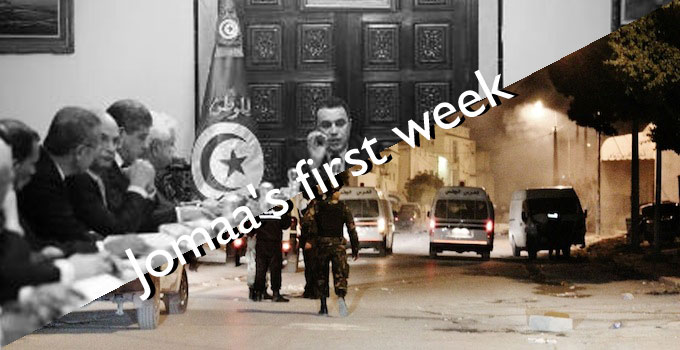
There is a palpable wait-and-see hesitancy that permeates the streets of Tunis, as many citizens hold their breath for tangible, measurable outcomes of Mehdi Jomâa’s work in office —an increase in value of national currency and reduction of the unemployment rate, for instance.
ولدت طاولة الحوار الوطني لقيطة بعيدة عن كل شرعية، مسقطة على المشهد السياسي التونسي بعد مبادرة من منظمات نصّبت نفسها راعية وحَكماً لهذا الحوار قافزةً على معطى مهم، وهو أنه لا يمكن لها أن تكون طرفا محايدا و الحال أنها جزء أصيل من المشكل التونسي.
Ce gouvernement est censé représenter un nouveau départ de la Tunisie; on l’espère tous. Mais force est de constater qu’il ne donne pas les gages nécessaires pour une pratique rénovée de la politique continuant d’user des recettes éculées, ayant échoué et condamnant à l’échec la nouvelle équipe. Car il ne suffit pas de changer les têtes avec la même politique pour réussir.