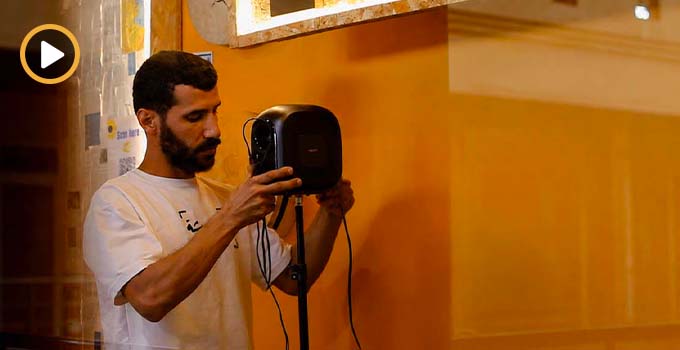
“Something dangerous is happening to the sector: artists are leaving. They can’t bear it any more. They are jumping ship,” warns Habib Belhadi, director of the space Le Rio, in an interview with Nawaat. Belhadi contines:
The government has created a sort of inflation at the level of arts education, but there are no resources to produce or show one’s work, nor are there spaces available for rehearsals.
As a result, a large wave of emigration has begun. This has largely gone unnoticed, however, I live in the heart of the cultural scene and am watching it unfold. Little by little, the most skilled artists and the very best among us are starting to leave, besides those who make do, one stint at a time, with overseas contracts of three or four years.
The drain is no longer filtering out just doctors and engineers. Now, dancers, actors and technicians are also eager to pursue their careers elsewhere, far from Tunisia.
The Ministry of Higher Education recorded a total of 42,172 “Literature and Arts” students in the public sector between 2024-2025. Within the arts, music represents the most widespread discipline in terms of a publicly trained workforce.
The Ministry of Cultural Affairs comprises a network of 25 public music and dance institutes with approximately 6,820 students. The number of establishments within this network has increased significantly since the 1990s, from 16 in 1994, to 18 in 2004, to 19 in 2014 to 25 by 2019-2020.
Thousands of youth educated in music, theater, film and fine arts. Degrees earned, years of learning, skills honed. And at the end of it all, one question remains unanswered by workforce statistics: for what career prospects?
With an underfunded sector, dilapidated performance venues, and an ambiguous legal status, Tunisian artists have long been accustomed to functioning in a situation of vulnerability. What is different today is the compounding of this situation by a social and political climate that is increasingly hostile to creative expression. Nawaat spoke with several artists to understand how this context influenced their decision to leave the country.
CONVERGENT TESTIMONIES
Actor Ghaith Naffati is among those who have opted to pursue their artistic careers elsewhere. For Naffati, Tunisian theater is plagued with a funding system inherited from the Ben Ali regime, in which the Ministry of Culture produces and distributes, at the expense of empty theaters, and thus maintains state control over artistic creation.
Beyond this, Naffati evokes how the creative process has been undermined, pointing a finger at grant proposals without any real artistic project and with the sole objective of securing funding. This practice, the artist notes, is widespread, and recognized by the administration.
His conclusion is clear: artists must learn to produce and diffuse their work autonomously, rather than to negotiate grants for shows performed before empty performance halls.
Naffati does not present his departure as a rejection of the country, but as the result of burnout in the face of a series of disasters: the political situation, the condition of institutions, pollution, corruption, widespread chaos. “Tunisia took too much of my energy,” he tells us. Leaving the country is less a definitive break than a separation with the hope that one day, the country will “shine again.”
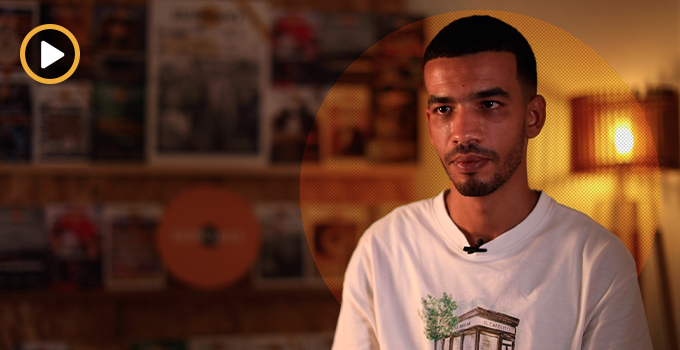
The vulnerability experienced by Tunisian artists is also deeply personal. How can one create while struggling to make a living from one’s art? “I’m inspired, but so what? I’m always thinking about my bills, about how to survive!” says author and performer Wissal Labidi, whose main obstacles are material ones.
Labidi doesn’t see her departure as an escape, but as part of a strategy to consolidate her career so that she might return one day in a stronger position. After five years in Istanbul, she is now aiming for Canada, France or Belgium. She considers this a “detour.” Labidi highlights a telling paradox: Tunisia’s cultural institutions often favor professional trajectories pursued overseas to those completed locally.
She also views her exile as political, and insists upon the necessity of independence from institutional frameworks. “I am for alternative pathways,” she remarks on the topic of professional recognition. Labidi criticizes the absence of a collective response to the crisis that weighs heavily upon the sector: “Every artist is left to fend for herself.”
Ironically, Labidi’s sense of solitude only dissipated once she left Tunisia. An artistic residency program in which she participated alongside an Argentine author revealed stronger similarities with artists from the Global South.
The desire to leave Tunisia is not unique to the cultural sector and indeed extends to society at large, however, it is significantly greater among film and theater technicians, dancers and actors. Destinations vary according to profession: Europe for choreographers and dancers, the Gulf countries and Egypt for technicians and actors, Canada—Montreal especially—for a broader spectrum of possibilities ever since the reopening of its immigration programs.
This is what actress Oumaima Bahri tells Nawaat. The general deterioration of Tunisia’s social climate has had a particular effect on the cultural sector. “There is no longer anything to get you out of bed in the morning,” she says.
Economic vulnerability, including the insecurity of free-lance status and the “uselessness” (as Bahri describes it) of a professional card—does nothing to help. Bahri also evokes the country’s general collapse: “In a context characterized by water and electricity outages, artistic creation is no longer a priority, even for artists.”
And yet leaving is not an easy way out. “This comes with a loss of professional skills, transition jobs until obtaining an official status or an educational degree, and a cultural barrier that is specific to artistic careers. Unlike scientific or technological disciplines, art is the product of a lived experience and of the country,” Bahri points out.
Still, the advantages enjoyed overseas are considerable. Bahri felt the difference after only a few weeks in Montreal. “I told myself, this can’t be, I’m dreaming—I don’t deserve all of this!”

STATUS OF THE ARTIST: DECADES OF PRECARITY
What these three artists describe reflects a structural crisis that has been documented for years. Today, the question of a formal status for artists remains without a legislative response, leaving the sector’s professionals without a clear framework for their rights, remuneration and social coverage.
The Law on Artists and Artistic Professions was finally promulgated in May 2026 after more than ten years of debate. Presented as a historical achievement, the text promises social rights in a sector that is characteristically precarious.
But behind this promise of protection, some within the sector suspect there is another intended effect: the establishment of new control mechanisms on artistic creation. At the center of controversy is the system which governs the professional card, and on the financial sanctions—up to 10,000 dinars—for artists practicing without one. Such fines are deemed excessive. “It’s an extremely punitive approach towards a sector that is already economically weak,” says Habib Belhadi.
NEGLECTED INFRASTRUCTURE
The country’s cultural centers [maisons de culture], which are supposed to be spaces for artistic creation and representation, are in a state of general disrepair. The Minister of Cultural Affairs herself, Amina Srarfi, reported that 70% of Tunisia’s 242 cultural centers are dilapidated.
Their neglect is nothing new, explains Belhadi. Established during the Bourguiba era, the country’s network of cultural centers was ultimately abandoned and gradually reduced to what Belhadi describes as mere “cobwebs.” Cultural policies function through isolated gestures—a projector here, a piano there—rather than a real comprehensive strategy.
A number of structures born in this context, such as the Municipal Theater of Tunis and El Hamra, have since disappeared or are struggling to survive. Among them, Le Rio itself constitutes one of Tunisia’s historical cultural spaces whose fragility directly feeds into the sense of abandonment described by Wissal Labidi.
Outside the capital, the absence of fully-equipped and regularly-maintained performance venues makes the diffusion of shows unpredictable. This reality weighs heavily upon artists in different regions throughout the country.
Movie theaters have followed a similar trend. Around 50 years ago, Tunisia boasted nearly 150 movie theaters. Today, there are but a handful, including those which have been replaced by multiplexes that standardize film distribution.
A BUDGET THAT SERVES UP LEFTOVERS TO CULTURE
For 2026, the Ministry of Cultural Affairs has a budget of about 461 million dinars. Most of this is absorbed by salaries, with the remaining sum allotted as direct support for artistic creation.
Creative freedom in Tunisia is also delineated by presidential priorities. The President has always been clear about his conception of culture, which—although founded on freedom and the ability to break norms—must align with official policies. His so-called “liberation war” proclaimed “in the name of the will of the people” appears thus to extend to the cultural sector.
And yet those working within this sector have yet to be guaranteed a decent standard of living. Underfunding has a concrete impact on how artists are remunerated. Theater actors receive between 150-200 dinars per show, and perform on average six to ten shows a year; the resulting income is deemed a paltry sum within the profession.
As for private funding (banks, patrons, sponsors), the problem is not only that companies do not give enough, but that the cultural market itself is not adequately structured to render investments comprehensible, predictable or profitable.
This reality rules out what might otherwise appear an easy solution, namely that public funding could simply be replaced by private funding. However, the two do not operate according to the same logic. Private funders look for profitability or visibility, and are disinterested in anything that does not produce an immediate gain. Accordingly, artists must prove their profitability even before having the means to create the project that is supposed to generate profit.
For companies whose main objective is visibility, projects likely to draw an audience or brand image are the ones that attract funding, not necessarily artistic work that is experimental, innovative or unsettling.
Nor can foreign funding replace cultural policies. In Tunisia, this type of funding enables projects, associations, residencies and events to stay afloat, but depends largely on calls for projects and temporary funding. It finances initiatives, but rarely ecosystems. Once a project is completed, structures resume their original weaknesses.
Such dependency imposes another limitation: in order to access resources, recipients must often enter into frameworks and adopt priorities defined by the funder. In the process of pursuing available resources, creative work risks being adapted to what is fundable. Along these lines, Oumaima Bahri notes that some artists have boycotted foreign cultural institutions since October 7 and the war in Gaza.
ARTISTIC CREATION UNDER JUDICIAL SURVEILLANCE
Beyond structural precarity, a more recent issue that factors into departures is the proliferation of lawsuits targeting artists for the content of their work. This criminalization of free speech has a real influence on ambitions to leave the country. “The fear is palpable,” Bahri observes.
Gradually, self-censorship has descended upon the cultural sector. According to Bahri, lawsuits involving publications on social media have pushed artists themselves to impose limits in their writing.
The system of repression which initially targeted journalists, lawyers and political opponents now effectively extends to artists and creators across different disciplines.
Graffiti artist Rached Tamboura was arrested in July 2023 after completing a mural which featured Kais Saied and denounced his policies pertaining to sub-Saharan migrants. Prosecuted under Article 67 of the Criminal Code and Decree-law 54, Tamboura was sentenced to two years in prison. He wasn’t released until July 2025 after purging the entirety of his sentence.

Other graffiti artists faced similar lawsuits in 2025, including Ilyes Souihi, known as “Trang,” and some 20 or so others, after a mural appeared on a wall of the STEG. Artist Abdallah Tekaya was detained and allegedly suffered violence by law enforcement.
The case of comedian Lotfi Abdelli is also telling. Abdelli, who has lived in Paris since 2022, was sentenced in absentia to 18 months in prison in relation to a past show on grounds of insulting a public official and immorality. The comedian has been openly critical of the Tunisian president in past months, and described the sentence as an infringement upon freedom of expression.
Yet another case: students in the governorate of Nabeul who faced charges by the public prosecutor for a satirical song called “Babar the elephant.” They were released following a widespread mobilization.
Rap has also been a target of repressive tactics by authorities. Once infused with a spirit of dissent, Tunisian rap has gradually given way to a more commercial, less politically engaged style. In 2024, Ghassen Ounallah and Nassim Nguili of Kebili were detained following the release of a song criticizing the country’s social-political situation.

Rapper Weld 15 denounces this shift as well as the police repression which targets rap artists:
The campaign carried out today against rappers by authorities has been in the works for a long time. It targets youth from working class neighborhoods who do art, produce and achieve success all completely outside control of the system and without support from the Ministry of Culture.
A number of rap artists were recently arrested in common law cases. Weld 15 himself announced that he left the country for Germany.
From a graffitied wall in Monastir to a verse recorded in a working class neighborhood, the message is the same: in Tunisia, not only is art unlikely to put bread on the artist’s table, but now also risks landing him before a judge.
Faced with a choice between silence or departure, more and more artists are jumping ship. The question now is: how long can a country continue to lose its culture before it also loses a part of what it has to say about itself?

iThere are no comments
Add yours