Media 92

Tunisia: Media Sink Back into Collusion ahead of run-off vote

In this extremely polarized electoral context, how did the media frame the public discussion and shaped the public opinion? A very bad role, if one believes the 3rd report of Independent High Authority for Audio-Visual Communication (Haica) on the political pluralism, which points the partiality of the audio-visual coverage of the presidential campaigns. Furthermore, the press took a dangerous turn when being engulfed in shifting sands of propaganda and voluntary complicity. But these repetitions seem to worry neither the politicians, nor the journalists.

Reporting Through the Grapevine: Western and Tunisian Media on “Foreign Fighters” in Syria

Even if it is for the lack of up-to-date and relevant data produced and diffused by Tunisian government institutions, that Tunisian media draws from foreign mainstream reports without questioning the validity of the data, analysis, or sources used–reporting through the grapevine, as it were–is a practice that diminishes rather than enhances the quality of dialogue on current issues. Noteworthy, for example, is the number of news agencies that have referenced the recent CNN International study and imprecisely or incorrectly attributed it to the Washington-based non-profit Pew Research Center.

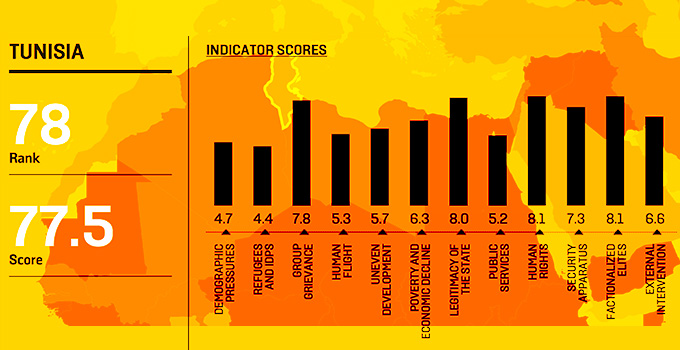
Good Country, Fragile State, the Arab World’s Sole Democracy : Tunisia by International Measures

Several comparative studies featuring Tunisia have recently caught our attention at Nawaat, and here we reflect on them conjunctively in the context of a sort of comparative examination of our own. The Good Country Index passes as the most engaging for its pragmatic persective and reassuring assertion that the index is one alternative perspective that is to be considered in conjunction other indices and analyses; the Fragile States Index is mildly interesting without presenting any strikingly revelatory insight, while two articles from The Economist that examine the so-called Arab World are flagrantly devoid of research- and critical thinking-based material for relevant, constructive discussion.

Tunisia: Harmonizing Politics and Media for and before the Elections

As much as instruments to monitor and ensure transparency and the constitutional operation of state powers and processes, the HAICA and the ISIE are, just several months into their roles, equally accountable for their own transparency and constitutional operation. The next six months will not only measure their competency and capacity to fulfill this dual responsability but will more generally decide the nature and successfulness of elections and the direction of the country through and beyond the transition period.

In the Name of National Security, ATT Poses Threat to Freedom of Expression, Separation of State Powers

Two recent articles from The International Business Times (New York) and Index on Censorship (a London-based organization that works to «protect freedom of expression around the world») resonate with the skepticism in publications from Tunisian media outlets and pose questions pertinent to national controversies that embody the challenges of post-revolution social and political transition.

Jomâa and Barack Open the Strategic Dialogue – American Media on the Tunisia-US Partnership

Perusing the articles available in American media on Prime Minister Mehdi Jomaa’s visit to Washington, one is faced with the gradation of quality and specificity and attention to detail that exists among different news sources…one is reminded that The Washington Post is a reliable outlet for fluffy pieces about the US’ benevolent role in the so called developing world, for sweeping generalizations about terrorism, the Arab Spring, democracy, etc. Unsurprisingly, most US news sources follow in this line of reporting.

Les photos de la 6e édition du Forum WAN-IFRA de la presse arabe.

Voici les photos de la dernière édition du Forum WAN-IFRA de la presse Arabe, ayant eu lieu du 24 au 26 novembre 2013. Au-delà de l’objet même du Forum, c’est l’une de ces rares occasions durant lesquelles se réunissent quelques-uns parmi ceux qui ont à cœur le devenir de la profession ainsi que son indépendance. Derrière ce combat pour la liberté de la presse, il y a d’abord des femmes et des hommes, mais également des ONGs qui font un travail forçant le respect depuis des années…