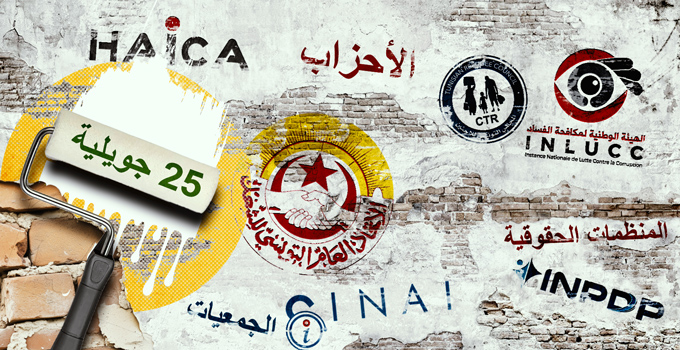
President Kais Saied wants to do away with all actors—from civil society, to union organizations, to the media—who might expose the limits of his power. And it seems that there is nothing to stop him.
The recent populist attack on the Tunisian General Labor Union (UGTT) served as a true test of the government’s capacity to rein in intermediary structures, whatever their weight on the political scene.
And while the country’s largest union organization may have managed (for now, at least) to counter assault by the regime’s militia, the same cannot be said for other organizations and associations, most of whom have disappeared without the least sign of resistance. Why has the government set out against intermediary structures? Are there even intermediary structures of which to speak in the context of dictatorship and an autocratic regime?
In 2012, former French President Nicolas Sarkozy—the notoriously right-wing and anti-immigrant politician—stated during his electoral campaign:
Over the span of five years, I learned that the real blockages did not come from the French people, but from certain unions, organizations and intermediary structures which favor immobility and conservatism for fear of a new world in which their influence would be diminished.
The same year, the investigative site Mediapart exposed a case of corruption dating back to the 2007 presidential election, when Sarkozy allegedly received 50 million euros from Libya’s former leader, Muammar Gaddafi. In 2014, Sarkozy was implicated in a second case in which he was accused of attempting to influence a judicial decision.
Such misleading discourse reflects a political doctrine that has spread globally over the past century. This doctrine, which continues to fuel many regimes (including the one that has taken power in Tunisia) oscillates between right-wing populism and extreme right xenophobia. Associations and unions that do not fall within their orbit are perceived as a real threat for their influence on the least educated segments of the population, which constitute an invaluable electoral base for these regimes.
Intermediary Structures, Enemies of the Populist Regime
It is impossible to understand the policies of the current government—embodied by Kais Saied—with regard to intermediary structures (organisms partially engaged in the implementation of the country’s major national directives) without fully grasping the President’s own vision of government.
In reality, since announcing his candidacy for the 2019 presidential election, Saied never sought to conceal his concept of government before beginning its implementation in mid-2021.
Which is why it is difficult to understand why some observers of the political scene in Tunisia are demonstrably upset each time the President takes a decision aiming to exclude intermediary structures. Towards the end of 2021, Saied’s intentions became clearer with the promulgation of Decree 117, whose chapters V and IX confer absolute power upon the president following the suspension of Parliament.

President Saied’s rejection of intermediary structures is not by chance. Rather, it is part of a populist ideology that has become, since the beginning of the 20th century, a political current that prospers in the context of severe economic and political crises. It was born at the end of the 19th century with the rise of the American People’s Party that was born of the alliance between farmers and Greenback.
While this party never made it into government, populism found great success in the 1920s and 1930s amidst the global economic crisis, and was imposed as fascist parties rose to power.
Interviewed by Nawaat, Hichem Snoussi, former member of the Independent High Authority for Audiovisual Communication (HAICA), explains:
The concept of mediation is fundamental to the modern state, since it is connected with the concept of modern democracy. However, the idea of modern democracy is to transcend catastrophes created by the elections prior to World War II. We must not forget that Hitler came to power following transparent elections, but that he quickly became a despot. The consequences of his reign were disastrous for the entire world.
In Tunisia, intermediary structures—whether independent organisms, non-governmental organizations, media outlets, political parties, etc.—constitute a pillar of representative democracy.

When regimes based on representative democracy face crises, especially in relation to the structural issues of democracy, an unexpected gap opens up to the populist current. As it gains momentum, the latter generally places the blame for these issues on the previous regime, then extends its field of hostility to intermediary structures, although they do not directly participate in exercising power.
In his book entitled Le Siècle du populisme : Histoire, théorie, critique [The Century of Populism: History, Theory, Critique, researcher], Pierre Rosanvallon writes:
The five elements of populist political culture are: a concept of the people, a theory of democracy, a mode of representation, an economic policy and philosophy, a regime of passions and emotions. The concept of the people founded on the distinction between “them” and “us” is the element which was most commonly analyzed. […] The populist theory of democracy is based on three elements: a preference for direct democracy (illustrated by the sacralization of the referendum), a polarized and hyper-electoral vision of the people’s sovereignty which rejects intermediary structures and sets out to subjugate unelected institutions (such as constitutional courts and independent authorities); a wariness regarding public opinion’s capacity to express itself spontaneously. […] The most common political criticism of populism is its association with illiberalism, or a tendency to place the (“societal”) expansion of individual rights second to the affirmation of collective sovereignty, and also to instruct the process of intermediary structures accused of contradicting the action of elected powers.
This definition applies perfectly to the situation in Tunisia. Indeed, about one month after having announced Parliament’s suspension on July 25, President Kais Saied ordered the closure of all branches of the National Anti-Corruption Body (INLUCC) and the seizure of all of its case files. This measure had the effect of removing the exclusive protection enjoyed by whistleblowers in relation to cases of corruption.
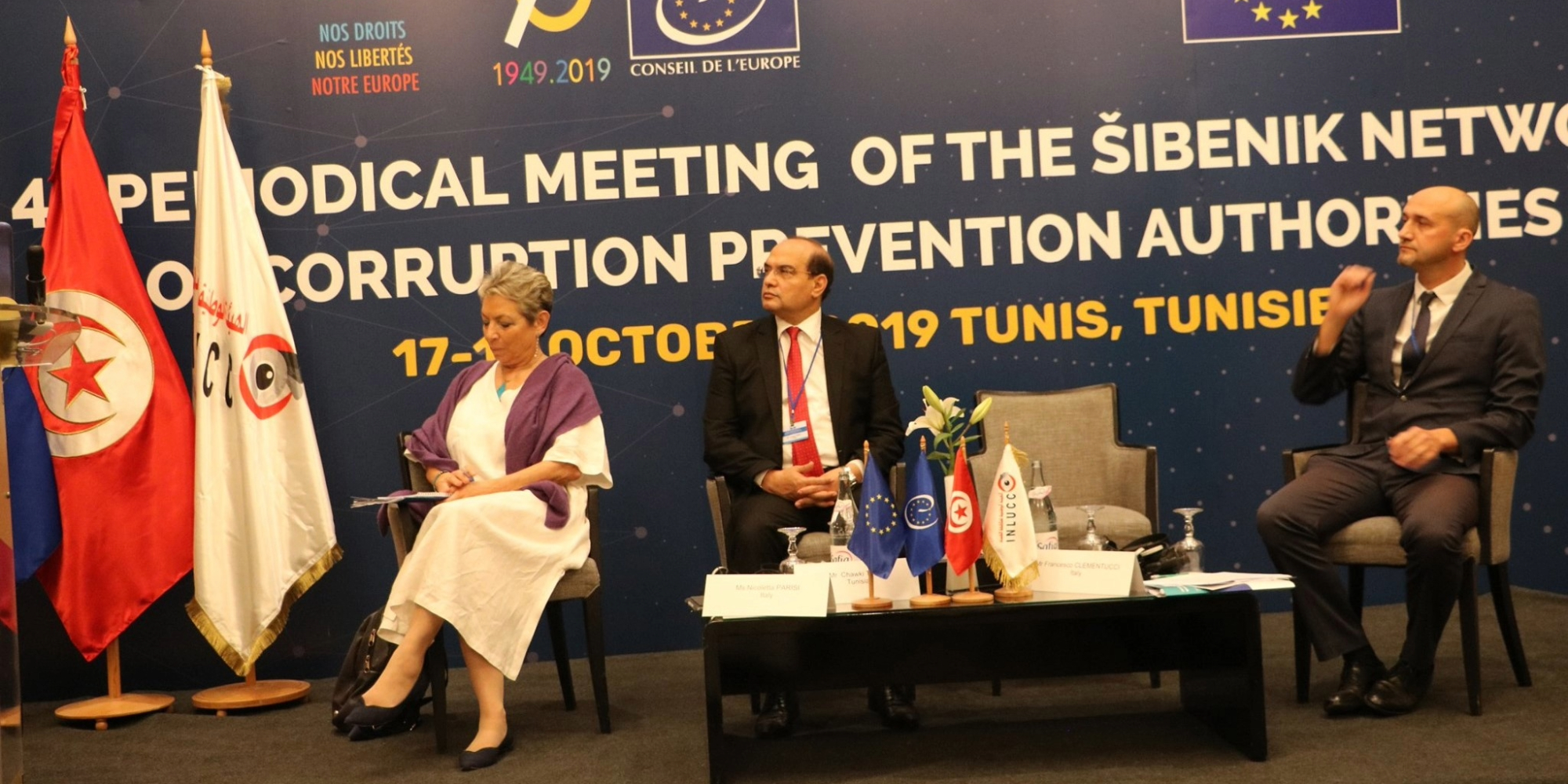
The INLUCC was not the only body targeted by Kais Saied in his crusade against intermediary structures. In December 2023, the government’s secretary general addressed the HAICA and announced, without prior notice, the freezing of its members’ salaries beginning January 2024, effectively freezing the activities of its council.
Hichem Snoussi recalls this event:
When the role of the HAICA was removed, some explained this decision by Kais Saied’s rejection of intermediary structures. But the real reason is the HAICA council’s refusal to sign an agreement with the Independent High Elections Authority for the 2022 elections. The HAICA deemed that the elections organization as proposed did not respond to the criteria of transparency and freedom of expression.
The HAICA council addressed a letter to the President in which it made clear its position concerning the electoral process and its misgivings about the gains of the revolution, particularly the freedom of expression. In the letter, it affirms its positions on the past decade and the negligence of political parties, while defending the positive aspects of the revolution, including the freedom of expression.
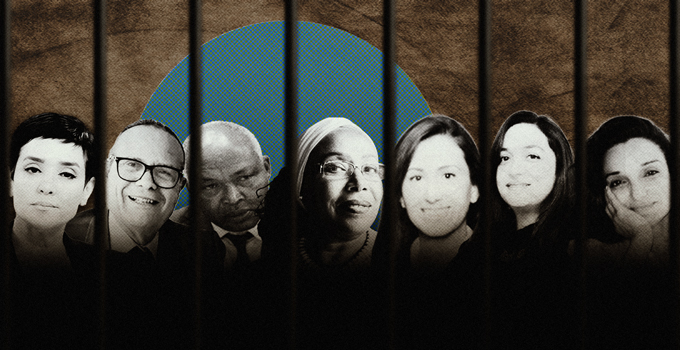
Snoussi adds that analyzing Saied’s discourse, which is fundamentally hostile to intermediary structures, reveals the President’s will to take control of all state authorities and establish an authoritarian regime. Prisons full of political opponents and the exclusion of indomitable journalists from the scene are proof.
In an interview with Nawaat in 2024, the late Chawki Gaddes, former president of the National Authority for the Protection of Personal Data, stated that the President had affirmed that independent bodies were “destroying the state from within.”
The President seemed truly convinced that these authorities—as well as other intermediary structures, particularly human rights organizations—constituted a threat to his power. In 2024, he launched intense attacks against most of them.
On May 7, president of the Tunisian Refugees Council Mustapha Jammali and the organization’s project manager Abderrazak Krimi were arrested. As a result, the organization—which assisted the UN High Commissioner for Refugees (HCR) in its humanitarian missions—closed its doors. This campaign of arrests led to the suspension of activities of organizations active in migration even as Tunisia praised them in its official responses to international interrogations.

On May 21, 2024, Adnen Lassoued was relieved of his temporary position at the Access to Information Authority. He had headed this structure since February 2020 as deputy to Imed Hazgui, its former president who was appointed to the position of National Defense Minister.
Nearly a month later, Hafsia Ardhaoui was dismissed from her position at the head of the National Authority for the Protection of Personal Data. Both authorities were considered frozen due to these vacant positions. This freeze took effect one year later when authorities decided to suspend the activities of the National Authority for Access to Information and to close its headquarters.
President Saied has concentrated all state power in his hands, thus contradicting speeches in which he repeated, “it is the people who decides.” His approach entails disdain for all intermediary structures and their gradual removal by any means available.
Without intermediary structures, government faces failure
On the evening of August 11, the President made his way onto the Avenue de la Liberté in Tunis where he visited the headquarters of the Consumer Protection Organization. There he announced that the latter would become the headquarters of the High Council for Education. The following morning, the organization’s sign had disappeared from the front of the building.
Saied’s visit carried two messages. The first: the government took over the headquarters of an intermediary structure. The second: it took over the role of this organization to protect consumers. This same position was iterated in a statement published by the Interior Ministry on September 6 announcing that police brigades had carried out campaigns for price control and against speculation. The statement affirmed that “the Tunisian state will continue to assume its responsibilities in protecting consumer rights.”
Saied’s disdain for intermediary structures is not arbitrary. The exclusion of independent organisms, political parties, associations, unions and the media has only one explanation: to take over all the roles that these organisms play. And yet these same structures sometimes provide support to the government, especially when it comes to pressing issues like migration.

Since the infamous speech in February 2023 when Saied lashed out at undocumented migrants, a crisis unfolded in the government’s management of migration issues relating to undocumented migrants and asylum seekers.
In July of the same year, government policies became clear as campaigns were launched to expel migrants and asylum seekers to Tunisia’s borders with Libya and Algeria, and to force others to remain in Olive groves in the region of Sfax.
In mid-2024, many observers began to warn that migrants, and asylum seekers in particular, were facing a serious humanitarian crisis.
The situation intensified after collective attacks were waged against a number of organizations working on migration issues, notably the Tunisian Council for Refugees which publicly supported HCR missions by receiving asylum seekers. Since the suspension of its activities, asylum seekers in Tunisia have been left to their own devices, since their asylum seeker cards are no longer renewed.
The government has failed in its response to a number of other issues as well. For over four years, dialogue with the Tunisian General Labor Union (UGTT) has been broken, extinguishing the social dialogue. Kais Saied wanted to show that he could respond to workers’ demands without mediation. For example, he announced a ban against subcontracting. After several months, however, the result was disastrous: hundreds of workers were dismissed without their situation being regularized.
As Hichem Snoussi explained to Nawaat:
The problem is that the current regime has no idea what it would look like to have a government without intermediaries—organizations, unions, political parties and independent authorities. This is particularly true in sectors like the media.
Since the HAICA Council’s activities were frozen, the media sector has fallen prey to an unprecedented crisis. Official discourse has completely taken over public media, while other platforms, both private and independent, face increasingly intense pressure. Journalists no longer have access to official information, enabling the official version—diffused exclusively on the Facebook pages of the Office of the President and other government structures and ministries—to be the only version relayed by the media.
In less than five years, Saied has managed to push out all actors capable of playing a role in the elaboration of a vision or building an image of the government. Having taken over the roles of the judiciary and legislative authorities, he has set his gaze on the remaining organizations and unions which could still challenge his discourse.
In reality, he has had no trouble in silencing voices unwilling to confront authoritarianism and despotism. The majority have preferred to bend to the government’s will or to keep in step in the hopes of better days to come. Even the legions of experts and opinion leaders from civil society who stood in the spotlight after 2011 generally avoid expressing themselves on respectable media platforms for fear of being denounced and placed on the list of undesirables.
Taking advantage of this general abdication, Saied has traced the outline of what he calls “construction by the base,” with the guiding principle of broad participation by a population who favors the government, without any intermediary. In fact, Saied has remained loyal to one principle alone which he has applied without fault: the elimination of intermediary structures. In the meantime, he has ignored the very principle which brought him to power: enabling the people to participate in exercising power.

iThere are no comments
Add yours