Attacks on the headquarters of the Tunisian General Labor Union (UGTT) by pro-government militia failed to bear their intended effect. Ever since, the government has attempted to isolate the organization, circumventing the issue of wage increases and blocking mediation and negotiations at every level. Beyond this, it has placed pressure on employers’ representatives to end negotiations for wage increases in the private sector.
The UGTT has responded by announcing a general strike to be held on January 21, 2026, as it continues the complex preparations for its special congress.
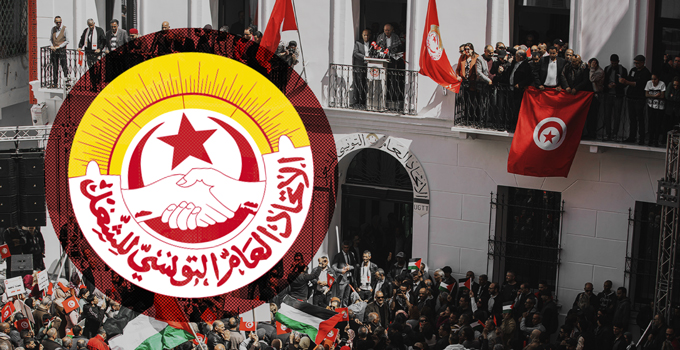
Following the power grab on July 25, 2021, Kais Saied avoided simultaneously entering into battle with different political, union and civil society actors. Instead, he chose to attack each one separately in order to prevent them from banding together and acting in concert. The judiciary and its members were the first victims of a process of concentration of power into the hands of one individual. After a well-executed smear campaign, dozens of magistrates whose allegiance was called into question were dismissed. Judicial institutions did not benefit from significant support among other civil society actors who believed they might avoid such abuses if they maintained their distance from the Ennahdha movement and its allies. As weeks passed, acts of political injustice multiplied and any form of political opposition became associated with a conspiracy to undermine national security. Next, the regime set out against other intermediary structures, especially those which continued to resist authoritarianism and its representatives. At the top of this list was the UGTT, whose historical significance as well as its geographic and demographic influence constituted the greatest threat to President Saied’s absolute power.
Testing the water, buying time
The President’s attempts to destabilize Tunisia’s largest union organization started before the summer of 2025, in the form of harassment campaigns whereby the government used every means possible to weaken the UGTT and tarnish its image. This included the isolation and imprisonment of numerous union members, unilateral negotiations concerning the union’s long-standing demands, and the publication of Decree 20. With this measure, the Union saw the restriction of its right to negotiate and the suspension of union secondment in order to normalize the idea that Tunisia under Kais Saied no longer has any need for union organizations, including the one founded by Farhat Hached. The tone was set with the last unilateral increase of the guaranteed minimum wage followed by retirement pensions, and also with the revision of the Labor Law as well as the suspension of labor sub-contracting. These and other issues should have been addressed alongside the UGTT as a social partner within the context of the National Council for Social Dialogue (yet another victim on the President’s list, whose dissolution took place in the absence of any notable resistance).
The question of wage increases in the public sector and civil service remains one of the most important issues that Saied has tried to extract from the organization’s prerogative. The government is thus expected to approve a wage increase that it wrote into the 2026 Finance Law, under a chapter considered to be politically motivated and directed towards the UGTT. It prescribes a wage increase not exceeding 4% (an absurd precedent, as far as Union leadership is concerned) as well as wage increases in the private sector. In an interview with Nawaat, Union spokesman Sami Tahri notes that “this constitutes a fatal blow to the bargaining policy that has been fundamental to social peace for decades, owing to regular negotiations among the three social partners.”
Despite its importance, the issue of wage increases is only one detail within a broader problem: the President’s decision, following the transport strike from July 30 to August 1, to refuse any negotiations with the UGTT and all of its national and regional structures. Taher Barbari, a member of the union’s executive bureau, also points to the official notifications issued by the General Labor Inspectorate and the Labor Dispute Services to the union leadership, informing it that all negotiation and conciliation sessions have been suspended across all sectors and regions.

It is clear that the so‑called mastermind appointed by those in power to undermine the role of unions in the country tried to exploit the transport strike, given the paralysis it caused and the public discontent it stirred. Which explains why, on August 7, a group of government “thugs” stormed UGTT headquarters demanding the organization’s dissolution. Despite the swell of support for the UGTT that this attack galvanized, Kais Saied did not hesitate to defend the assailants, arguing that their intent had neither been to attack nor break into the Union’s headquarters. But the most alarming part of his speech was his allusion to the opening of investigations concerning the organization and its leadership, in yet another attempt to demonize his adversaries and make them an object of public contempt, essentially accusing them of corruption and treachery.
Eliminate the Union, ban negotiations
The attack waged by regime henchmen on Union headquarters at the Place Mohamed-Ali and at the regional office in Sfax had the opposite effect than that which the government had envisioned. Even opponents of UGTT leadership stood by the organization and refused that Saied reproduce the same methods practiced by the militia of Sayah and Ennahdha to subdue the UGTT. This refusal was manifest in the Union’s strong response: it organized a large demonstration in which its various structures, supporters, sympathizers and a substantial segment of the political class took part. This initiative forced the presidency to switch tactics and play the card of suspending dialogue and collective bargaining with the Union and all of its structures, at every level. It even applied pressure to prevent negotiations with employers’ unions and other independent bodies on wage increases in the private sector, effectively conveying the message that the government would no longer recognize the Union as a representative of workers nor engage with it in any sort of dialogue. The presidency thus ordered central and regional labor inspectorates as well as governors to not hold any meetings with union structures.

According to Taher Mezzi, the UGTT’s assistant secretary general in charge of the private sector, the government’s decision to completely suspend negotiations with union structures through a notification issued by the General Labor Inspectorate was unconstitutional and in violation of international conventions ratified by Tunisia. For Mezzi, who spoke to Nawaat, the violation was not simply administrative, but political in nature, the aim being not only to marginalize the UGTT but in fact to eliminate it and diminish the role of organizations in general. Indeed, the suspension of negotiations and dialogue affects all other organizations that represent social partners and certain sectors, not only the UGTT. Mezzi elaborates:
There are clear messages that the government has sent to the UGTT, beginning with the revision of the Labor Law without consulting the Union as per the regulatory framework that is the National Council for Social Dialogue, which the president himself dissolved. Today, we find ourselves faced with a situation in which labor laws are revised without input from the union most representative of workers. And we are suffering the consequences of this decision and of certain inadequate amendments that the organization can never accept.

Pressure on employer representatives
And so it has been that orders aiming to exclude union structures from negotiations have also affected the private sector, even though the government’s role in this arena is limited to reconciling the views espoused by employers and the workers’ union. It is clear, however, that employer representatives, in particular those defending Tunisian businesses, fear the government’s reaction should they choose to sign agreements with UGTT representatives to increase wages in the private sector. Which is why employer representatives suddenly withdrew following negotiations, some of which had been concluded with the signature of an amendment for increased wages; this was the case in the sectors of insurance, banking and financial institutions.
According to Union sources, negotiations between the banking sector, financial institutions and insurance concluded with an agreement on the amount of the anticipated wage increase. Without any explanation, employer representatives subsequently pulled out of negotiations. As a result, the General Union of Banks, Insurance and Financial Institutions protested against the violation of the right to collective bargaining and carried out a strike on November 3 and 4. No reconciliation meeting was set up as an attempt to cancel or postpone the strike (as is customary) since the president had given the order to ban any negotiations with the Union and all of its structures. This pushed the Union to threaten another strike for three days at the end of December, before the date for the nationwide strike had been fixed.
As Taher Mezzi told Nawaat, a number of independent structures representing employers are ready to disburse wage increases to workers, but are waiting for government approval. “Certain companies have entered into negotiations with us,” he affirms, “but they have asked us not to make this be known for fear of the government’s reaction.”
Government approval is the standard, however…
At the end of April and beginning of May 2025, the Ministry of Social Affairs summoned the UGTT and the UTICA to a bilateral meeting, which was followed by a trilateral meeting during which the UGTT presented its demands concerning wage increase negotiations for the private sector. The International Labor Organization (OIT) also held a meeting around the same time, from June 4-14. During the course of this meeting, the Ministry of Social Affairs urged that the representatives of both organizations resume negotiations, and conclude them, as quickly as possible. After returning to Tunisia, however, contact was broken between the Ministry and the UGTT on the one hand, and the UTICA and the UGTT on the other. This pushed the UGTT to address a letter to the Ministry on June 23, followed by another on July 23, demanding the continuation of negotiations. The organization has yet to receive a response.
According to Mezzi,
I cannot speak on behalf of the UTICA, but what I can confirm is that the UTICA now refuses to negotiate with the UGTT. In compliance with international agreements, it is absolutely legal for the Union to engage in bilateral negotiations with the private sector, despite the government’s refusal, and to reach a general agreement on the percentage of a wage increase, as was the case for the increases which took place in 2022, 2023 and 2024. This time, the agreement framework on wage increases in the private sector was only signed by the UGTT and UTICA, despite the government’s refusal to sign and to be there with us, or to organize negotiation sessions at the office of the Ministry of Social Affairs, and to sign at the presidential office, as is customary. If the UTICA intended to negotiate, it would have done so.
What Mezzi recounts is similar to what took place in Sfax following the strike on November 18 involving 68 companies who refused to negotiate. Work carried on as usual in private companies that had granted wage increases to employees and were thus excluded from the strike. The same rule will apply during the general strike in the private sector set for January 21, 2026.
Formulating a response strategy
Confronted with such hostility, the UGTT had to respond. In the beginning of the third week of October, the organization decided to relaunch a mobilization in anticipation of the general strike. On Tuesday, October 14, the Union’s executive bureau met to discuss the suspension of negotiations, the violation of the right to organize, and a response strategy. All UGTT structures concerned by the implementation of a general strike met successively, beginning with all members of the executive bureau, the Sectors Council and the private sector conference, followed by the union leaders’ conferences and finally the National Administrative Commission (CAN) which set the date for the general strike: January 21, to be preceded by worker rallies to mobilize and prepare.
Clearly, the implementation of a general strike more than 14 months after the initial decision was made—in the context of an unprecedented attack on intermediary structures and the broadening spectrum of political prisoners—is not a choice, but indeed the only path forward for the UGTT. It is also clear that Kais Saied, who has yet to digest a simple sector-specific strike, will not just stand by and watch as a nationwide general strike takes place across sectors. There are likely to be some plot twists in the months to come, especially in the form of attempts to abort the general strike and fuel public opinion against this initiative. The government’s scornful reaction to the Union’s strike on June 16, 2022 is a telling precedent, as depicted in an unlikely photo published by the Office of the President in an official statement the morning of the event. The image shows the Council of Ministers and its president, Najla Bouden, their faces alight with laughter.

However, times have changed, and the era when authorities ridiculed union movements is no more. Kais Saied’s apparent exasperation following his meeting with the European Union’s ambassador to Tunisia, Taboubi and Ben Kaddour at the UGTT headquarters is proof. Whereas the President did not appear so troubled following his meeting with the same ambassador and a UTICA delegation, only 48 hours before he stopped to meet with UGTT leadership. Evidently, sitting around the table with a foreigner and those who have pledged allegiance to the government is not the same as sitting around the table with the same foreigner and those who oppose the government.
How the strike saved the special congress
Beyond its tense relations with the government, the UGTT also suffers from internal conflicts, especially concerning the date of the extraordinary general congress, to be held in Tunis on March 25-27, 2026. The conference holds an important place in debates due to pressure from certain members of the Administrative Council (supporters of the “group of four”) to move the date forward. Another point of contention relates to the succession of Monem Amira, formerly in charge of the administration and finance department, and the appointment of Slaheddine Selmi to take his place. A choice so strongly opposed by several out of the ten members (who prefer Mohsen Yousfi) that they have threatened to resign.

This controversy pushed the Administrative Commission, which met on December 5, to prolong its work for two days as a result of altercations, discord and threats. Some went so far as to threaten to not take part in the general strike, which led certain members of the Union’s leadership to take leave of the discussion, flip-flop, and threaten to resign. Fortunately for the organization, all of these divergences were smoothed out with an agreement on the date for the general strike—January 21—and a collective commitment to making it a successful mobilization. It was also decided that the Administrative Council should hold a meeting as soon as possible in order to continue the debate around preparations for the general congress. Those who are familiar with the Union know that it is the battle of the delegations which will determine the orientation of the long-awaited special congress. There will be some 630 delegations whose selections began with a series of conferences held by base, regional and sectorial unions. This question is at the center of the conflict which divides the two sides at odds within the organization, and their supporters in the sectors and regions who play a decisive role in the designation of delegates. This is because they supervise the submission of candidates’ applications as well as base union conferences. The conflict recently escalated during the conference held by the base union for the Tunisian National Oil and Gas Company (ETAP), which was postponed due to clashes requiring police intervention.
2026 promises to be a decisive year for the UGTT, whose place, image and very existence are hanging in the balance. The Union is pouring everything it has into its nationwide general strike and special congress to be held during the first trimester. Over the coming year, the organization’s challenge is twofold: it must, on the one hand, respond to those who call out the absence of internal democracy, and, on the other, resist the government’s efforts to blot it out of Tunisia’s political landscape. 2026 promises to be a year of resistance and the Union’s struggle to reaffirm its role as the crucible of society’s dynamic forces—or else to abandon this role indefinitely to the benefit of other organizations that have become the refuge for democratic forces as the Union continues to tread water.

This is a very thorough analysis of the ongoing tensions between Kais Saied’s government and the UGTT, highlighting not just political maneuvers but the deep implications for labor rights, civil society, and Tunisia’s socio-economic stability. The stakes of the January 21, 2026 general strike are immense, especially given the government’s repeated attempts to marginalize unions, control wage negotiations, and undermine the National Council for Social Dialogue. For those following the intersection of labor movements, union democracy, and authoritarian governance, keeping track of how these developments unfold will be critical.