Following the revolution of 2011, Tunisia seemed to turn a new page in the history of its media sector. However, with the power grab on July 25, 2021, this evolution began to regress: opposition voices were marginalized, the notion of public information service began to dissipate, private media organizations pledged allegiance to the ruling power and repression stifled associative, independent platforms. Grim though it may be, this landscape has also produced a force of fierce internal resistance that is confronting the ruling power’s mediocrity and propaganda.
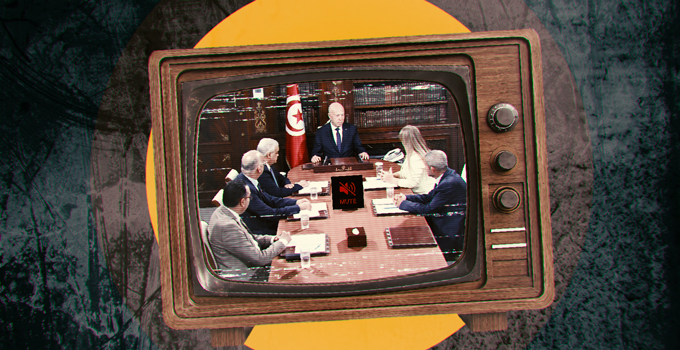
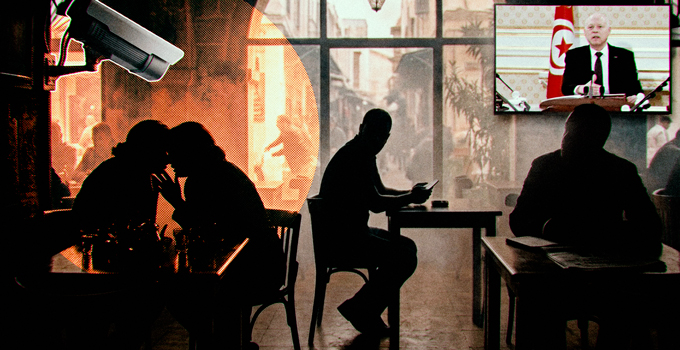
On August 3, 2026 at the Palace of Carthage, Kais Saied received the heads of several “public information service” agencies: Télévision tunisienne, Radio tunisienne, Agence Tunis Afrique Presse (TAP), SNIP-LA Presse and Dar Assabah. During the course of this meeting, the President urged the national media to be a “free voice” of “intrepid speech,” to produce responsible coverage founded on truth and serving “the country’s best interest.” At first glance, the president’s exhortations appear to defend an intrepid and independent press. And yet words do not suffice to decipher policies. We must know the author’s true convictions, the quality of his audience, the party or parties which hold the power to appoint, to influence and to finance, and, above all, to know the limitations around expression before the mic is even on.
When the President calls upon the heads of the public media sector in order to dictate what the press should be, one is left wondering whether it is possible to imagine a free press within the context of an institutional relationship in which the head of the executive authority is the direct interlocutor. Freedom is not measured by what is said inside the Palace of Carthage, but by what a journalist dares to ask outside of it. Freedom is not measured by an exhortation for “intrepid speech,” but by the capacity of this speech to call out the government and refute its discourse without inviting lawsuits, political trials or professional pressures.

This meeting with the heads of public media agencies took place several days after the Tunisian Foreign Affairs Ministry in France protested the diffusion by the station France 24 of an interview with former president Moncef Marzouki. The Ministry saw this interview as an insult to state sovereignty and a threat to national security and the country’s institutions. Beyond Marzouki’s political line or the content of his discourse, the incident shed light on a paradox that is impossible to mask behind official rhetoric on sovereignty and ethics. Whereas the government (in rhetoric formulated for internal consumption) praises a “free” national press, it affirms its outrage (in rhetoric formulated for external consumption) when a foreign media agency provides a platform for an opposition voice or political adversary. However, a ruling power with confidence in its own legitimacy responds to ideas with ideas, to facts with facts, and to criticism with achievements and programs—not by bringing home its overseas ambassadors or censoring platforms that relay divergent opinions.
The question here is not why a Tunisian opposition figure would express himself on a foreign station, but why some Tunisians can no longer find a space to express themselves in their own country. And why foreign media are considered a threat by Tunisia’s ruling power, when they provide a platform for a dissident voice, at the precise moment when national media have been called upon to constitute a “free voice” without anyone knowing: free from whom, at what price, and to what extent?
A MONOLITHIC PRESS, OR MEDIA DESERT
After 2011, Tunisia seemed to turn to a new chapter in the history of its media sector. The landscape was by no means ideal and the media were not innocent of abuses, hidden funding sources and disorganization. However, after decades throughout which the media operated under the government’s thumb, pluralism constituted a historical feat. For the first time, Tunisians could hear—on the same station—politicians of different loyalties, human rights activists, experts in various areas, government officials, political opponents and citizens debating issues that were once confined to decision-making circles. After July 25, 2021, this dynamic was gradually diminished. The result was a reshuffling of leadership across the public media sector, the decreased presence of dissident voices, and restrictions on access to information. Beyond this, journalists began to face legal harassment, the economic vulnerability of privately-operated media platforms was exploited, as systematic repression aimed to weaken independent media organizations capable of upholding the rules of pluralism. The mode of operation adopted by the government of Kais Saied was modern authoritarianism. It isn’t always necessary to shut down a newspaper or turn off a camera; instead, work conditions can be reconfigured so that independence becomes costly, criticism risky, and journalism an exercise in practicing caution.
All of this has not defeated the press. However, it has resulted in an abundance of media outlets whose capacity to spark real debate has continued to erode. Here is where we find the meaning of what is known as a “media desert”: studios remain open and programming continues, however, the notion of difference comes to mean the continuous rehashing of the same discourse. In this context, censorship no longer needs a department in charge of monitoring all content, because the institution itself produces journalists who know from the outset what is off-limits.
PUBLIC MEDIA: A PUBLIC SERVICE TURNED MOUTHPIECE FOR THE GOVERNMENT
A key question was raised in the wake of the revolution: to whom do the public media belong? To the government, which appoints its leadership, or to society, which funds it? The difference between state media and public media is not in a simple terminological nuance, since the state sees this institution as an instrument to serve the political power. However, the public media are a fundamentally social service which guarantees citizens their right to information, reflects the diversity of society and monitors decision-makers. Citizens do not pay taxes in order to finance the government’s public relations department, but to finance an institution whose mission is to inform them what is taking place, including what the government does not wish to show.
Over the course of recent years, the role of Tunisia’s public media has significantly regressed. The issue is not only information content, but in the order of priorities, the quality of questions asked, the choice of interlocutors and time allotted to official discourse in comparison with the time designated for other voices. When an official is presented as the only source of truth, when investigative reporting is replaced by the reading of a formal statement, when the citizen appears as no more than a fleeting figure in a segment on an official visit, public media have lost their original function, even if they have not received a single direct instruction.
The worst fate to befall public media is not their transformation into a tool for propaganda, since propaganda, once identified, can be unmasked and fought. The worst fate for public media is the loss, over time, of their ability to represent society without admitting it: journalists learn to formulate questions that do not ruffle feathers, producers learn to pick guest speakers who are unlikely to keep any surprises hidden up their sleeves, and viewers learn to see as normal the absence of certain voices… As opposed to something imposed from the outside, censorship thus becomes an internal practice.
Here is where the concept of the public space assumes its full meaning. Democracy not only relies on official institutions, but demands a space where society can discuss its concerns, evaluate the pertinence of its arguments and forge a public opinion capable of influencing the course of events. When the role of the media is transformed into that of a mere transmission belt for official discourse, citizens are no longer political actors, and become passive receivers. Public opinion is reduced to a sum of impressions shaped by titles and formal statements instead of debates and facts.
The situation is still more dire when we apply the notion of symbolic violence as formulated by Pierre Bourdieu. Exclusion does not necessarily occur when a person is prevented from expressing him- or herself; it suffices to present them from the outset as suspicious, unpatriotic or undeserving of being heard. And when certain voices disappear from the platform, the public does not always notice the exclusion, but gradually perceives their absence as normal. This analysis corroborates Gramsci’s read on how our perception of power becomes self-evident and indisputable “common sense.” The latter does not need to silence different voices, but only to make one voice more present and widespread to the degree that it appears to be the only truth.
PRIVATE MEDIA: THE ECONOMIC BALL AND CHAIN
Although the public media have lost much of their independence on account of their political and administrative dependency, the private media have been unsuccessful in filling in the gap. Not because the pluralism which emerged after 2011 was illusory, but because this quantitative plurality depended upon an extremely fragile economy and opaque ownership structure. TV channels, radio stations, and online news platforms opened new doors, hosted political adversaries, experts, human rights activists and citizens, and integrated authentic debate into the public arena. However, an abundance of platforms does not necessarily reflect a plurality of voices, just as an abundance of programs does not necessarily reflect a diversity of themes and issues covered. A study by Media Ownership Monitor (MOM) on Tunisia, carried out by Reporters Without Borders and the association Al-Khatt, reveals that six television stations out of the ten cited are affiliated with public figures or political parties. The authors of the study report that data relating to ownership, financing and ratings are incomplete or impossible to verify. At first glance, this observation conveys the image of a broad and diversified media market. But the truth is that the levers of the media market are concentrated in the hands of owners, advertisers and interest groups, whose ties are largely unknown to the public.
That a media outlet defends a particular editorial identity or clear-cut position is not the problem. Absolute neutrality is a myth, and each choice of theme, guest speaker or title presumes a particular angle or point of view. However, the editorial line becomes propaganda when the media decide to renounce the verification of facts, equity and the distinction between information and commentary, and when sponsors can redefine editorial priorities without appearing in the text or on the screen. A media outlet which depends upon a single advertiser, a single owner with political interests or commercial privileges connected to the ruling power does not need to receive direct orders to practice self-censorship or to attack political adversaries in the name of “national interest.” It is enough for the outlet to ascertain that a report on the public market, a web of influence or a case of financial corruption threatens its source of revenue for fear to become an invisible member of the editorial team.
And here is the difference between editorial independence and the fact of possessing a private license. Private ownership does not automatically mean independence from the ruling power. An institution in which the state is not a shareholder can maintain close ties with decision-making circles through commercial interests, personal relations or publicity. A Media Ownership Monitor report indicates that the difficulties in accessing financial information prevents the public from knowing who funds the media, who can influence editorial lines and who shoulders the losses when the advertising market stagnates. In this context, the private media are exposed to a form of “soft appropriation”: the authorities do not suspend news coverage or shut down the station through an official decision; instead, they expose the media outlet to unstable funding and repeated legal threats. This is where fear bears its effect, and the question changes from “Has the government censored certain information?” to “How many outlets can afford to publish that information?”
The vulnerability of this model is exacerbated when the advertising market itself is weak, concentrated and opaque. On this topic, a study on media funding and the strategies of advertising companies in Tunisia highlights that Tunisian media depend significantly on ad revenues, while advertising expenses are declining and competition is increasing among TV stations, radio stations and online platforms. In the meantime, the criteria for audience ratings remain subject to controversy. In this case, advertisers are not only buying space for advertising, but acquiring—directly or indirectly—the capacity to influence the environment in which journalists function. They might not ask the outlet to remove a report, but can postpone ad breaks, give them to a competitor or threaten to end their contract. The simple threat of such recourse is enough to persuade an editor-in-chief to revise programming. When advertising is poorly regulated and lacks transparency, it shifts from its function as a source of funding to become a tool for control. Especially when the press company is burdened by debt or incapable of ensuring stable contracts for its employees.
This allows us to better understand why some private stations have transformed into bazaars in which ads for utensils, home appliances, perfume or beauty products last for hours on end. However, such “casserole dish marketing,” as it were, is not to be taken lightly. Underlying this telemarketing bazaar is a deeper economic and professional issue. When a station that is supposed to diffuse information, analyses and debates becomes a platform for selling kitchen items, it is not so much the public’s taste or the mediocrity of content that is cause for concern but the vacuity of the economic model that is supposed to fund the press without stifling it. In the present scenario, the station is not only selling kitchen items, but its air time, space and the public’s right to accessing information, and not telemarketing.
It is nevertheless important to distinguish the explanation of a phenomenon from its justification. A press company has the right to search for resources in order to ensure its survival. We cannot require a station burdened by debt to produce expensive reports or cultural and political programming. However, this right does not authorize violation of the law or justify dissolving the boundaries between advertising and journalistic content. Along these lines, the HAICA’s rules governing the length of ads and telemarketing programs were not a regulatory indulgence, but an attempt to protect viewers from confusion between commercial content and media content. It was also a way to prevent the station from becoming a simple go-between functioning to rent out air time. But when the regulatory authority fails in its role or its activities are frozen, commercial interests often gain the upper hand—to the detriment of the editorial aspect. Ultimately, this weakens the audience’s capacity to distinguish between information and advertising, between journalistic work and commercial marketing.
The worst thing about this “economy of terror” is that it does not result in total silence, but gives rise to media that chit chat without ever diving into the heart of issues. The cameras turn and programming continues, but subjects relating to politics, rights and freedoms, the authoritarian practices of the ruling power, conflicts of interest and administrative corruption are pushed into the background to the benefit of themes that are less costly and more profitable. In this context, the government does not need to control the media. It suffices to make independence costly and submission profitable, and to bring editorial teams to believe that in order to survive, they must be less honest and more docile.
At this stage, the screen turns from a space where ideas are debated into a platform where those who give voice to their ideas are, so to speak, on trial. The dissident politician becomes an “enemy,” the activist a “suspect,” and the journalist who asks a disturbing question a “disruptive element.” Whereas allegiance to the ruling power is presented as the standard of patriotism. Instead of explaining the stakes of political conflict, the media give lessons, raising some to the rank of “good patriots” while demoting others—already censored—to the category of traitors.
This mechanism is worse than an open campaign because it hides behind the eternal slogan of the general interest. When a private media company asserts that it defends the state, one wonders to which state it is referring. The state in terms of institutions, laws and citizens, or the ruling power in terms of its people and policies? And when it justifies the exclusion of a voice in the name of “stability,” we must ask the question: is stability the result of the absence of criticism, or of institutions’ capacity to take criticism?

A state does not ensure its stability by concealing differences, but by managing them transparently. The media do not serve society by avoiding tension, but by subjecting it to debate instead of allowing it to build up in the public space or on social media.
Which is why defending the private media today must not be limited to the idea of opposing the closure of stations or the prosecution of journalists. Instead, we must reform the economic model upon which the press depends: transparency in ownership and funding, the publication of financial information, the regulation of public advertising, the development of fair mechanisms for audiences and, finally, the establishment of funding models that do not render journalists hostage to advertisers, sponsors or the ruling power. But when selling casserole dishes becomes the easiest solution for ensuring a television station’s longevity, we must call out the economic and political system that makes truth seeking less profitable than the sale of kitchen items.
Featuring symbolic figures such as Zied Dabbar, president of the National Syndicate of Tunisian Journalists, Alain Gresh, founder of Orient XXI and the editor-in-chief of 7iber, Lina Ejeilat, the debate explored challenges confronted by the independent media in a context of constant change, and in which, more than ever, journalistic values are being put to the test. The debate also shined light on crucial questions such as Western media’s coverage of the genocide in Gaza and the complexity of media and politics in the MENA region.
ARSENAL OF TERROR: DECREE 54 and ARTICLE 86
The past few years have shown that the crisis endured by the private media is not only due to the quality of programming or competition between stations, but also to relations between journalists and the judiciary. A journalist who publishes a post on his personal account risks winding up in court. The accusation can shift over the course of legal proceedings, and questions on information can become an interrogation on political affiliation. This does not mean that the press is above the law or that anything a journalist publishes is true. The victim maintains the right to reply, to seek reparations and even to press charges. Just like intentional defamation, hate speech and the disclosure of confidential information constitute violations in all judicial systems. However, democratic standards are not limited to the simple existence of a legislative text, but demand its quality: clarity, relevance, the proportionality of punishments and the impact of its application on the general interest.
When Decree 54 was promulgated in September 2022, it was presented as a text that aimed to fight crimes relating to information and communication systems. However, the official text did not restrict its effects to acts of piracy, fraud and technical attacks. Indeed, article 24 of the Decree broadened the playing field by criminalizing the diffusion of “information, rumors or misleading statements” that could harm others, public security or national defense, with a heavier sentence for cases involving civil servants. The International Commission of Jurists (ICJ) warned that the text’s ambiguous wording enabled its use against independent voices on grounds of fighting cybercrime. The association Article 19 pointed out that notions such as “harm,” “damage” and “false information” are ambiguous for journalists, since such terms do not enable journalists to know what is authorized before they set to work on an investigation.
Here we find the perfect illustration of the judicial/political paradox. Investigative journalism inherently operates within the context of what could be called the “incomplete truth,” or “the other version of the facts”: it is permissible to publish part of the truth before all elements have been assembled, and to base reporting on a confidential source that remains anonymous. This kind of journalism can also reveal a contradiction between two official documents, or present a hypothesis that evolves into a judgement only after a period of several months. And yet the criminal code treats the result as if it were established from the time of publication, and gives the party which considers itself to be the victim of wrongdoing the possibility of reframing the debate, so that the initial question, “Is the information accurate?” becomes “Did the journalist commit an offense?” In this case, not only is the journalist expected to provide proof to support what she published, but to anticipate how each word might be interpreted by the prosecutor, security services or government official. Clearly, such conditions render it impossible for a journalist to accomplish pertinent, independent reporting.
The price to pay is even greater when an investigation concerns a public institution, senior official or security-related issue. In this case, the high-ranking civil servant has the right to reply, an official platform as well as legal and media power. A journalist, on the other hand, often has nothing more than his notebook and a source whose identity he is afraid to expose. Recourse to Decree 54 carries this reversal of roles through to the courts, where the power-holding official determines the judgement and the journalist is expected to prove his innocence. From early on the Committee for the Protection of Journalists warned against the use of Decree 54 against journalists and other commentators. Reporters Without Borders (RSF) concluded that the text deviates from its original objective by criminalizing journalism and restricting access to information.
That said, the impact upon the sources is even more profound. This is because behind an investigation, there is not only the journalist, but an entire network of actors, informants, experts, documents and financial resources. The greater the legal risk, the more likely the source is to remain silent. Not because the information is not important, but because sharing it can mean the confiscation of one’s phone, the arrest of family members or colleagues and the disclosure of private communications as a simple administrative dispute becomes a national security threat. Which is why the protection guaranteed journalistic sources under Decree 115 becomes broken down when journalists practice within a legal environment that allows the broadening of digital criminalization and the confiscation of journalists’ work tools. Protecting the source does not only entail ensuring that the journalist does not reveal an individual’s identity, but also ensuring that communication channels, documents and descriptive data do not become a means of pressure on either the source or the journalist.
In this light, Decree 54 not only has an impact to bear on reports that have already been published, but also prevents the realization of planned investigations. For a journalist who sets out to investigate a case relating to public markets, a suspicion of conflict of interest or of irregularities within a public entity can influence the decision to backpedal before a source is even contacted. The journalist might limit herself to publishing general information, replacing a document with an official statement, or even opting for less sensitive subject matter. Under pressure of Decree 54, investigative journalism is reduced to managing risks as opposed to exposing them.
The true conflict is not between a press agency which seeks to avoid its responsibilities and a ruling power which aims to protect society, but between two models of control. In the democratic model, investigation is subject to confrontation: by the right to reply, written proof, rectification or reasonable legal recourse. Incarceration remains an exception that is not applied as punishment for press-related offenses or political criticism. In the model inspired by Decree 54, however, arrests begin in police stations and courts, with the risk of imprisonment before all possibilities of rectification and debate have been exhausted. Far from constituting a superficial cosmetic improvement, a revision of Decree 54 or the abrogation of its controversial provisions is indispensable to the reestablishment of the function of investigative journalism. Without this vital step, investigative journalism can no longer serve as a tool to fight corruption, or to protect public resources, or to guarantee citizens’ right to hear a version of the facts that is different from the one presented by authorities.
Unfortunately, Decree 54 is not the only problem. Other criminal texts, both old and new, are applied in cases relating to freedom of expression. Article 86 of the Telecommunications Code, for instance, “punishes” any person who deliberately harms others through social media. The issue here is not in the intent to protect individuals from harm, but in the fact that the notions of “harm,” “damage,” and “false information” are open to interpretation, especially when the injured party is a government official or public institution. An official can react through a statement, press conference or by presenting documents that refute what was published in his her regard. An official should not automatically enjoy greater criminal protection than does a citizen who has no other means of defending himself than by publishing a message or filing a complaint.
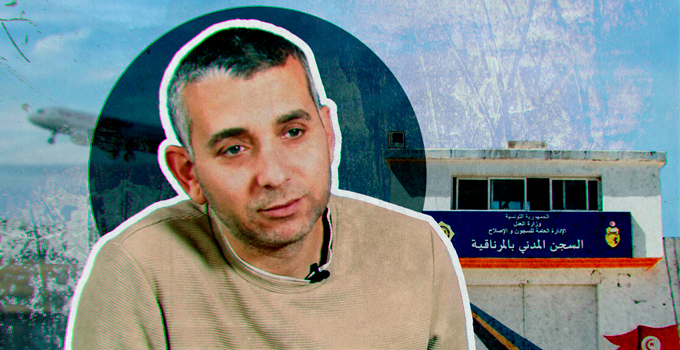
The case of journalist Haythem Mekki is an apt illustration of how information addressed within a journalistic context can be pulled into a criminal one. In January 2024, Mekki was summoned following a complaint filed by the Habib Bourguiba university hospital in Sfax. The hospital reproached Mekki for an article he had written evoking the situation of the morgue which, according to him, was operating beyond its capacity. Above all, the institution took issue with Mekki’s reporting on the storage conditions for the remains of undocumented migrants. Charges were brought against the journalist on the basis of Article 24 of Decree 54. In December 2024, the court of first instance decided to dismiss the case, a decision subsequently appealed by the public prosecutor. On July 15, 2026, the Court of Appeals of Sfax sentenced Mekki to one year in prison under Article 86 of the Telecommunications Code for “harming others through public communication networks.”
Imprisonment is not the only consequence of a lawsuit. This fact allows us to observe the function of the law as a deterrent. Beyond prison sentences, there are also arrests, searches, the confiscation of devices, the costs associated with hiring a lawyer and lengthy waiting periods, not to mention the damage caused to one’s reputation. Which is why lawsuits can come to an end before a verdict is even pronounced. Once a journalist begins to sense that an article on a hospital, ministry or security department could land him before the Brigade Against Cybercrimes, he may very well change his course of action. In this scenario, the law serves not only to issue a sanction after the fact, but also to command silence.
ALTERNATIVE MEDIA: LAST BASTIONS OF FREEDOM…AND THE MOST VULNERABLE
Despite the drastic shrinking of public spaces, platforms such as Nawaat, Inkyfada, Legal Agenda, Alqatiba and others continue to assume the function abandoned by other media: opening up cases that have been locked down by official statements, investigating cash flows and decision-making processes, publishing documents and demanding accountability from officials, all from outside the framework that the government has imposed upon the public media. The editorial teams behind these pockets of resistance within the media landscape are working in a highly sensitive context, with editorial independence demanded by the public and sponsors, legal and financial compliance determined by the administration, sources fearful of being exposed, and a ruling power that regards investigative journalism not as a common benefit, but as competition for a monopoly over the truth and accepted narrative.

The vulnerability of alternative media platforms runs deeper than a lack of publicity or limited human resources. An outlet which funds its investigations through grants or temporary partnerships and which pays journalists who work in precarious conditions is exposed to complex pressures that range from fiscal audits to legal challenges.
When the administration freezes funds, blocks the renewal of a document or opens a long financial investigation, it is not sanctioning one publication in particular, but destabilizing the entire journalistic production process: a media outlet’s investigative report is delayed, relations with its information sources suffer, and doubts arise among sponsors, pushing journalists to calculate the cost of each investigative report before delving in to work. Repression operates according to a strategy of attrition as opposed to one of direct censorship. Targeted media outlets are not directly blocked from working, but rather led to believe that independent writing has become so costly that it threatens the organization’s survival in the long-run.
The suspension of the activities of Nawaat’s journalists on October 31, 2025 offers a prime example of this sort of pressure. The association received notification of the month-long suspension of its activities on the basis of Decree 88. Nawaat was informed of the decision in unusual procedural circumstances, after one year of administrative and financial audits. Reporters Without Borders described this administrative suspension as being motivated by a political decision. The Electronic Frontier Foundation observed that the decision did not constitute an isolated case but fell within the context of a broader campaign of fiscal inspections, financial investigations and administrative audits.
Nawaat will not be silenced
31/10/2025
The message relayed is not that any one publication in particular has crossed a red line, but that the media platform which has established its independence outside of official networks can be brought to heel through the very structure upon which it is built: its association, funding, administrative documents and, ultimately, its capacity to pursue its activities.
Nawaat is not the only case in point. The experience of the association Al-Khatt, which edits the site Inkyfada, shows how pressure in the form of a temporary suspension can transform into the threat of legal dissolution. On April 23, 2026, the association indicated that its funds had been frozen on several occasions, sometimes over a seven-month period, and that the activities of Inkyfada had been suspended for one month in October 2025. In January 2026, the association was summoned to appear before the Financial Crimes Brigade of the National Guard, although it affirms that it had provided all documents requested along the way. A series of hearings was scheduled to start on May 11, 2026 to examine the request to dissolve the association Al-Khatt. After suspension, the halting of publication, summons to appear for hearings and the request for dissolution, a lawsuit was opened. The latter did not require an explicit decision to put an end to the work of the editorial team, since it had already been enough to dismantle the legal and financial matrix which ensured the association’s viability. These facts show why pressures exercised upon alternative media cannot be regarded as a simple dispute between the administration and a media platform. Inkyfada, for instance, operates under an association that provides a legal framework, funding and protection that ensures editorial independence.
What we are witnessing is the implementation of a mechanism that could be called “bureaucratic authoritarianism.” The former system of censorship was more clear-cut: authorization to publish, banning, confiscation or arrest. The new form of censorship takes the form of decisions that appear to be justifiable with an administrative context: financial inspections, the request for documents, investigation into funding sources, temporary suspension or legal proceedings aiming to dissolve the association. Isolated, each measure taken can be presented as an application of the law, however, as these measures accumulate, the law becomes an instrument of attrition.
Defending these independent platforms in Tunisia today is not corporatist. It means defending the infrastructure of pluralism in the media. Major press agencies can continue to broadcast even when they lose the freedom of expression, however, platforms working in investigative journalism do not have the luxury of waiting. An article published on the site Arab Reform shows that legal pressure on the media has intensified since the spring of 2024, and online independent platforms have not been spared. This is why a diverse media landscape depends upon the existence of an effective safeguard for legitimate funding, in compliance with transparent regulations, as well as a legal system that does not allow temporary measures to be used as political sanctions in disguise.
SNJT AND PRESS COUNCIL: SELF-REGULATION WITHOUT A DEFENSE MECHANISM
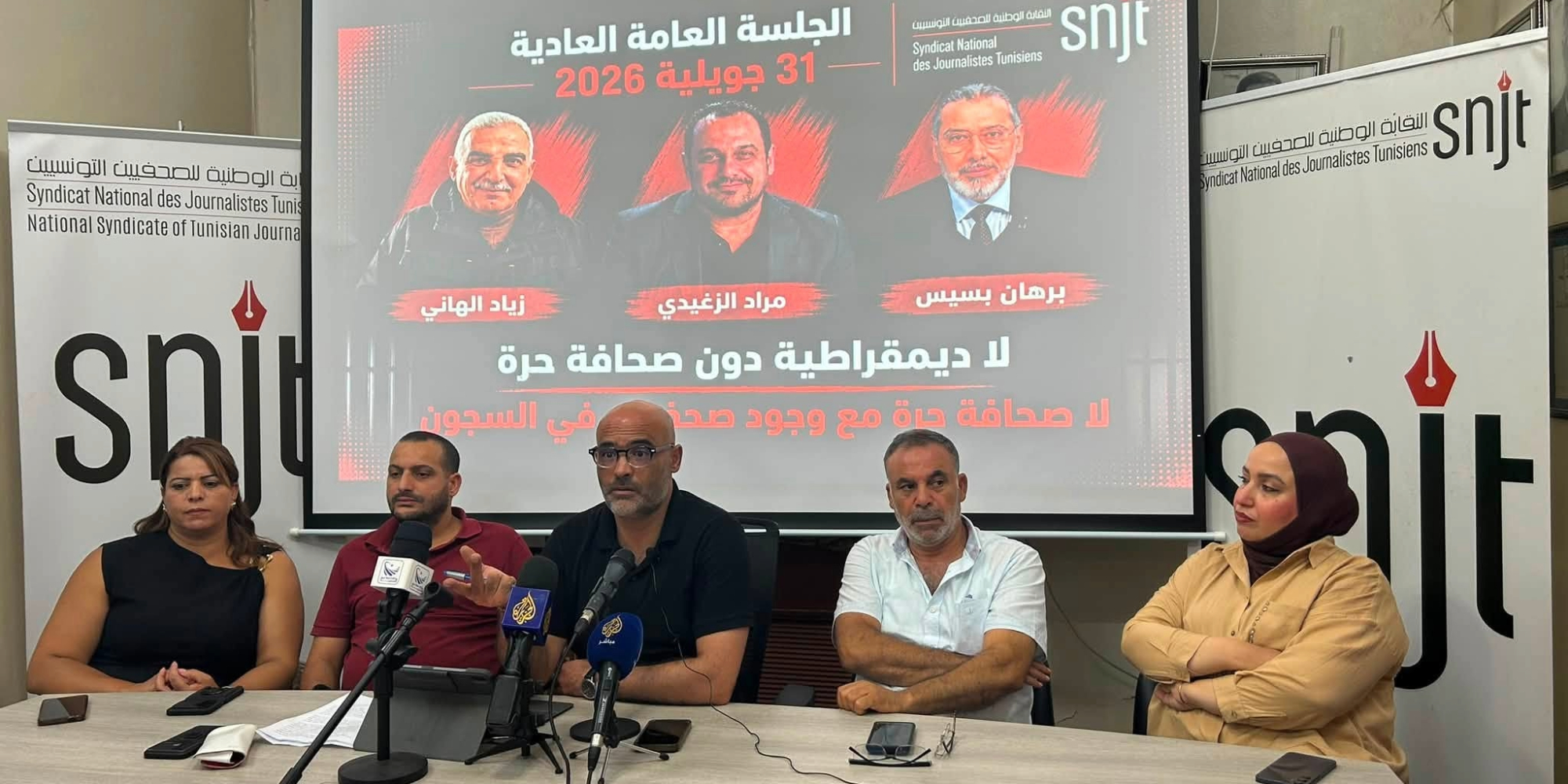
We cannot get the full picture of pressures exercised upon the media if we only consider the journalist who has been arrested or the media outlet which has been the object of audits and inspections. The battle has also been waged upon organizations whose mission is to protect the profession against the use of arbitrary power and to ensure that professional misconduct not be gratuitously construed as a security threat. With the rise of lawsuits in the media sector since 2021, the National Syndicate of Tunisian Journalists (SNJT) has found itself in a state of permanent defense, protesting against arrests and sentences, following cases involving journalists and pressing for the application of Decree 115. Over the same period, it has also wrestled with questions regarding its capacity to translate its protest rhetoric into concrete action.
In its annual report presented on May 3, 2025 and entitled “The Syndicate of Journalists Faces the Collapse of the Tunisian Media System,” the SNJT evokes the deterioration of liberties across the sector. Limited by its own redundancy, the report fails to thoroughly elaborate on its critique of disinformation, hate speech and censorship within editorial rooms. This shortcoming does not undermine the sincerity of the organization’s commitment, but merely reveals its limitations. As it works to protect journalists facing the ruling power and the courts, the SNJT is also called upon by members of the profession to hold media outlets themselves accountable and to build a proactive deontological and professional alternative.
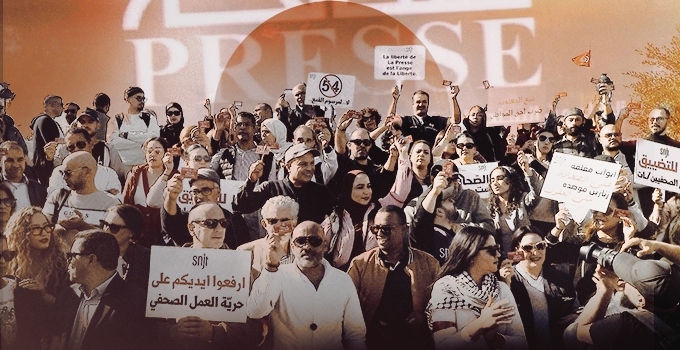
This pressure is even greater in the absence of a climate of normal negotiations. When journalists risk being arrested and imprisoned, and the private media endure financial and administrative pressures, and journalists’ access to information is slowly whittled away, the Syndicate ceases to be a social partner whose role is to negotiate the conditions in which journalists practice their profession. Instead, it acts as a fire department. Even union mobilization which is supposed to serve as a counter-balance is challenged by a fragmentation of the profession, by fears of salaried employees about job loss, and by media outlets’ dependency on advertising and their relationships to centers of power. This is why the organization’s pullback must not be measured by the number of its statements, but by the general context in which protests have lost ground. For example, a statement demanding the release of a journalist does not prevent the continuation of legal harassment, a sit-in organized in solidarity with incarcerated journalists does not override criminal provisions, and legal assistance does not protect against bankruptcy or administrative retaliation. For these reasons, a lack of reactivity does not indicate that the organization is absent, but that its avenues of recourse are weaker than those of the ruling power which possesses control of the justice system, the administration and public resources.
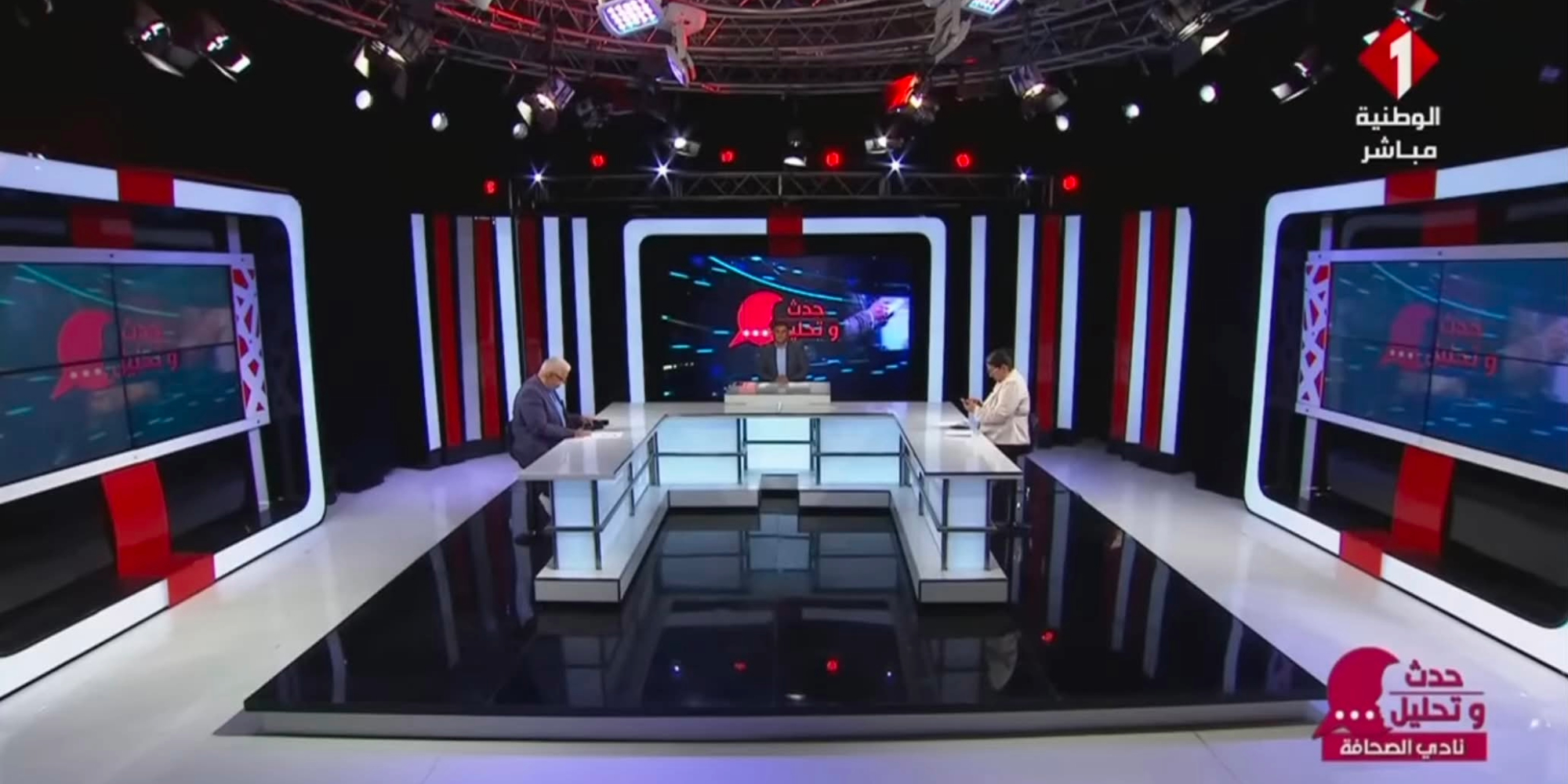
The Press Council, created in 2020 after years of debate, was originally conceived as recourse for journalists in the face of repression. The Council is an independent authority made up of journalists, the owners of media platforms and civil society actors who receive complaints filed by the public, defend the profession’s deontological code and propose solutions and mediation in order to avoid disputes being brought before security services or the courts. Its creation was lauded as a historical landmark in media reform. However, this experiment has been challenged by the absence of a clear legal framework, a lack of resources and the absence of a watchdog organization, not to mention that the public was generally unaware of its existence. Nearly five years later, in May 2025, the SNJT announced the Press Council’s new composition. However, the reorganization of this body was perceived as implicit recognition of its failure during its first term of operation. Instead of ensuring regular monitoring and effective mediation, its role has essentially been limited to publishing statements and recommendations.
This retreat cannot be dissociated from the fate which befell the HAICA. Self-regulation does not function in a vacuum; the Press Council addresses issues relating to deontology, however, the audio-visual sector also needs an independent authority which guarantees pluralism, oversees compliance with the rules of the profession and prevents the market from becoming an arena of political and financial influence. Each time the HAICA grows weaker, or its restructuring is prolonged, or the salaries of certain members are suspended, or its operations are disrupted, the Press Council loses the institutional basis for its decisions and recommendations in the audiovisual sector. Self-regulation is thus trapped between, on the one hand, a ruling power that does not recognize it and provides neither legal framework nor financial resources, and, on the other, media institutions that do not always see a direct interest in complying with an independent regulatory authority within the profession.
And here is the paradox: the government accuses the media of sowing chaos, but contributes to weakening the public mechanisms capable of sector regulation. When the Press Council remains inactive or lacks adequate resources and authority, professional misconduct does not disappear; it is taken up for examination in the most unforgiving arenas, where investigation brigades and courts prescribe the only remedies they know: criminal proceedings and imprisonment. This is why saving the Press Council and the SNJT is no longer a purely sector-specific demand, but an imperative condition to protect society yet again against an uncontrolled press and arbitrary power; the former must comply with profession-specific regulations, while the latter must submit to an independent regulatory body. For indeed, the judiciary cannot assume either of these functions without becoming an instrument of sterilization for the public space.
FREEDOM OF THE PRESS, MEASURE OF A FREE SOCIETY
The media crisis in Tunisia is not a simple question of dysfunction within a particular press outlet, television station or legal text, but stems from a deeper imbalance in the relationship between the ruling power and the truth. The public media, which are supposed to belong to the public and not the occupant of the Palace of Carthage, are being shaped according to a logic of administrative and political subordination which tailors their discourse to whatever suits the regime. The private media, which are supposed to broaden the scope of pluralism within the sector, are crippled by a fragile economy, an ambiguous ownership structure, a limited advertising market and legal risks that render independence an unbearable burden. Independent online media outlets have broadened the sphere of possibility for serious investigations and voices that do not reach mainstream platforms; however, these independent platforms continue to function with inadequate resources and under threat of suspension, censorship and court summons. As if their very existence were cause for suspicion.

The current regime is not satisfied with the old model of government control over the media. No longer is it necessary that the censor write out in advance what is to be published, nor is it necessary that officials send explicit instructions to editorial teams. Today, it suffices to keep the public media in the government’s pay, to threaten private stations with bankruptcy, to exert pressure on web-based platforms to the point of exhaustion, and to subject journalists to Decree 54 or Article 86 of the Communications Code, for the entire system to bend to the code of silence. That said, reducing the issue to a conflict between the government and journalists obscures the root of the problem. The real combat is not merely to gain a few advantages for journalists, but to secure society’s right to examine itself and all of its contradictions. For a society which loses a free press does not only lose information, but also its critical memory, its capacity to denounce misconduct, and its right to imagine alternatives and to demand accountability. Whenever information is blotted out by the mainstream media, it reemerges in the form of rumors, unrest or symbolic violence on social media. Whenever the government closes a door to criticism, it opens another to the loss of trust.
Freedom does not take root in the presidential palace or through official discourse, but in a journalist’s ability to say what the ruling power does not want to hear, and in an employer’s ability to protect the journalist. Freedom is established in the judiciary’s ability to refuse to transform divergent opinions into a crime, and in the public’s ability to access multiple versions of the facts without being asked to choose between silence or betrayal.

iThere are no comments
Add yours